The Quick Read
- Freedom at Midnight in Kerala is an Independence Day-eve initiative of the state’s Women and Child Development Department.
- From 10 pm on August 14 to 1 am on August 15, a stretch of road in Thiruvananthapuram will be closed to vehicles and opened as a women-only pedestrian zone.
- Women will be able to walk, cycle, perform, play, shop, eat and participate in open-mic and cultural activities.
- A night market will create space for women entrepreneurs and self-help groups to sell their products.
- Women will also handle security, first aid, crowd management, volunteering and event coordination.
- The initiative makes a positive statement about women’s right to occupy public spaces after dark. Its longer-term value will depend on whether that confidence becomes ordinary rather than exceptional.
Kerala’s ‘Freedom at Midnight, Celebrate Her’
There is something particularly fitting about celebrating Independence Day by asking a very literal question: Who feels free at midnight?
On the evening of August 14, the answer in one part of Thiruvananthapuram will deliberately be women.
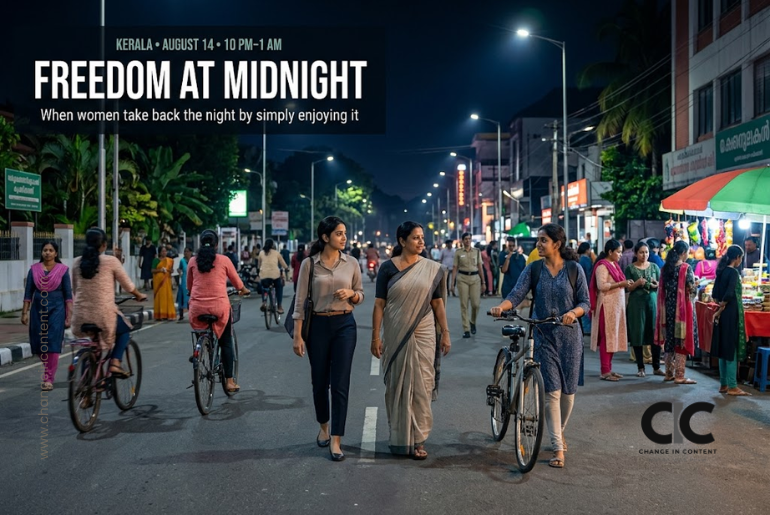
The Kerala Department of Women and Child Development is preparing a special Independence Day-eve street programme initially announced as “Freedom at Midnight, Celebrate Her”. For three hours, from 10 pm to 1 am, a major road in the state capital will become a pedestrian space reserved for women.
They will be able to walk. Cycle. Listen to music. Perform. Tell stories. Shop. Eat. Meet other women. Or simply be outside late at night without the ordinary mental calculation that so often accompanies a woman walking through an Indian city after dark.
That last possibility may be the most powerful part of Freedom at Midnight in Kerala.
What will happen on August 14?
The programme is being organised as part of India’s Independence Day celebrations.
The proposed pedestrian stretch will operate between 10 pm and 1 am, with vehicular traffic suspended during the event. More recent reporting identifies the planned stretch as running from Overbridge to PMG Junction in Thiruvananthapuram, although final event arrangements may still evolve before August 14.
The programme is expected to include:
- Street games
- Cycling
- Music and dance
- Cultural performances
- Storytelling
- Open-mic sessions
- Food stalls
- A night market
- Products from women entrepreneurs and self-help groups
Students, professionals, homemakers, senior citizens and artists have all been invited. Women can also participate as performers, volunteers and entrepreneurs. Even the infrastructure of the event has been designed around women’s participation.
Women will handle security. So will crowd management. First aid. Volunteering. Event coordination.
It turns women from the protected participants of an event into the people running it. That is a more interesting form of visibility.
There is value in simply occupying the street
Public space is not gender-neutral merely because the pavement has no admission policy.
People experience cities differently. A man stepping outside at 11.30 pm may think about transport, traffic or whether anything is still open.
A woman may think about all of those things and then add:
- Is this road well lit?
- Who is behind me?
- Will I get an auto?
- Should I call somebody while walking?
- Is my clothing attracting attention?
- How far away is the next group of people?
- Should I share my live location?
That invisible checklist limits freedom long before any formal restriction does.
Change in Content has previously examined this relationship between infrastructure and inclusion in our analysis of gender equity in India’s urban spaces. Lighting, transport, footpaths, policing and the design of public spaces directly affect how freely women can participate in city life. So there is genuine value in creating a night on which women can experience the street differently.
Joy has policy value too. Women do not always need to gather because something terrible happened. Sometimes they should be able to gather because music is playing and the food stalls are open.
The women entrepreneurs belong in this story too
One detail could easily get lost behind the symbolism.
The event will include a night market featuring products from women entrepreneurs and self-help groups. That brings economic participation into the celebration. A safe night-time economy expands who can sell, buy, perform and work after conventional daytime hours.
For women running small businesses, particularly home enterprises and self-help-group ventures, public markets can provide customers, visibility and confidence.
For cities, that creates another useful question. If women participate successfully as sellers, organisers, security personnel and customers during one controlled night market, what prevents more night-time commercial spaces from becoming accessible to them regularly?
An experiment can become useful when somebody asks what part of it deserves to survive after the banners come down.
The best outcome would be for this idea to become unnecessary
There is an obvious contradiction inside a women-only freedom zone. Women are being given exclusive access to a street because ordinary streets are not always experienced equally.
Some critics have already questioned whether genuine freedom can be represented by restricting one gender for a few hours, arguing instead for safe public spaces every day.
That is a legitimate argument. But a temporary intervention and a permanent aspiration do not have to compete.
The event can demonstrate what women’s unrestricted occupation of public space feels like while the longer work continues: safer transport, responsive policing, better lighting, respectful behaviour and social norms that stop treating a woman outdoors at midnight as unusual.
Success would eventually make the special zone redundant. That would be progress.
And the same question belongs inside workplaces
Public freedom and economic freedom frequently meet at the office door.
Many women work late. They work in hospitals, hotels, media houses, factories, technology companies, transport systems, airports, customer-support operations and restaurants.
The ability to work after dark depends on more than whether legislation permits it.
- Can she travel home safely?
- Does her organisation provide reliable transport?
- Is there adequate security?
- Can she decline a late shift without damaging her career?
- Does the office culture remain professional when fewer employees are present?
- Are men and women held to the same standards?
Change in Content explored these questions when Delhi expanded opportunities for women to work night shifts. The regulatory permission mattered, but the quality of that freedom ultimately depended on transport, safety, consent and workplace practices.
There is another side to workplace freedom too. Employers need freedom to organise productive businesses. Employees need fair expectations, safe environments and reasonable autonomy.
The healthiest workplaces should gradually move away from gender-specific accommodations wherever circumstances allow, while retaining the safeguards required to correct genuine inequalities.
Equality becomes mature when everybody can participate, and the system has stopped asking whether their gender makes that participation unusual.
The Change Ahead: A Night Worth Celebrating, and Outgrowing
Freedom at Midnight in Kerala offers an appealing image for Independence Day.
Women on bicycles; women running stalls; women performing on the street; women managing security; women walking at midnight because they feel like walking at midnight. There is nothing wrong with celebrating that.
We hope the evening is crowded, joyful and uneventful in precisely the right way. But perhaps the highest compliment we could eventually pay initiatives such as this would be to no longer need them.
A future Independence Day should find women occupying streets, running businesses, working late shifts, travelling home and enjoying cities without any of it requiring a special declaration of freedom.
Men should enjoy the same safety. Employers and employees should experience workplaces where opportunity and responsibility are distributed fairly.
Society should gradually lose its fascination with women doing ordinary things after dark. Until then, experiments such as Kerala’s are useful. They allow us to experience the future for three hours. The real work begins the following night.
Editorial Note and Disclaimer
This news analysis is based on details announced by Kerala’s Department of Women and Child Development and public reporting available as of 10 August 2026. The programme was initially announced under the working title “Freedom at Midnight, Celebrate Her”; the department has subsequently invited public suggestions for the event’s final name, so branding or logistical details may change before August 14. Change in Content supports equal access to safe public and professional spaces for people of all genders. This article is intended for editorial and informational purposes.
Sources
- Government of Kerala — official state portal