
The Quick Read
- PLFS data from July 2026 puts India’s overall Labour Force Participation Rate for people aged 15 and above at 55.4%, up from 54.4% in June. Overall unemployment fell from 5.5% to 5.1%.
- Female LFPR rose more sharply, from 32.7% in June to 34.4% in July. It was also higher than the 33.3% recorded in July 2025.
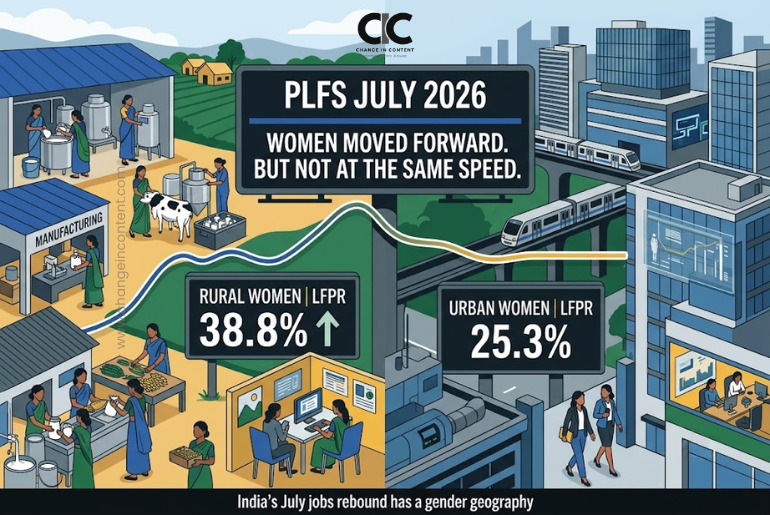
- Rural women drove most of the improvement. Their LFPR increased from 36.6% to 38.8%, and their Worker Population Ratio rose 2.5 percentage points to 37.2%.
- Urban female LFPR improved modestly to 25.3%, but remained below the 25.8% recorded a year earlier. Urban female unemployment rose from 8.4% in June to 8.8% in July.
- The numbers are therefore encouraging, though not uniform. More women entered the labour force, and more were working, but the rural-urban divide remains one of the biggest questions inside India’s female employment story.
- The monthly PLFS figures use Current Weekly Status, based on activity during the preceding seven days. They should not be casually compared with annual PLFS figures based on usual status.
PLFS July 2026: Where do we stand?
There are months when employment data offers very little drama. July 2026 is not one of them.
After several months of weakening labour-force participation, India saw a meaningful rebound. The overall Labour Force Participation Rate for people aged 15 and above climbed from 54.4% in June to 55.4% in July, while the Worker Population Ratio rose from 51.4% to 52.5%. Unemployment fell to 5.1%.
For Change in Content, though, the more interesting movement sits inside the women’s numbers. Female labour-force participation rose from 32.7% to 34.4% in a single month. Female employment rose too.
That deserves some optimism. But PLFS July 2026 also gives us a reminder we have encountered repeatedly while examining India’s women’s employment data: The national female number can hide two quite different Indias. One rural. One urban. And right now, they are not moving at the same speed.
34.4%: The female participation number deserves attention
Start with the good news.
Female LFPR for people aged 15 and above reached 34.4% in July, a 1.7-percentage-point rise over June’s 32.7%. Compared with July 2025, participation was up 1.1 percentage points from 33.3%. It matters because the previous few months had been heading in the wrong direction.
Female LFPR had reached 35.3% in February before sliding to 34.4% in March, 33.9% in April, 32.8% in May and 32.7% in June. July broke that decline.
The employment number backs up the movement. The female Worker Population Ratio, which tells us the share of women actually employed rather than merely participating in the labour market, rose from 30.8% in June to 32.5% in July.
So this was not simply more women declaring themselves available for work. More women were working. And that is worth recognising.
But then we separate the rural and urban numbers. And the story changes.
Rural women delivered July’s biggest movement
Rural female LFPR increased from 36.6% in June to 38.8% in July. That is a 2.2-percentage-point rise in one month.
Compared with July 2025, when rural female LFPR stood at 36.9%, the improvement is even more visible: 1.9 percentage points year on year.
The rural female employment number moved even more strongly. Female WPR in rural India increased from 34.7% to 37.2% between June and July. That is a 2.5-percentage-point rise in a month.
Rural female unemployment also fell, from around 5% in June to 4.3% in July.
Put those three indicators together:
- more rural women entered the labour force;
- more rural women were working;
- and unemployment among participating rural women fell.
On the surface, that is a strong month. But Change in Content readers will already know why we should ask one more question. What kind of work?
Participation is important. Job quality remains important too.
The July bulletin does not provide the detailed employment status or sectoral breakdown needed to answer that question. So we should not guess. But previous PLFS analysis gives us reason to keep watching it.
Our earlier examination of women in agricultural employment found that much of the longer-term increase in rural women’s work has been concentrated in agriculture, including substantial unpaid family labour.
Similarly, our analysis of women moving from unpaid family work to self-employment found that 55.2% of women workers in the relevant 2025 PLFS measure were self-employed, with own-account work and household-enterprise activities forming a large share of that category.
Those findings do not invalidate July’s improvement. They tell us what to examine next.
If female participation rises because women gain paid, productive and increasingly secure work, that is powerful economic progress. Similarly, if large increases are concentrated in low-productivity, unpaid or precarious work, the policy interpretation becomes more complicated.
The next quarterly and annual breakdowns will help us tell those stories apart.
Then comes urban India
This is where July becomes considerably less comfortable.
Urban female LFPR rose from 24.8% in June to 25.3% in July. So there was month-on-month improvement.
But in July 2025, it was 25.8%. A year later, urban women’s labour force participation remains 0.5 percentage points lower.
The employment number is similarly modest. Urban female WPR increased from 22.7% to 23.1% in July.
Then unemployment moved in the opposite direction. Urban female unemployment increased from 8.4% in June to 8.8% in July. It was also roughly where it stood a year earlier, when the rate was 8.7%.
That makes urban women one of the most interesting groups in the entire bulletin.
- Across India, unemployment fell.
- Across rural India, it fell.
- Among men, it fell overall.
- Yet urban female unemployment increased.
That deserves considerably more attention than a national headline saying unemployment dropped to 5.1%.
The urban puzzle keeps returning
This is not the first time Change in Content has encountered it.
Our analysis of the June 2026 unemployment numbers found urban female LFPR stuck at 24.8%, even as rural participation remained considerably higher.
Another NSO dataset showed that female workforce participation in India’s cities with populations above 10 lakh had risen over the longer term, from 19.8% in 2017-18 to 27.2% in 2025 under the relevant usual-status measure.
So the longer trend contains improvement. But the latest monthly numbers tell us the urban labour market for women remains difficult.
That raises several practical questions.
- Are enough suitable jobs being created?
- Are women finding those jobs where they live?
- Do salary levels compensate for commuting and care costs?
- Does workplace location matter?
- What role does transport safety play?
- Are hybrid and flexible roles available?
- Are women entering fast-growing sectors?
- Are childcare responsibilities still pulling women away precisely when urban employment requires rigid schedules?
- Are women applying and failing to convert applications into employment?
- Do cities have enough work infrastructure for women, including safe transport, crèches, hostels, sanitation and predictable shifts?
Those questions cannot be answered by the July bulletin alone. But a stubborn 25.3% urban female LFPR gives us good reason to keep asking them.
There is another number worth putting beside 34.4%
Male LFPR remains dramatically higher.
The July monthly bulletin does not make the national gender comparison its headline, but its series shows the persistent scale of the participation divide.
That context matters because a rising number of females can seem larger than it is when viewed in isolation.
India has set an ambitious goal of dramatically increasing women’s economic participation by 2047. Change in Content has previously examined the country’s ambition to reach 70% female workforce participation and why achieving anything near that level requires changes in jobs, infrastructure, workplace design, and social expectations rather than merely higher enrolment in employment schemes.
July’s rise is useful. The distance ahead remains substantial. Both statements can be true at once.
And formal employment remains another test
Participation indicates whether women are working or actively seeking work. It does not tell us enough about whether that work is formal, protected or secure.
Just last week, our analysis of PM-VBRY first-time employees found that women accounted for only 28.56% of those registered under the employment-linked formalisation programme.
Another recent Change in Content story found that women remain more likely than men to work informally.
Put these pieces together, and the policy objective becomes clearer. India needs:
- more women participating;
- more women actually employed;
- more women in paid work;
- more women entering formal employment;
- more women in productive sectors;
- and more women remaining and progressing in those jobs.
LFPR is the first part of that journey. It should never become the only scorecard.
A word of caution before we compare every PLFS number we see
This is particularly important because India’s labour data now appears more frequently.
The July monthly bulletin uses Current Weekly Status, or CWS. That means a person’s activity status is determined by what they were doing during the seven days preceding the survey.
Annual PLFS reports also publish figures using usual status, which considers a much longer reference period. Those measures answer related but different questions.
So when somebody says:
“Female LFPR was 40% in 2025 but only 34.4% in July 2026, therefore women’s employment collapsed”, the comparison is wrong.
The 40% annual figure uses usual status. And the 34.4% figure for July uses Current Weekly Status.
We should not place them side by side as though they were identical measurements. MoSPI explicitly notes the CWS basis of its monthly releases and that the survey methodology was modified from January 2025 to generate monthly and quarterly national estimates.
Data becomes useful only when we understand what it measures.
So, was July actually a good month for women?
Yes. With qualifications.
Women’s labour-force participation rose sharply. Women’s employment rose. Rural women’s participation and employment recorded particularly strong increases. Overall female unemployment fell from roughly 5.9% in June to 5.4% in July.
Those are positive signals. But the urban female story remains weak.
A quarter of urban women aged 15 and above are in the labour force, as measured by the monthly CWS.
Urban female participation remains below its level of a year earlier. And unemployment among urban women moved up, not down, during July.
That is why the headline cannot simply be: “Women are back.”
The better description is: Women moved forward in July. Rural women moved much faster.
And that difference may tell us where India’s employment policy needs to look next.
The Change in Content View: The 34.4% is welcome. The 25.3% needs our attention.
It is easy to decide whether an employment report is good or bad. The harder work is understanding for whom it was good.
PLFS July 2026 presents India with several encouraging figures:
- Participation improved.
- Employment improved.
- Unemployment eased.
Women participated in that recovery. In rural India, they participated strongly. That deserves recognition. But one number keeps pulling us back: 25.3%. That is urban female LFPR.
India’s cities contain universities, corporate headquarters, financial centres, technology companies, hospitals, service industries, startups and enormous pools of educated women.
Yet roughly three out of four urban women aged 15 and above were outside the labour force under July’s Current Weekly Status measure.
- Some will be studying.
- Some will be retired.
- Some will not want paid employment.
- Others may be prevented from working by care, health or personal circumstances.
But among such a large group there are almost certainly many women who would work if the economics, infrastructure, flexibility, safety and opportunities aligned better. That is the number we should become curious about.
The rural rise deserves applause, while the national improvement deserves cautious optimism. And the number of urban females deserves work.
Because India’s employment story will become genuinely transformative when women are not simply entering the labour force in greater numbers, but can find work worth entering it for.
Editorial Note and Disclaimer
This report is based on the National Statistics Office’s Periodic Labour Force Survey Monthly Bulletin for July 2026, released by the Ministry of Statistics and Programme Implementation on 17 August 2026. Monthly PLFS estimates use Current Weekly Status and are not directly interchangeable with annual usual-status estimates.
Interpretations of job quality, care, mobility, safety, sectoral opportunities, and employment infrastructure are analytical questions informed by broader labour-market evidence; the July bulletin itself does not establish these as causes of the rural-urban differences.
The July monthly estimates are based on information from 371,021 people, including 211,411 rural and 159,610 urban respondents.
Primary Source
National Statistics Office, Ministry of Statistics and Programme Implementation — Periodic Labour Force Survey Monthly Bulletin, July 2026, released 17 August 2026.
