The Quick Read
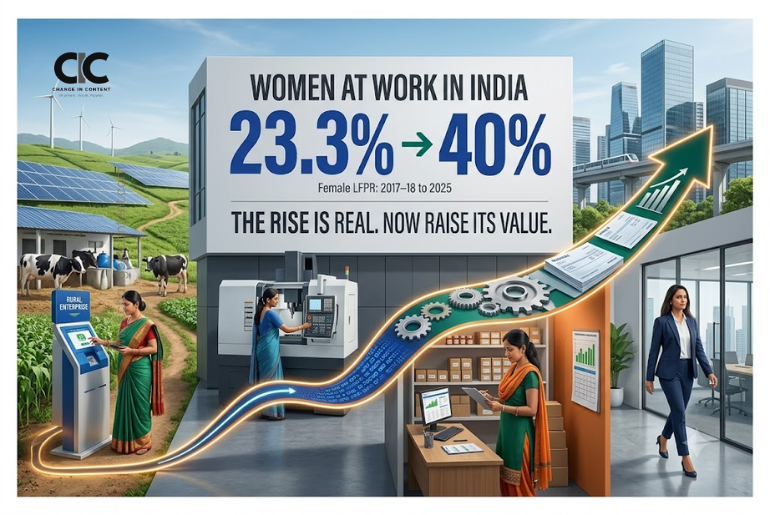
- The rise in women at work in India is substantial. Female labour-force participation among people aged 15 and above, under the PLFS usual-status measure, increased from 23.3% in 2017–18 to 40% in 2025.
- Female employment has risen alongside participation. The female Worker Population Ratio reached 38.8% in 2025, while female unemployment, by the same measure, was 3.1%.
- There is an income signal too. Between 2024 and 2025, nominal wages for women increased 8.8% in self-employment, 7.2% in regular salaried work and 5.4% in casual labour.
- The caution lies in the composition of work. Rural women account for much of India’s participation growth, and self-employment, agriculture and household enterprises remain important parts of women’s employment.
- Urban India still has considerable room to improve. In million-plus cities, women’s LFPR reached 27.2% in 2025, even though women who were working had relatively strong access to regular salaried jobs.
- The next phase should therefore build on the rise rather than argue it away: increase women’s earnings, productivity, formalisation, market access, mobility, ownership and progression.
The rise in women at work in India: The ground story
There is a peculiar habit in economic debate. A good number appears. Someone immediately explains why it isn’t really good. Then another person defends it so enthusiastically that every weakness disappears.
Women’s employment in India deserves better than either reaction.
The rise in women at work in India is real. The country’s female labour-force participation rate for people aged 15 and above, measured in usual status, reached 40% in 2025. In 2017–18, it was 23.3%. The female Worker Population Ratio has moved from around 22% to 38.8% over roughly the same period.
That is a substantial movement in less than a decade. We should be pleased about it. We should also be curious about what comes next.
Because a woman entering economic activity matters. A woman earning more matters even more. A woman building an asset, acquiring skills, gaining control over income, entering formal employment, expanding a business or progressing into a better-paying occupation adds another layer to the story.
India now has an opportunity to turn a participation gain into an income and productivity gain. That is a considerably more exciting conversation than arguing about whether progress exists.
First, the rise should not be talked out of existence
There are legitimate reasons researchers have examined the numbers carefully. Much of the rise has come from rural women.
Agriculture remains important. Self-employment is significant. Some women classified as employed are helpers in household enterprises. None of these observations is trivial. But neither do they prove that the rise is meaningless.
Economic change rarely arrives in its final form. A woman who was previously reported outside the labour force and is now economically active is part of a change worth understanding.
Her work might begin on a family farm. In a dairy cooperative. At a sewing machine. Inside a household enterprise. On a digital marketplace. Through a self-help group. With a small retail operation. In a salaried office. At a factory. Or on a delivery platform.
Those routes have very different implications for income and security. But simply declaring some forms of women’s work too imperfect to count can recreate an old mistake: treating economic activity as valuable only when it resembles a particular kind of formal, urban male career.
Women’s work has been underestimated for long enough. The answer to imperfect work is better work, not pretending the worker is absent.
There is another encouraging signal: Women are earning more
The PLFS 2025 report contains a data point that deserves considerably more attention.
From 2024 to 2025, nominal wages for women increased:
- 8.8% among the self-employed,
- 7.2% among regular wage and salaried workers,
- and 5.4% among casual workers.
Inflation and category differences matter, so these numbers should not be read as pure real-income gains. But they add something important to the story of participation.
We are not looking only at more women being counted. There is evidence of movement in women’s earnings too. That matters because labour-force participation is ultimately valuable to women when work improves economic agency.
- Can she earn?
- Can she retain some control over that income?
- Can she save?
- Buy an asset?
- Use formal credit?
- Invest in a child’s education?
- Pay for her own healthcare?
- Build a business?
- Leave an unsafe situation if she needs to?
- Make a financial decision without asking somebody else for the money?
A percentage in a labour table becomes transformative when it eventually changes the answers to those questions.
Self-employment should be improved, not casually dismissed
More than half of women workers in the relevant PLFS 2025 current-weekly-status analysis were self-employed. Change in Content’s earlier examination found 55.2% of women workers were in self-employment, with own-account workers and employers forming a large component alongside helpers in household enterprises. That category deserves nuance.
- Self-employment can mean a woman running a profitable enterprise.
- It can also mean low-margin survival work.
- It can mean independence.
- Or work shaped by the absence of suitable salaried employment nearby.
- Sometimes it means all of those things at once.
But there is something economically interesting happening when women move from invisible participation in family enterprises towards more identifiable own-account work.
Our earlier analysis of women moving from unpaid family work to self-employment examined that transition closely.
- A woman who starts receiving payments in her own account has changed her economic position.
- If she starts setting prices, the position changes again.
- If she accesses credit in her own name, again.
- If she hires someone, formalises the enterprise, enters new markets, or purchases productive assets, the change becomes larger.
Instead of debating whether self-employment is good or bad, India can ask a more productive question: How do we help more women’s self-employment move up the value chain?
Credit. Digital commerce. Better market linkages. Business training. Procurement opportunities. Social security. Technology. Logistics. Formal registration. Networks.
That is how a participation statistic starts producing higher income.
Agriculture presents the same opportunity
The rise in agricultural employment among women has received considerable scrutiny. And rightly so.
Our previous analysis on women in agricultural employment noted that much of the increase includes women working as unpaid family labour.
A woman working every day on a farm without receiving a separate wage or controlling farm income is obviously not the economic destination we should celebrate.
But again, the solution lies in moving forward from the participation.
- Recognise women as farmers.
- Improve land and asset ownership.
- Give them direct access to agricultural credit.
- Include them in extension services.
- Expand producer organisations.
- Give them access to machinery and agricultural technology.
- Improve storage and market linkages.
- Make payments directly visible.
- Support women moving into higher-value processing, packaging and agribusiness.
The woman is already working. The opportunity is to make that work more productive and remunerative. That distinction matters.
Urban India may hold the next big upside
If rural women’s participation has powered much of the increase, urban India may contain one of the biggest opportunities for the next stage. MoSPI’s analysis of million-plus cities found female LFPR at 27.2% in 2025, compared with 75.9% for men under the usual-status measure.
That gap is huge. But another figure in the same analysis is interesting.
Among women who were employed in those million-plus cities, 65.1% were in regular wage or salaried employment. That was higher than the average for female workers in urban India and even higher than the corresponding share among male workers in those cities.
It suggests an intriguing policy opportunity. Cities appear capable of offering many working women relatively strong employment structures once women are actually inside the workforce.
The problem is getting far more women through the door. Our report on female workforce participation in India’s million-plus cities explored precisely this contradiction.
India’s cities have universities, technology companies, financial centres, hospitals, retail, professional services, startups, manufacturing clusters, creative industries, and enormous service economies. They also contain millions of educated women.
Connecting those two pools more effectively could become one of India’s biggest labour-market gains.
Why aren’t more urban women joining?
There is no single answer. And that is useful, because it means there are several levers available.
Job location matters. Commuting time matters. Safety matters. Childcare matters. Housing near employment clusters matters. Workplace flexibility matters. The economics of taking a job matters.
Imagine an urban woman considering a ₹30,000-a-month role. Now, subtract childcare, transport, paid domestic assistance, work clothing, meals. Then add two hours of commuting and whatever unpaid work still waits when she gets home.
Her decision cannot be understood entirely through the salary written on the offer letter. That is why we have previously argued that safe and affordable housing for working women belongs inside India’s growth conversation.
Sometimes the barrier between a woman and a job is not her qualification. It is the infrastructure around the job. That is fixable.
Then there is the second shift
India’s Time Use Survey 2024 gives the employment conversation an unavoidable companion statistic.
Among people aged 15–59, 83.1% of women participated in unpaid domestic services on normal days, compared with 26.4% of men. Women were also much more likely to provide unpaid caregiving.
Interestingly, change is occurring here too.
The 2024 survey found female participation in paid activities had increased from 2019, while the time female participants spent in unpaid domestic services had declined from about 315 minutes to 305 minutes a day. 10 minutes is hardly a domestic revolution. But direction matters.
If India wants women’s paid work to rise considerably further, the movement inside homes will have to accelerate too. Men doing more care. Better childcare. Domestic infrastructure. Affordable eldercare. Labour-saving technology. More acceptance of men’s parental responsibilities. Schools and cities structured around working families.
Women’s employment policy cannot end at the factory gate or office reception. Part of it lives in the kitchen at 7 am.
The 40% headline also hides the women who still cannot participate
Another PLFS 2025 finding should sit beside the optimism.
Among women outside the labour force, 44.4% cited childcare or personal commitments in homemaking as their main reason. That is an enormous pool of potential economic activity.
We should be careful not to assume every woman outside the labour force wants a job. Many do not, and choice matters. But where women would participate if care, mobility, workplace design or job availability changed, India has an economic opportunity sitting unused.
That is why the government’s stated ambition of reaching much higher female participation by 2047 matters. We examined the scale of that challenge in our earlier story on India’s 70% female workforce participation goal.
Moving from 40% towards that level will require a different type of growth.
The easier gains may already be underway. The next gains will require systems.
Formal employment must grow with participation
There is another transition India should now pursue aggressively.
More women need to move into formal employment. Formal jobs can provide contracts, predictable wages, social security, regulated working conditions and career pathways.
The recent PM-VBRY data clearly illustrate the gap: women accounted for only 28.56% of first-time employees registered under the scheme, despite the broader increase in women’s economic participation.
That tells us participation and formalisation are not progressing at the same rate. And it gives policymakers another useful target. Increase female participation, yes.
Then improve the probability that a woman entering the workforce enters EPFO-covered employment, social protection, formal payrolls, better occupational categories, and jobs offering progression.
The ambition is not merely more women working somewhere. It is more women building economically stronger working lives.
Corporates should see the demand side of this story
This conversation is often presented as a government policy problem. Businesses have enormous influence over the next phase.
- Where are companies creating jobs?
- What qualifications do they unnecessarily demand?
- Which jobs can be offered in Tier II and III cities?
- Can shifts be redesigned?
- Is transport provided?
- Are manufacturing facilities genuinely equipped for women?
- Do managers penalise flexibility?
- Can career-returners enter at the level their previous experience warrants?
- Are companies building women into emerging sectors such as electronics, AI, clean energy, advanced manufacturing, logistics and financial technology?
Female participation is not simply a diversity metric. It expands the available talent pool.
Our earlier guide on female workforce participation and corporate productivity makes this broader economic argument.
A company looking for skills while ignoring half the country’s potential workforce has a talent problem before it has a gender problem.
We should also become more demanding about income
That is where the conversation should eventually move.
LFPR asks: Is she economically active or seeking work?
WPR asks: Is she working?
The next set of questions should ask:
- How much does she earn?
- How consistently?
- Who controls the income?
- Does it increase over time?
- Does she gain an asset?
- A pension?
- Health protection?
- Savings?
- Business capital?
- Does her productivity improve?
- Can she move from informal to formal work?
- From unpaid helper to owner?
- From micro-enterprise to employer?
- From junior employee to manager?
- From support function to P&L?
- From salary to wealth?
That is how women’s work becomes women’s economic power.
Progress doesn’t become less real because there is more to do
This may be the most important point. There is a tendency in gender discussions to believe that acknowledging progress somehow weakens the argument for further change. The opposite can be true.
- Progress tells us change is possible.
- Female LFPR moving from 23.3% to 40% tells us that behaviour, economic circumstances, measurement, policy, and opportunity can change dramatically.
- Rising women’s wages tell us income can move.
- More women entering paid activities tell us time allocation can move.
- Women shifting towards visible self-employment tell us economic identity can move.
- Women obtaining high shares of salaried employment in major cities tell us job quality can move.
The unfinished areas do not cancel these gains. They tell us where the next returns could come from.
The Change in Content View: Celebrate the Rise. Then Raise Its Value.
For years, the conversation about India’s female workforce revolved around a troubling question: Where are the women?
Increasingly, we can begin asking something more ambitious. Where can they go from here?
The rise in women at work in India should give us confidence.
- More women participating in the economy is good news.
- More women actually working is good news.
- Women’s wages increasing is good news.
- Women becoming visible as own-account workers, entrepreneurs and earners is good news.
We do not need to apologise for recognising any of that. But optimism should make us more ambitious, not less.
Now make self-employment more productive. Make agricultural work more remunerative. Bring more women into urban jobs. Expand formal employment. Make childcare infrastructure economically viable. Reduce the unpaid-work imbalance. Make commuting safer. Give women easier access to credit, technology and markets.
Move women into higher-productivity industries. Help those already working progress towards management, ownership and leadership. Measure income alongside participation. Measure assets alongside jobs. And measure longevity alongside entry.
India already has millions more women participating in economic activity than it did a decade ago. That is not the end of the story. It is the resource from which the next chapter can be built.
And if India manages that transition well, the biggest result may eventually be a larger female labour-force participation rate. It will show up in household incomes, enterprise creation, productivity, consumption, tax revenues, savings, skills and economic growth.
The rise is worth celebrating. What India does with it could be worth considerably more.
Editorial Note and Disclaimer
This DEI Insights editorial draws primarily on official data from the National Statistical Office’s Periodic Labour Force Survey 2025 and Time Use Survey 2024. Different PLFS measures, including usual status and Current Weekly Status, use different reference periods and should not be directly compared as though they measure identical labour-market conditions. References to job quality, infrastructure, formalisation, income control, and career progression are editorial interpretations of the opportunities arising from rising women’s economic participation.
Primary Sources
- National Statistical Office, MoSPI: Periodic Labour Force Survey Annual Report 2025. Female LFPR for people aged 15+ was 40%, female WPR 38.8%, and the report records wage changes across employment categories.
- Ministry of Statistics & Programme Implementation: Time Use Survey 2024. The survey documents changes in paid work alongside the continuing gender imbalance in domestic and caregiving responsibilities.
- MoSPI: Labour Market Dynamics in Million-plus Cities, as analysed through official data on women’s participation and salaried employment.