
The Quick Read
- New research on the impact of night shift laws on women workers finds that relaxing state restrictions increased women’s employment in urban service-sector jobs and improved access to formal contracts and wages.
- The research covers state-level reforms introduced from the mid-2010s and labour-market outcomes between 2017 and 2023, using nationally representative labour-force and time-use data.
- Gains were strongest among younger, more educated and wage-employed women, particularly in higher-skilled services such as finance, professional services and healthcare.
- The reforms appear to have expanded access to jobs and shifts rather than making women already in work put in substantially longer hours.
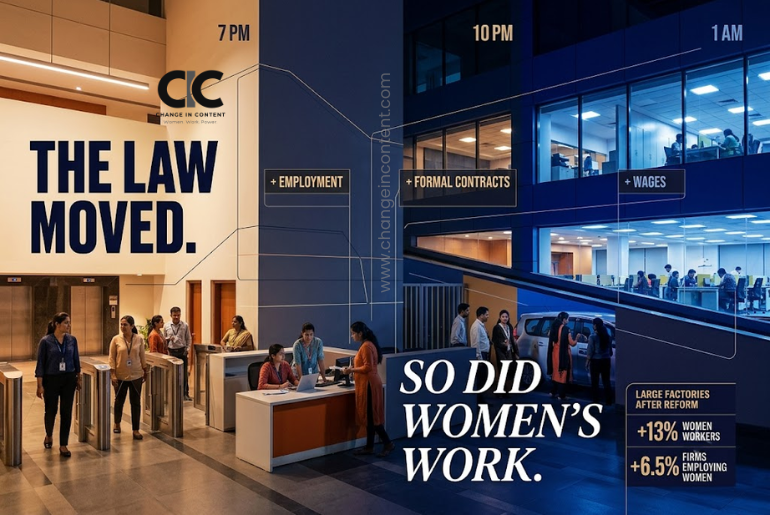
- Separate research on manufacturing found a similar employment effect after seven states relaxed factory night-work restrictions. At large firms, women’s share of employment rose by 3.5%, the number of women workers by 13%, and the likelihood of employing at least one woman by 6.5%.
- The manufacturing gains were concentrated among larger employers, suggesting that transport, security and other compliance costs can still limit how far reform travels.
For years, the law had a peculiar answer to an unsafe night
Do not let the woman work it.
That was effectively the logic built into several Indian labour regulations.
If late-night travel was unsafe, limit women’s working hours. If factories could be dangerous after dark, prohibit women from taking those shifts. And if harassment is a concern, keep female workers away from the period when the risk might arise.
The objective was protection. But the economic consequence was much larger.
A restaurant choosing between employees who could cover every shift and somebody legally unavailable after a specified hour had an obvious hiring calculation to make. So did a hotel. A call centre, a factory, a hospital, or a business operating across international time zones.
Even a woman who never wanted to work at 2 am could become less attractive to an employer simply because the law reduced the shifts she was permitted to cover.
Researchers are now beginning to put numbers around that consequence. And the evidence suggests that some protective rules were costing women work.
The impact of night shift laws for women workers: What exactly changed?
The older Factories Act framework placed explicit restrictions on women’s working hours. Section 66 generally limited women’s factory employment to between 6 am and 7 pm, while giving states some powers to vary the permitted hours. State amendments subsequently began dismantling those restrictions.
Service-sector rules varied across states through their respective Shops and Establishments legislation.
From the mid-2010s, several states began relaxing restrictions on establishments such as hospitality businesses, multinational companies, and call centres. Women could work later or overnight, usually subject to conditions such as employer-provided transport, workplace security, and safeguards against harassment.
The reform philosophy had changed.
Instead of assuming that women should be removed from night work because the environment could be unsafe, governments increasingly placed responsibility on employers to make night work safer.
India’s new labour code framework also reflects that direction. The Ministry of Labour and Employment states that consenting women may work at night under the Occupational Safety, Health and Working Conditions Code, subject to prescribed safety conditions. Now, employers must make appropriate arrangements.
Change in Content has already explained what India’s night-shift policies for women now require, including the importance of consent and employer safeguards. The new research allows us to ask the question that comes afterwards: Did changing the rules actually change women’s work? It appears that it did.
Women became more likely to work
Vernekar and Singhal examined the staggered reform of night-work restrictions across states.
Their study uses nationally representative labour-force surveys alongside time-use data and focuses on women in urban service-sector employment. Because states changed their rules at different times, the researchers could compare outcomes before and after reform with those in places where similar reforms had not yet occurred.
The first finding is the most important. Women’s employment increased after night-work restrictions were removed.
Women were also more likely to hold formal employment contracts. Weekly and hourly wages increased overall. And the employment effect was particularly visible among women in wage employment, younger women and those with higher levels of education.
Those details matter because deregulation can sometimes increase the quantity of work while doing little for its quality.
That is not what this evidence primarily suggests. The researchers find stronger access to jobs that were already more likely to be formal.
The largest employment gains were in relatively higher-skilled service occupations, including finance and insurance, professional and technical services, and healthcare.
A rule governing the night, in other words, was influencing women’s opportunities during the rest of their careers too.
You did not have to want the night shift to be affected by the ban
This may be the most useful part of the study.
We tend to think of a night-work restriction as affecting only somebody who wants to work overnight. But hiring does not necessarily work that neatly.
Consider two candidates applying for the same role in an operation that runs from 8 am until midnight. Both are equally qualified. One can legally be rostered across the operation. The other comes with restrictions.
An employer may decide the second candidate creates less scheduling flexibility even if most of her eventual shifts would have been during the day.
The researchers make this point precisely: Night restrictions could reduce the jobs firms were prepared to offer women even when individual women were not expected to work through the night.
That turns what looks like a scheduling regulation into a hiring regulation. It also explains why the benefits show up in overall employment rather than simply in the number of women working at 1 am.
The women who got jobs did not simply work more hours
Another result prevents the story from becoming too simplistic.
The reforms did not substantially increase women’s total working hours overall. Among women already employed in service jobs, working hours declined slightly following the reform. That suggests employers were not merely squeezing extra hours out of existing women workers once restrictions disappeared.
The bigger effect appears to have come through access. More women could enter particular jobs and shift structures.
The time-use data offers another interesting clue. Women in reforming states became relatively more likely to work night shifts and spent somewhat more time in night work. At the same time, the researchers find suggestive evidence of a marginal reduction in unpaid domestic work and some movement of paid work away from daytime hours.
One law had therefore begun altering not only whether women worked. It was changing when the day could belong to paid work. For a woman managing childcare, elder care or household responsibilities, that flexibility can matter.
Though here, the celebration needs a footnote.
A night shift can open one door and expose another problem
Allowing women to work at night does not magically make the street outside safe at midnight.
Nor does it create buses. Streetlights. Childcare. Secure last-mile travel. Functioning complaint systems. Managers trained to handle sexual harassment. Or families suddenly comfortable with daughters and daughters-in-law returning at 3 am.
Legal permission removes one barrier. The social and physical infrastructure surrounding the job decides how useful that permission becomes. That is why the safeguards attached to these reforms are so important.
Employer-provided transport, adequate security, separate facilities, rest periods and mechanisms to prevent harassment are sometimes described as compliance requirements.
For a woman deciding whether to accept a night shift, they are closer to the job description.
A company’s experience can show what implementation looks like. Hindustan Zinc’s deployment of women in night and underground shifts has combined expanded access with transport, workplace infrastructure and broader employee support. Similar efforts by industrial employers suggest that access after dark becomes viable when operations are redesigned around women rather than simply declaring the shift open.
The regulation can permit the work. The employer has to make it believable.
And here is where company size becomes unexpectedly important
A second body of research helps complete the picture. Bhanu Gupta, Kanika Mahajan, Anisha Sharma and Daksh Walia examined night-shift reforms in Indian manufacturing.
Between 2014 and 2017, Andhra Pradesh, Assam, Haryana, Himachal Pradesh, Maharashtra, Punjab and Uttar Pradesh relaxed restrictions to permit women to work at night in factories subject to specified safeguards.
The researchers analysed data covering more than 290,000 registered manufacturing establishments. Again, women’s employment increased. But predominantly in large firms.
Among establishments with at least 250 employees, the reforms were associated with:
- 3.5% higher female share of workers
- 13% more women workers
- 6.5% higher likelihood that a firm employed any woman at all
Importantly, the increase did not appear to come through replacing male workers.
That sounds like an uncomplicated success until we ask why small firms responded much less. The answer may lie partly in the cost of properly implementing reform.
- Transport costs money.
- Security costs money.
- Separate facilities cost money.
- Staffing systems cost money.
A large factory can spread these fixed costs across hundreds or thousands of workers. A smaller employer may decide that employing women on night shifts simply costs too much.
The ban disappears from the law book. A commercial barrier can quietly replace it.
That creates a policy dilemma worth taking seriously
What should governments do? Relax the safety requirements so small companies employ more women? That would be a dangerous interpretation of the evidence.
Women should not have to purchase employment opportunity with personal risk. But policymakers cannot ignore the economics either.
If compliance requirements are designed so that only India’s largest employers can reasonably meet them, the benefits of deregulation may remain concentrated in a narrow slice of the formal economy.
The manufacturing researchers suggest targeted support for smaller businesses, potentially including shared facilities, subsidies or reconsideration of requirements that impose heavy costs without delivering proportionate protection.
Shared secure transport in industrial clusters is one possibility. Common late-night transit routes serving multiple establishments could be another.
Industrial parks can provide well-lit access roads, security infrastructure and common facilities rather than requiring every small employer to recreate the entire system independently.
Government policy can help move the cost of safety from the individual woman towards the employment ecosystem around her.
That would be a better interpretation of protection.
Something else changed when the restriction disappeared: Employer expectations
The manufacturing research found that firms already employing women responded most strongly after reform. Export-oriented companies also showed larger increases in women’s employment.
There is an encouraging dynamic hiding in that finding. Once an organisation has already solved some of the practical problems of employing women, hiring more women becomes easier.
The first women on a factory floor may require infrastructure to change.
- Changing rooms.
- Transport.
- Shift planning.
- Safety practices.
- Supervisory habits.
Once these systems exist, the marginal cost of hiring the next woman falls.
We can see versions of this already happening in Indian manufacturing. Syrma SGS reported that women accounted for 48% of its total workforce in FY26, while employers such as Maruti Suzuki and Tata Steel have been expanding women’s participation in core shop-floor roles. Representation can therefore become infrastructure for further representation.
The first hire is not merely one job filled. Sometimes she alters what the workplace can do next.
Night work should still be a choice
There is one word in the current policy architecture that deserves more attention than it usually receives. Consent.
Greater equality cannot mean women acquire the same right to be forced into undesirable shifts. The Ministry of Labour’s guidance explicitly frames women’s night work around consent alongside safety requirements. That distinction needs meaningful enforcement.
A worker with little bargaining power may technically sign a consent form while fully understanding that refusing the shift could reduce her hours, promotion prospects, or employment security. Organisations therefore need something stronger than paperwork.
Women should know:
- which shifts a role requires before accepting it;
- whether night work is voluntary;
- how transport operates;
- what happens if they withdraw consent;
- whom they contact in an emergency;
- how complaints are handled;
- whether refusing an unsafe shift carries consequences.
Safety should also reach beyond the factory gate.
India’s broader push to strengthen workplace grievance mechanisms, including SHe-Box and sexual harassment compliance, becomes particularly relevant when work extends beyond conventional hours.
A woman deciding whether she can work at midnight needs both a car home and confidence that the organisation will listen if something goes wrong.
So, did India’s night-shift reforms work?
On the evidence now emerging, yes, in important ways. Relaxing restrictions increased women’s employment in the urban services studied.
It increased access to formal employment. Wages improved. Higher-skilled women benefited particularly.
Separate manufacturing research found sizeable employment gains among large factories. And there is little indication that women’s gains simply came by removing men from jobs.
But the results also reveal the limits of legislative change.
- Smaller employers may struggle with implementation costs.
- Safety outside work remains uneven.
- Care responsibilities still shape women’s schedules.
- Consent can become meaningless without bargaining power.
And the strongest service-sector gains appear concentrated among younger, educated women already positioned to enter more formal occupations.
The reform has widened a door. It has not levelled everything behind it.
Change in Content View: Protect the woman, without shrinking her working day
There was a time when restricting women’s night work could be defended as a reasonable response to an unsafe environment.
The newer evidence forces a better question: Why was the woman’s freedom the part of the equation that had to be reduced?
- A city unsafe after dark needs safer transport.
- A workplace vulnerable to harassment needs better supervision and accountability.
- A factory employing people overnight needs secure facilities.
- A woman with caring responsibilities may need flexibility.
None of those problems is solved particularly well by telling her that one-third of the clock does not belong to her.
The state-level reforms studied here moved India towards a more useful principle: women can work at night, employers have obligations to make that work safe, and women retain the right to consent.
The employment gains suggest that this shift has economic consequences. Now comes the more difficult phase.
Making those opportunities accessible beyond large companies, beyond highly educated women and beyond the small number of employers already accustomed to building workplaces around a female workforce.
The night was never merely about the night. It was about whether a woman’s working life could occupy the same 24 hours as everybody else’s.
Editorial Note
This Mosaic analysis draws principally on ongoing research by Nisha Pankaj Vernekar and Karan Singhal examining state-level service-sector night-work reforms and women’s employment outcomes in urban India between 2017 and 2023. The article also considers separate research by Bhanu Gupta, Kanika Mahajan, Anisha Sharma and Daksh Walia on factory night-shift reforms, alongside official labour-law material from the Government of India and the India Code. The studies examine different sectors, periods and policy reforms, so their estimates should not be treated as directly interchangeable. Associations described as policy effects are based on the econometric research designs used by the respective authors.
Sources:
- Vernekar & Singhal: Breaking the Night Barrier: Night-shift Reforms and Women’s Work in India
- Ideas for India: When Protection Becomes a Barrier: Night Shift Laws and Women’s Work
- Gupta, Mahajan, Sharma & Walia: From Dusk Till Dawn: The Impact of Lifting Night Shift Bans on Female Employment
- Isaac Centre for Public Policy: Night Shift Bans and Female Employment in Indian Manufacturing
- India Code: Factories Act, 1948
- Ministry of Labour and Employment: Women’s Employment Under the Labour Codes
