
The Quick Read
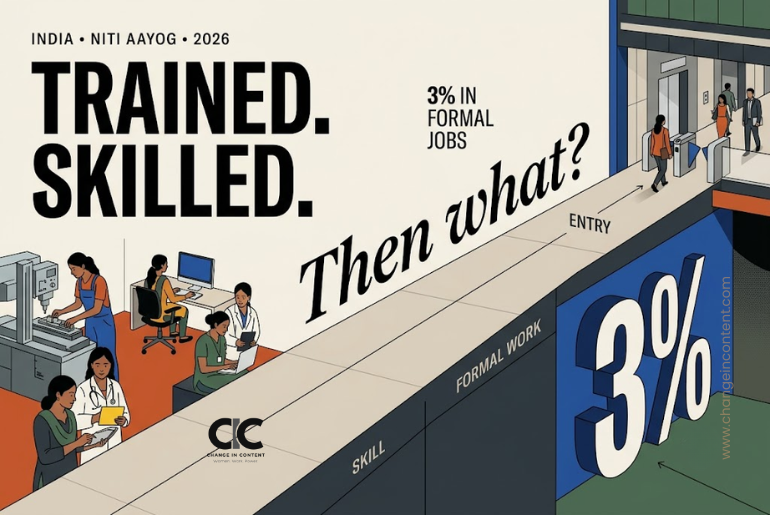
- NITI Aayog’s new Reimagining Skilling for Viksit Bharat@2047 report says just 3% of women across the segments studied are in formal jobs, while 71% are either working informally or are in the NEET category. The report treats women as a cross-cutting group and does not present the figure as a standalone PLFS formal-employment rate for all Indian women.
- India has trained more than 7.67 crore people since 2014–15, and the Union Budget for FY2025–26 allocated ₹34,000 crore towards skilling-related expenditure across central ministries. Yet NITI Aayog says outcomes remain uneven.
- 47% of women who do not pursue skilling cite lack of awareness of suitable programmes as one of their top three reasons. Financial constraints, care responsibilities, safety concerns, transport, and limited control over money create additional barriers.
- NITI Aayog recommends moving away from uniform training pathways towards women-specific support, such as flexible programmes, career guidance, local opportunities, safe transport, financial support, and routes back into learning and employment.
- Employers are part of the solution. Skills-first hiring, apprenticeships, work-integrated learning, return pathways and jobs designed around real constraints can help convert training into formal employment that women can enter, retain and progress through.
3% is the sort of number that makes you read it twice
India has spent years building its skilling machinery.
Training centres have expanded. Vocational programmes have multiplied. Apprenticeships are receiving renewed attention. Digital courses have made learning easier to reach. Governments increasingly speak about AI skills, manufacturing skills, green jobs, and a workforce prepared for 2047.
Then NITI Aayog places another number on the page. 3%.
That, according to its new Reimagining Skilling for Viksit Bharat@2047 report, is the share of women across the segments studied who are in formal jobs. Another 71% are either in informal employment or fall within the NEET category: not in employment, education or training.
That does not mean India has failed to skill women. It means skilling alone is proving to be a surprisingly unreliable bridge to sustained economic participation.
For women in formal jobs, the problem appears to sit across the entire journey: discovering the right skill, being able to afford it, completing it, reaching an employer, getting hired, finding a job close enough and safe enough to accept, and then remaining in work long enough for the training to become a career.
The certificate may be the easiest part.
India has built scale. Now it needs conversion.
NITI Aayog begins from a position of considerable achievement.
More than 7.67 crore people have been trained since 2014–15, while skilling expenditure across central ministries received an allocation of ₹34,000 crore in FY2025–26. States have added their own programmes, and industry, educational institutions, and civil society organisations have further expanded the ecosystem.
The question is no longer whether India has skilling programmes. It has many.
The question is whether a person who enters one emerges with a credible path towards better work.
For women, that conversion remains particularly weak.
It fits a pattern Change in Content has been tracking for months. Female labour-force participation has risen sharply, reaching 40% in 2025 under the PLFS usual-status measure. That is real progress. But our analysis of the rise of women in the workforce in India also showed why the next stage needs to focus on job quality, earnings, formality, and progression.
More women are economically active. Too many are still entering the workforce without contracts, social protection, or a reliable career ladder.
An Economic Advisory Council to the Prime Minister working paper published earlier this year found that women were 4.8 percentage points more likely than men to be in informal employment. Education significantly reduced the probability of informal work, and vocational training helped as well.
Training therefore matters. It just cannot carry the entire burden.
What happens between “skilled” and “employed”?
A training programme can teach a woman accounting software. It cannot guarantee that there is an accounting job within a commute her family considers manageable.
- A course can teach CNC machine operation. It cannot make the factory provide safe transport after the second shift.
- A digital programme can teach AI tools. It cannot persuade an employer to interview someone after a three-year career break.
- A healthcare qualification can prepare a woman for work. It cannot arrange childcare for a 7 am shift.
These are not marginal complications. They determine whether the skill gets used.
NITI Aayog’s report argues that India’s current system often treats learners too uniformly even though their circumstances are radically different. A school student, a mid-career worker, an unemployed young person and a woman returning after a care break do not need the same route.
For women, the report highlights:
- flexible and hybrid learning;
- women-focused career guidance;
- trusted peer and mentorship networks;
- safe and nearby employment;
- transport facilities;
- affordable training;
- financing support;
- and routes that allow women to re-enter education and work after interruption.
That is a significant shift in thinking.
- The skilling system traditionally asks, “What course does she need?“
- The stronger question is: What has to be true around her for that course to become an income?
Nearly half of women who skip skilling do not know what to choose
One statistic in the report deserves more attention than it is likely to receive. Among women who do not pursue skilling, 47% cite lack of awareness of the right programmes as one of their top three reasons.
This is not an absence of courses. It is an absence of navigation.
India’s skilling ecosystem can be difficult to understand even for people already comfortable searching online. There are government schemes, state programmes, private courses, vocational institutions, apprenticeships, degree-linked options and online credentials, often carrying very different quality and employment outcomes.
A woman returning to work after eight years does not need a catalogue.
She needs to know:
- Which course matches the jobs available near me?
- Will an employer recognise this certificate?
- How many previous trainees actually found work?
- What salary did they receive?
- Can I study part-time?
- Is there childcare?
- Will I need to relocate?
- Is there a pathway from this qualification to another one later?
NITI Aayog proposes tools, including skill-discovery platforms, local “Sakhi Booths”, community women’s circles, digital skills passports, and a National Career Outcome Repository, intended to make such information easier to navigate.
The principle behind them is sound. Training choices need labour-market information attached to them.
A course with no visible employment outcome is an educational product. A course that tells a learner where it can take her becomes a career pathway.
Women also pay a different opportunity cost for training
Consider a six-week course that runs from 10 am to 4 pm.
For one learner, the cost is the fee. For another, it is:
- the fee;
- six weeks of lost informal earnings;
- transport;
- childcare;
- someone to manage an elderly parent’s medicine;
- and perhaps the family negotiation required to leave home every day.
Same programme. Very different price.
NITI Aayog explicitly identifies affordability as a barrier and notes that women’s limited control over finances and competing household responsibilities can make paid training particularly difficult.
That explains why “free skilling” can still be expensive.
If policymakers want more women to complete courses, the cost calculation needs to include what economists call opportunity cost: what the learner gives up to attend.
Targeted vouchers, travel support, stipends and modular training can therefore matter as much as reducing tuition.
That is also why programmes that connect learning directly to jobs deserve attention. Change in Content recently looked at Kaabil by Mahindra Group, where training is combined with counselling, livelihood pathways and employer connections rather than ending at certification.
The relevant metric is not merely how many women were trained. It is how many could use the training afterwards.
Then comes the geography of formal work
Formal employment is not evenly distributed across India. Neither are women.
A considerable part of the recent rise in female labour-force participation has come from rural India, where self-employment, agriculture and household enterprises remain significant sources of women’s work. Urban women, despite often having greater educational attainment, participate at much lower rates.
That creates a geographical problem for skilling.
A woman may be trained for a formal-sector occupation that exists primarily in an industrial cluster 60 kilometres away. The job technically exists. Her labour-market access may not.
NITI Aayog responds to this with proposals for proximate, flexible work, safer transport, and a concept called Surakshit Saathi, which involves public-private support for hostels and transport for women.
That sounds like infrastructure policy because it is.
- A bus route can be employment policy.
- A hostel can be skilling policy.
- A well-lit road can be workforce policy.
- Childcare can be productivity policy.
We often describe these as women’s welfare measures. Their economic function is much larger.
Formal employment also has to become easier to enter
There is another uncomfortable possibility.
A woman may have exactly the skills an employer needs and still be screened out because the recruitment process asks for the wrong evidence.
- A degree from a particular college.
- Two uninterrupted years of experience.
- A previous salary.
- A conventional employment history.
- Immediate relocation.
- Full-time availability from day one.
Formal hiring systems can unintentionally privilege people whose lives have followed the neatest professional path.
Many women’s careers do not.
- Some leave work for childbirth or caregiving.
- Some build skills through family businesses.
- Some freelance.
- Some work informally.
- Some learn through community programmes or online courses.
- Some return with strong capabilities but a CV with a three-year gap.
NITI Aayog recommends skills-first hiring, with job descriptions and selection processes that focus more directly on capabilities.
For companies, that cannot simply mean deleting degree requirements from advertisements.
- It means changing how talent is assessed.
- Work samples.
- Skill tests.
- Portfolios.
- Apprenticeships.
- Job simulations.
- Returnships.
- Recognition of prior learning.
- Structured interviews.
The Change in Content’s guide to inclusive hiring practices in 2026 made the same argument: skills-based recruitment is useful only when employers genuinely redesign selection processes rather than replace one superficial filter with another.
Corporate India cannot wait for the skilling system to deliver a finished employee
This is where employer responsibility becomes unavoidable.
- Companies frequently complain about the “skills gap”.
- Training institutions complain that employers will not hire beginners.
- Learners sit between them, acquiring another certificate.
If India wants significantly more women in formal jobs, employers will have to become participants in the skilling system rather than customers at its end.
- That can mean co-designing curricula with training providers.
- Offering apprenticeships.
- Providing paid work-integrated learning.
- Opening entry-level jobs to candidates without previous formal experience.
- Supporting return-to-work programmes.
- Publishing realistic skills requirements.
- Giving employees time to reskill.
- Hiring from ITIs, polytechnics, regional colleges and women’s training programmes rather than only familiar institutions.
- Creating transport and shift systems that allow women to accept the jobs being created.
NITI Aayog explicitly calls for industry co-ownership of the skilling ecosystem. That phrase matters. If companies define tomorrow’s jobs, they cannot outsource the entire responsibility for producing tomorrow’s workers.
Apprenticeships could be one of the missing bridges
There is a reason apprenticeships appear repeatedly in current skilling policy. They solve a particular problem rather well.
- A learner gets training.
- An employer gets to see the learner perform actual work.
- The learner gains an employment record.
- The skill becomes attached to workplace experience.
For women trying to enter formal employment for the first time, that bridge can be valuable.
India’s experience already contains encouraging signals. The Her Path, Her Power research, previously covered by Change in Content, found the number of women apprentices rose from 124,000 in 2021–22 to 196,914 in 2023–24.
But even here, access needs attention.
- Where are the apprenticeships?
- Which occupations are women entering?
- Do they convert into permanent jobs?
- Can women commute to them?
- Do employers retain female apprentices at the same rate as men?
- Are stipends sufficient?
If apprenticeship becomes another programme measured by enrolment, India will recreate the same problem one stage later.
The NEET figure needs a careful reading
The report’s 71% figure combines women in informal work with women in the NEET category. That makes for a dramatic headline. It also requires precision.
NEET means Not in Employment, Education or Training. It does not automatically mean unemployed or actively seeking employment.
After media coverage of the report, the Government issued a clarification specifically warning against interpreting the report’s estimate of 8.7 crore NEET youth as 8.7 crore unemployed young people.
The same caution belongs in any discussion of women.
Some women outside employment or education may be performing unpaid domestic work. Some may be caregivers. At the same time, some may not currently want paid employment. Others may want work but face constraints that prevent them from seeking it.
Those groups require different policies.
- A woman who wants work but cannot find childcare needs one solution.
- A woman who lacks a marketable skill needs another.
- A woman with a skill but unable to commute safely needs another.
- A woman who is not seeking employment by choice does not require a government programme to “activate” her.
That is exactly why NITI Aayog’s rejection of a one-size-fits-all skilling model is important.
Segmentation sounds technical.
In practice, it means stop treating millions of very different women as one labour-market problem.
And yet, we should not lose sight of the progress
There is a danger with the 3% figure. It can make India’s women-and-work story sound static. It isn’t.
- Female labour-force participation has risen sharply.
- Women are entering manufacturing in greater numbers.
- Apprenticeship participation is growing.
- Women are moving into non-traditional occupations.
- Formalisation programmes are expanding.
- More companies are experimenting with returnships, targeted skilling and women-focused recruitment.
The number should therefore create urgency, not fatalism.
Change in Content recently reported that women workers remain more likely to be informally employed, even though education and vocational training materially improve the odds of formal employment. That combination gives India a direction.
Skills are helping. Now strengthen everything around them.
What should change if India wants more women in formal jobs?
The answer is not another standalone women’s skilling scheme. It is a better chain.
Before training: Tell women where the jobs are
Career counselling and local labour-market information should come before course enrolment.
Women should know likely salaries, employer demand, location, shift expectations and progression routes.
During training: Design around women’s lives
Offer modular schedules, hybrid formats, safe centres, childcare support where feasible, transport and financial assistance.
A technically excellent programme that women cannot attend is poorly designed.
Between training and employment: Build the bridge
Every large skilling programme should track placement, retention and wage progression, not merely certification.
Apprenticeships, work-integrated programmes and employer partnerships should become routine.
At hiring: Remove unnecessary filters
Companies should audit whether degree requirements, career-gap penalties, prior-salary questions, rigid experience requirements and relocation expectations are eliminating capable women before assessment begins.
After hiring: Measure whether women stay
Formal employment is useful only if women can sustain it.
- Look at six-month retention.
- One-year retention.
- Promotions.
- Wage progression.
- Shift allocation.
- Social-security coverage.
- Return after maternity leave.
If women enter and disappear a year later, recruitment was only the first part of the problem.
At leadership level: Make this somebody’s business metric
The conversion of trained women into formal employees should not be confined entirely to CSR or DEI teams.
Operations leaders need it. HR needs it. Business heads need it. Government procurement and incentive systems can reinforce it.
The labour market will change much faster when women’s employment is connected to production, talent shortages, and growth, rather than being treated only as a social responsibility.
Viksit Bharat cannot be built on training certificates
India’s 2047 ambition depends on productivity. That requires people who can learn new skills as technology changes, move between occupations, enter better jobs and remain economically active over long careers.
NITI Aayog’s report describes skilling as a lifelong continuum between school and work rather than a collection of isolated courses.
For women, that continuum is frequently interrupted.
- Marriage.
- Caregiving.
- Migration.
- Pregnancy.
- Unsafe transport.
- Financial dependence.
- A poor first job.
- An employer unwilling to consider a career break.
- A course that leads nowhere.
- A labour market too far from home.
Every interruption increases the risk that capability disappears from formal economic activity. India has spent a decade expanding access to skills.
The next decade should be judged by something tougher: How many women can convert those skills into durable economic lives.
The Change: Stop counting training. Start following the woman.
A woman enrols. She attends, completes the course, and receives the certificate.
At this point, most programme dashboards turn green. But her story has barely begun.
- Did she get an interview?
- Could she reach the job?
- Was the salary worth the commute?
- Did her family support the move?
- Could she arrange care?
- Did the company accept her career history?
- Did she receive a contract?
- Was she still there twelve months later?
- Did she earn more?
- Could she move upwards?
Those are the questions that turn skilling into economic participation.
The 3% figure in NITI Aayog’s report is uncomfortable precisely because India has already invested so heavily in improving capability.
That investment can still pay a much larger dividend. But the country must stop imagining that women fail to enter formal employment because one missing skill stands between them and the workplace.
- Sometimes she needs training.
- Sometimes she needs transport.
- Sometimes childcare.
- Sometimes information.
- Sometimes an apprenticeship.
- Sometimes a manager willing to look beyond the gap in her CV.
- Sometimes a formal job needs to become a better job before she can afford to take it.
Skill the woman, certainly. Then build the road that allows her skill to travel.
Editorial Note
This DEI Insights analysis is based primarily on NITI Aayog’s August 2026 report, Reimagining Skilling for Viksit Bharat@2047, and is supported by official government clarifications and related research on labour formalisation. NITI Aayog treats women as a cross-cutting segment in its skilling analysis and reports that 3% are in formal jobs while 71% are in informal work or the NEET segment. The report excludes agriculture from parts of its formal/informal workforce analysis, and NEET should not be equated with unemployment. The percentages, therefore, should not be treated as directly interchangeable with PLFS female labour force participation or employment rates. This article provides policy and workplace analysis rather than employment or training advice.
Sources
- NITI Aayog: Reimagining Skilling for Viksit Bharat@2047
- Press Information Bureau: Government Reiterates Its Commitment for Reimagining Skilling
- Economic Advisory Council to the Prime Minister: Formalisation of Labour Market in India
