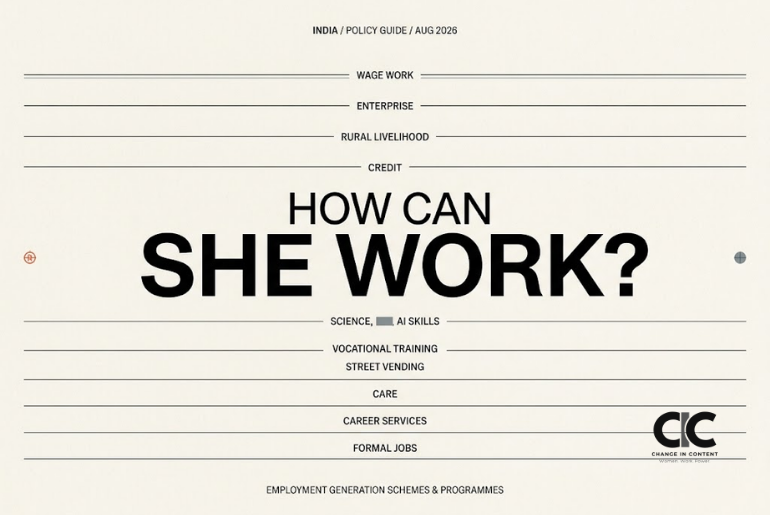
The Quick Read
- India’s Employment Generation Schemes and Programmes are spread across several ministries and do not fall under a single “women’s employment” scheme. The Government combines direct employment, entrepreneurship, skilling, livelihoods and enabling support.
- Women-specific initiatives currently listed by the Directorate General of Employment include Namo Drone Didi, Lakhpati Didi, WISE-KIRAN, SERB-POWER, NAVYA, AI Career for Women, Mission Shakti and Palna.
- Mainstream schemes can also be highly relevant to women. These include MGNREGS, PMEGP, DAY-NRLM, DDU-GKY, RSETIs, PM SVANidhi and Pradhan Mantri Mudra Yojana.
- PMEGP treats women as a special category: eligible women setting up new enterprises make a 5% beneficiary contribution. They can receive a margin-money subsidy of 25% in urban areas and 35% in rural areas, subject to scheme rules.
- MGNREGS remains significant because it offers demand-driven rural wage employment and explicitly promotes women’s participation.
- Some employment policy works indirectly. The Palna crèche programme, for example, does not create a job for the mother, but childcare can determine whether she can take one and remain in it.
There is no single government scheme called “women’s employment”
That is useful to establish at the beginning.
India’s employment policy operates through several different routes.
- One programme gives wage work.
- Another supports a micro-enterprise.
- Another connects women through self-help groups.
- Another trains girls for roles in AI or cybersecurity.
- Another supports women scientists.
- And another provides childcare, giving a mother a greater chance of remaining economically active.
So when we talk about Employment Generation Schemes and Programmes for women, the better question is not simply: Which schemes are reserved for women?
It is: Which government programmes can help a woman earn, build employability, start an enterprise or overcome a barrier that prevents her from working?
That produces a much more useful list.
1. MGNREGS: Rural wage employment with women built into the design
The Mahatma Gandhi National Rural Employment Guarantee Scheme is the most direct employment programme on this list.
It guarantees eligible rural households up to 100 days of wage employment in a financial year when adult members volunteer for unskilled manual work.
Women’s participation is explicitly built into the programme. The official MGNREGS portal states that at least one-third of beneficiaries should be women and notes efforts to ensure that women constitute at least half of workers.
Why it matters for women
MGNREGS is particularly significant because it creates local wage work.
For women whose employment options are constrained by mobility, transport or care responsibilities, work available closer to home can matter considerably.
It is not a pathway to every kind of career, but it can provide an independent income, bank-linked wage payments and an entry into paid economic activity.
2. DAY-NRLM and Lakhpati Didi: From self-help groups towards sustainable livelihoods
The Deendayal Antyodaya Yojana-National Rural Livelihoods Mission has become one of India’s largest platforms for organising rural women into self-help groups and connecting them with credit, livelihoods and enterprise opportunities.
Lakhpati Didi builds on this ecosystem.
The Government defines a Lakhpati Didi as a woman SHG member earning an annual household income of at least ₹1 lakh on a sustainable basis across agricultural seasons or business cycles.
Why it matters for women
The objective is not simply access to a loan. It is the movement from membership in an SHG towards a viable livelihood through farm, non-farm or service activity.
That distinction matters because women’s self-employment becomes much more valuable when it produces sustained income rather than merely economic activity.
Change in Content has previously examined this shift in our analysis of women’s transition from unpaid family work to self-employment. The next test for programmes such as these is income, control and business sustainability rather than participation alone.
3. Namo Drone Didi: Taking rural women into agricultural technology
Namo Drone Didi takes the SHG model into a very different occupation.
The Central Sector Scheme was approved with an outlay of ₹1,261 crore to provide drones to 14,500 selected women’s SHGs for agricultural rental services, including the application of liquid fertilisers and pesticides.
Why it matters for women
This is notable because it moves the conversation beyond traditional livelihood activities.
Women are being positioned as operators and service providers around agricultural technology. That can create income while also expanding women’s access to equipment, digital capability and a sector of work that might otherwise remain male-dominated.
4. PMEGP: An entrepreneurship route where women receive special-category support
The Prime Minister’s Employment Generation Programme supports the creation of new micro-enterprises through bank-linked financing and a margin money subsidy.
Women fall within PMEGP’s special category.
Under the current scheme guidelines, special-category beneficiaries contribute 5% of project cost. Eligible new units can receive a subsidy of 25% of project cost in urban areas and 35% in rural areas, compared with lower subsidy rates for the general category.
Why it matters for women
PMEGP is particularly relevant to women who want to create a business rather than find salaried employment.
But applicants should treat it as an enterprise scheme, not free business funding. The bank appraisal, project viability, eligible activities, and other scheme conditions still apply.
The official PMEGP portal should be used for current eligibility and applications.
5. PMMY and PM SVANidhi: Credit can also become an employment policy
Not every employment scheme pays a wage.
Credit can create work by enabling someone to build or expand an enterprise.
The Government includes Pradhan Mantri Mudra Yojana among its employment-generation programmes because it provides collateral-free credit for micro and small business activity. PM SVANidhi supports street vendors through working capital financing.
Neither is exclusively for women.
Both can nevertheless matter substantially to women working in informal commerce, home-based enterprises, retail and microbusinesses.
This distinction is worth keeping throughout the article: “women-focused” and “women-only” are not the same thing.
6. WISE-KIRAN: For women building or returning to science careers
The Department of Science and Technology implements Women in Science and Engineering-KIRAN to increase women’s participation in science and technology.
DGE describes WISE-KIRAN as a broader framework that addresses different stages of women’s scientific careers and the challenges they encounter along the way.
Why it matters for women
Women’s employment policy cannot stop at low-income livelihoods.
Retention and re-entry into high-skilled professions matter too.
WISE-KIRAN is relevant because women’s scientific careers can be interrupted by career breaks, family responsibilities and institutional barriers. Programmes that create routes back into research help preserve skills India has already invested in developing.
7. SERB-POWER: Addressing the research-funding gap
SERB-POWER, or Promoting Opportunities for Women in Exploratory Research, is aimed specifically at improving women’s access to research funding and opportunities in science and engineering.
The DGE describes it as an intervention aimed at reducing gender disparity in research funding within Indian academic institutions and R&D laboratories. This is employment policy at the upper end of the skills spectrum.
A woman scientist may already be employed. The constraint can instead be access to research grants, laboratories, leadership opportunities and the resources needed to build a durable research career.
8. NAVYA: Starting before girls enter the labour market
NAVYA (Nurturing Aspirations through Vocational Training for Young Adolescent Girls) was launched in June 2025 as a joint initiative of the Ministry of Skill Development and Entrepreneurship and the Ministry of Women and Child Development.
It targets girls aged 16–18 in aspirational districts.
The initiative is designed to combine vocational training with health, nutrition, hygiene, financial literacy, life skills, and legal awareness, while building pathways to internships, apprenticeships, jobs, and self-employment.
The Government planned training for 3,850 girls under PMKVY 4.0 in areas such as digital marketing, cybersecurity, AI-enabled services, and green jobs.
Why it matters for women
NAVYA intervenes before the first-job problem develops. That is useful because occupational segregation often begins much earlier than recruitment.
Girls need exposure to emerging occupations before conventional expectations determine which careers feel available to them.
9. AI Career for Women: A deliberately future-facing intervention
The AI Career for Women initiative was launched in April 2025 to support young women and girls studying at rural undergraduate colleges.
According to DGE’s current scheme listing, the programme involves 320 hours of training and was initially designed to enable economic opportunities for 8,000 girls in its first year, with a hub-and-spoke model intended for expansion.
Why it matters for women
India is creating jobs around AI while simultaneously confronting a gender gap in access to many advanced technology roles.
An intervention targeted at women in rural colleges can help broaden the geography of participation in that opportunity.
The important long-term metrics will be what follows the course: internships, jobs, earnings, continued learning, and progression into technology careers.
That is the same conversion challenge Change in Content recently examined in our analysis of women in formal jobs and India’s skilling system.
10. DDU-GKY and RSETIs: Skills tied more closely to livelihoods
The Government also lists the Deen Dayal Upadhyaya Grameen Kaushalya Yojana and Rural Self-Employment Training Institutes as part of its employment-generation architecture.
DDU-GKY focuses on skilling rural youth for employment, while RSETIs support training for self-employment and entrepreneurship.
For women, the usefulness of programmes like these depends heavily on what happens after training.
- A course completed is useful.
- A job obtained is better.
- Income sustained a year later is better still.
The policy conversation in 2026 is increasingly moving towards that distinction.
11. Palna: The employment programme that does not look like one
Palna belongs in this guide even though it does not directly generate employment.
The scheme, under Mission Shakti’s Samarthya component, provides crèche/day-care facilities for children aged 6 months to 6 years, along with nutritional, health, and developmental support.
The service is available to mothers irrespective of their employment status.
Why include childcare in an employment guide? Because a job opportunity is useful only when somebody can take it.
Care responsibilities remain among the most persistent barriers to women’s employment. The Government itself has increasingly acknowledged this connection through crèche policy, working-women hostel initiatives and its 2024 advisory encouraging employers to consider family-friendly policies and shared care.
Palna therefore illustrates a broader shift in employment thinking: employment generation for women cannot consist solely of job creation. It also has to enable participation.
What about National Career Service?
The National Career Service is worth knowing even though it is not women-specific.
The Ministry of Labour and Employment operates NCS as a digital platform that connects jobseekers with public- and private-sector vacancies, job fairs, career counselling, vocational guidance, and information about skill-development programmes.
For women trying to re-enter the workforce, move sectors, or identify employment options, this can be a useful starting point.
And what changed with employment-linked incentives?
India’s broader employment architecture is also shifting towards incentives for formal job creation.
The Government’s Employment Linked Incentive scheme was approved to support first-time employees and incentivise employers to create additional jobs, with special emphasis on manufacturing. The first-time-worker component provides an incentive of up to one month’s wage, capped at ₹15,000, subject to scheme conditions.
This is a mainstream programme rather than a women-specific one. That distinction matters because access does not automatically translate into equal uptake.
Change in Content’s analysis of women among first-time employees under PM-VBRY found women represented less than one-third of the first-time employees in the data examined.
A gender-neutral employment incentive can therefore still produce a gendered outcome.
Which scheme should a woman look at?
The easiest way to navigate the system is by objective.
| If the objective is… | Programmes worth checking |
| Rural wage employment | MGNREGS |
| Rural SHG livelihood growth | DAY-NRLM, Lakhpati Didi |
| Agri-tech enterprise/service | Namo Drone Didi |
| Starting a micro-enterprise | PMEGP, PMMY |
| Street-vending finance | PM SVANidhi |
| Rural skilling/employment | DDU-GKY |
| Self-employment training | RSETIs |
| Science/research career | WISE-KIRAN, SERB-POWER |
| Emerging-tech skills for girls | NAVYA, AI Career for Women |
| Childcare support | Palna |
| Finding jobs/career services | National Career Service |
The individual scheme portal should always be checked before applying, as eligibility, application windows, funding, and implementation arrangements can change.
The Change: Women’s employment policy is becoming a wider system
What stands out in India’s current Employment Generation Schemes and Programmes is their range.
- A woman may need a wage.
- Another needs credit.
- Another needs an SHG.
- Another needs an AI course.
- A scientist may need research funding after a career interruption.
- A street vendor needs working capital.
- A farmer’s collective may need a drone.
- A mother may simply need somewhere safe for her child between 9 am and 5 pm.
Those are very different employment problems. Policy becomes more useful when it recognises them as such.
India’s female labour-force participation has already risen substantially. Change in Content recently examined how the rise of women in the workforce now creates a new opportunity: improving the quality, earnings, formality, and sustainability of women’s work.
The next stage of employment policy should therefore be judged by more than the number of schemes or beneficiaries.
- Did the woman begin earning?
- Did her earnings rise?
- Did the enterprise survive?
- Did training lead somewhere?
- Could she remain in work?
- Could she move into a better job later?
A scheme can open the route. Those outcomes tell us whether the route went anywhere.
Editorial Note
This Policy Pulse guide is based primarily on the Directorate General of Employment’s official listing of Government of India employment-generation and women-centric programmes, last updated on 11 February 2026, supplemented with official programme documentation. The DGE itself states that its list is not exhaustive. Several schemes covered here are mainstream programmes available to women rather than women-only schemes. Eligibility, benefits, application periods, and implementation may change, so readers should verify the current details on the relevant ministry or official scheme portal before applying.
Sources
Directorate General of Employment, Ministry of Labour & Employment — Employment Generation Schemes/Programmes of Government of India: The central official index for employment-generation and women-centric programmes.
Mahatma Gandhi NREGA — Official Portal: Current programme description and women’s participation provisions.
KVIC — Revised PMEGP Guidelines: Official subsidy, contribution and beneficiary-category rules, including provisions for women.