
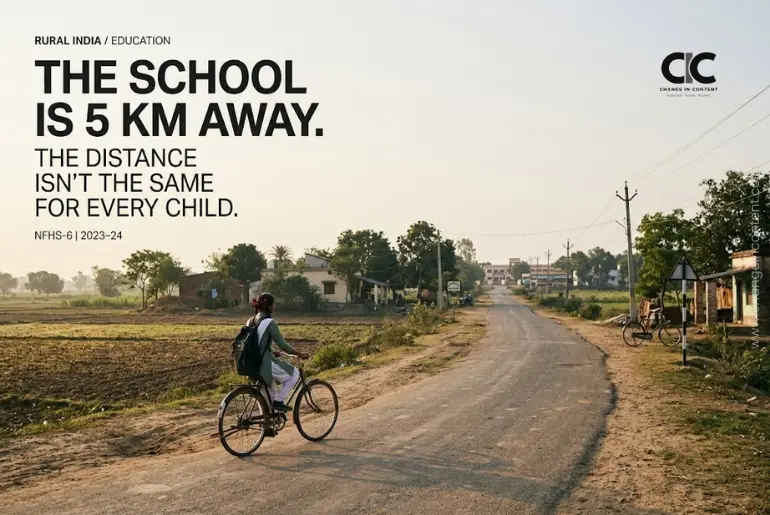
The Brief
- NFHS-6 shows a 10.2 percentage-point rural gender gap in completing 10 or more years of education: 49.9% of rural men compared with 39.7% of rural women. The equivalent urban gap is only 2.5 points.
- Nationally, women have made substantial progress: the share of women aged 15–49 with at least 10 years of schooling increased from 41% in NFHS-5 to 46.4% in NFHS-6.
- The gap becomes harder to close when secondary schools are distant. Travel brings additional costs and, especially for girls, questions of safety, transport, and family permission.
- Household work, sibling care, early marriage, sanitation and menstruation can add further pressure during adolescence. UNICEF identifies domestic responsibilities, safety and inadequate sanitation among the reasons girls leave school.
- The solution is no longer simply “enrol more girls”. India needs secondary schools within practical reach, safe transport, functional toilets, re-entry pathways and families that see daughters’ education as worth protecting when circumstances become difficult.
Education gender gap in rural India
A village can have a school and still be too far from education.
That sounds contradictory until the child reaches Class 9.
Primary school may be nearby. The upper-primary school may require a longer walk. Secondary school might be in another village, beside a highway, several kilometres away or reachable only through transport that does not run conveniently around school hours.
For a boy, this can be an inconvenience. For a girl, the same distance can become a family decision.
- Can she travel alone?
- Who will accompany her?
- Is the road safe?
- What will transport cost?
- What time will she return?
- Who will look after her younger sibling?
- What if she menstruates at school?
And somewhere within those practical questions lies the education gender gap in rural India.
The latest numbers make that divide unusually visible.
According to NFHS-6, 61.5% of urban women aged 15–49 have completed at least 10 years of schooling, compared with 64% of urban men. The gap is 2.5 percentage points.
In rural India, only 39.7% of women have reached the same educational milestone, compared with 49.9% of men. The gender gap is 10.2 points.
4 times wider.
India is therefore not dealing with one education gender gap. It involves several versions of it. And geography is increasingly deciding which one a girl encounters.
National progress can hide a rural daughter
There is good news first.
Women’s educational attainment has improved considerably. The proportion of Indian women aged 15–49 with 10 or more years of schooling increased from 41% in NFHS-5 to 46.4% in NFHS-6. The figure for men rose from 50.2% to 54.6%, meaning the national gap narrowed from 9.2 to 8.2 percentage points.
Current school-age indicators are also encouraging.
NITI Aayog’s 2026 assessment concludes that India has largely achieved gender parity in school education, with female-to-male ratios at or above parity across several indicators including primary and lower-secondary completion, enrolment and progression to secondary education.
Both facts can be true.
Today’s girls have far greater educational access than earlier generations. And the accumulated educational attainment of rural women still shows a very large disadvantage. That is why we should be careful with averages.
A national gender ratio can indicate that girls and boys enter school in similar numbers. It cannot tell us how far the next school is from a particular village. Nor what happens when the family has enough money or time for only one child to make that journey.
The gender gap sometimes begins at the edge of the village
India has done exceptionally well at bringing primary schools within reach of children. Secondary education presents a different physical problem.
Historical NSS data clearly illustrate the pattern. Nearly 99% of rural and urban households had a primary school within 2 km.
For secondary schools, the picture changed sharply. Only 60% of rural households reported having a secondary school within 2 km, compared with 91% of urban households.
The data is older, and secondary-school access has expanded since then. But the underlying issue remains important enough that NITI Aayog’s 2026 education roadmap specifically recommends transport vouchers or bicycle schemes for girls in remote and high-dropout areas, alongside expansion of residential schooling.
Distance is rarely gender-neutral.
- A bicycle ride that is considered ordinary for a son may be considered unsafe for a daughter.
- A bus fare that the family grudgingly pays for a boy may become harder to justify for a girl if her education is already viewed as temporary before marriage.
- A school that finishes after dark in winter may be accessible in theory and unacceptable to parents in practice.
That is how infrastructure becomes culture.
The road does not discriminate. The decisions made around the road can.
When something has to give, girls often have more to lose
Families do not always withdraw daughters from school because they oppose education. Sometimes the decision comes from competing pressures.
- A younger sibling needs care.
- An elderly relative needs help.
- The family farm needs another pair of hands.
- A mother has gone to work.
- Household chores still need doing.
- Money is tight.
A secondary school requires transport, uniforms, books or tutoring. And adolescent girls already perform considerably more unpaid domestic work than boys in many households.
UNICEF identifies household responsibilities, safety concerns, inadequate sanitation and gender expectations around women’s roles among the factors contributing to girls leaving school.
That is where the idea of “choice” can become misleading.
A girl may technically choose to leave school. But what choices surrounded her choice?
If the household needs someone to stay home and everyone already assumes that person will be female, the educational outcome has been gendered long before the withdrawal form is signed.
That same pattern does not disappear once women enter adulthood.
Change in Content has repeatedly found that unpaid care influences women’s employment and labour-force participation. The rural education gap shows how early that negotiation between women’s time and everyone else’s needs can begin.
Secondary school is where several disadvantages arrive together
The transition into adolescence changes what girls need from a school.
- Privacy begins to matter differently.
- Menstruation enters everyday life.
- Mobility can become more closely monitored.
- Safety acquires greater importance for parents.
- Marriage begins appearing in conversations in some communities.
- And academic decisions start carrying more obvious economic consequences.
At precisely this stage, retention across the education system weakens.
NITI Aayog’s 2026 report shows that national retention falls substantially as children progress through school: from 82.8% around Class 8 to 62.9% at Class 10 and 47.2% at Class 12, under the relevant retention measure.
Those figures cover boys and girls together. But girls can face additional obstacles layered onto the general secondary-school problem.
One of them is as ordinary as a toilet.
UDISE+ 2024–25 recorded 1,372,881 schools with functional girls’ toilets out of 1,471,473 schools, leaving 98,592 without one.
We examined that infrastructure gap separately in our report on why 98,592 Indian schools still lacked functional girls’ toilets.
A toilet does not guarantee that a girl remains in school. Its absence can make staying considerably harder.
Is there water? A lock? A place to change? Or a disposal facility? Can she manage menstruation without humiliation?
These are small details that only people who have never had to structure a school day around them notice.
Safety can protect girls by removing them from opportunity
There is another uncomfortable part of this problem.
Parents’ concerns about safety are not imaginary. Harassment on roads and public transport exists. Remote journeys can genuinely create risk. But the response to unsafe public spaces is often to reduce girls’ mobility rather than to make the spaces safer.
- The daughter stops travelling.
- The daughter attends the nearer school even if it offers fewer subjects.
- The daughter avoids evening coaching.
- The daughter does not use the library after hours.
- The daughter chooses the college the bus reaches.
Protection gradually becomes educational limitation.
We see versions of this much later in women’s working lives too, where unsafe transport and inconvenient locations restrict which jobs women can reasonably accept.
If we want to understand why women eventually appear in some professions and not others, the path does not begin with recruitment.
Sometimes it begins with which secondary school a 14-year-old could safely reach.
Rural India is not one place
The national rural figure is important. It can also conceal enormous variation.
The NFHS data reported across states shows that rural location does not mechanically produce poor female education.
Kerala offers an obvious counterexample: educational attainment among rural women there remains exceptionally high. Other states show much larger rural-urban and male-female differences.
That tells us something useful.
The gap is not inevitable. Geography creates constraints. Policy, public infrastructure and social expectations determine how powerful those constraints become.
A village does not need to become a city before girls can finish secondary school. It needs schooling designed around the realities of living there.
A school building alone does not create access
Education systems often measure access in terms of infrastructure.
School opened. Classroom built. Teacher posted. Toilet constructed. Scheme launched.
Those indicators matter enormously. But a family experiences access differently.
- Can the girl reach the school every morning?
- Does the bus arrive?
- Does the teacher actually teach the subjects she needs?
- Can she study science?
- Is there electricity?
- A laboratory?
- Internet?
- Is the toilet functional rather than merely recorded?
- Will she be allowed to return if she leaves temporarily?
- Does anybody notice if she stops attending?
These questions explain why NITI Aayog’s recent roadmap goes beyond school construction.
In the short term, it recommends safe transport support, bicycles, functional girls’ toilets, menstrual hygiene facilities, peer support, and gender sensitisation.
Over the medium term, it proposes expanding Kasturba Gandhi Balika Vidyalayas, community early-warning systems for dropout associated with marriage or household burdens, and bridge learning and re-entry pathways for girls who leave after Class 8 or 10.
It is closer to what the next phase of girls’ education requires.
Not one intervention. A pathway that remains usable when life becomes complicated.
Re-entry may be as important as retention
Education policy understandably focuses on preventing dropout.
There is another population worth designing for: the girl who has already left.
- Perhaps the family moved.
- Perhaps she cared for someone.
- Perhaps she married young.
- Perhaps illness interrupted school.
- Perhaps money ran out.
Our education system tends to treat a linear school journey as the norm: Classes 8, 9, 10, 11, and 12.
Life does not always cooperate. For rural girls especially, a temporary interruption can become permanent because the route back is unclear.
Bridge courses, open schooling, flexible learning, recognised re-entry and local counselling can prevent one difficult year from determining the rest of a woman’s education.
NITI Aayog’s explicit recommendation for re-entry pathways is therefore more important than it may initially sound.
An education system committed to equality should ask not only: “Why did she leave?” But: “How easily can she return?”
We should also be careful not to measure success at Class 10
Completing secondary school is a vital milestone. It cannot be the finish line. The next questions arrive immediately.
- Does she continue to higher secondary?
- Which subjects are available nearby?
- Can she afford coaching?
- Can she reach college?
- Does she have digital access?
- Does the family believe another three or five years of education will produce economic returns?
India already has evidence of what happens when educational achievement does not convert reliably into employment.
Girls and women have made impressive gains in classrooms, including in higher education and STEM, yet the education-to-employment gap for women remains substantial. That connection matters enormously in rural areas.
Families make education decisions partly on expectation. If they repeatedly see educated young women around them unable to find suitable work, the economic case for keeping the next daughter in education weakens.
A school system, therefore, cannot be entirely separated from the opportunity system that lies beyond it.
Digital education can narrow distance, but only if girls own the access
Technology offers obvious possibilities.
A village that cannot sustain every specialised secondary subject may connect students to teaching elsewhere. Online preparation can reduce dependence on distant coaching centres. Career information can reach students far beyond cities. But digital solutions can reproduce the same gender gap in another form.
GSMA’s 2026 data found women in India substantially less likely than men to own smartphones and use mobile internet. That means an online educational opportunity delivered to “the household” may still reach a brother more easily than a sister.
Our recent analysis of the Mobile Gender Gap Report 2026 examined why digital access is increasingly influencing education, work, and economic opportunity.
A shared phone is not the same as independent access. A data connection is not the same as permission to use it.
Digital schooling can shorten physical distance. It should not create a second gate.
What would materially narrow the rural education gender gap?
The answers are not mysterious. Some are expensive. Some simply require execution.
Bring secondary schooling within practical reach
Where population density makes additional schools viable, expand access to secondary and senior-secondary schools. Where it does not, build school clusters, transport networks and residential options.
The relevant measure should be less “Is there a school?” and more: Can an adolescent girl reasonably reach it every day?
Make transport part of education policy
Bicycles have already demonstrated value in several Indian states. But distance, road conditions and geography vary enormously.
Some communities need buses. Others need transport vouchers. Some require safe last-mile arrangements.
Safety cannot remain an informal problem for families to solve individually.
Treat girls’ toilets as education infrastructure
A functioning toilet with water, privacy, and menstrual hygiene provision is not a welfare extra.
It is part of a functioning secondary school.
Protect girls’ time at home
This is harder.
No ministry can entirely legislate the distribution of household chores. But community groups, schools, teachers and local institutions can make visible when adolescent girls’ education is being displaced by care or domestic work.
NITI Aayog’s proposal to involve self-help groups and community organisations in early-warning systems is particularly promising for this reason.
Give a girl a route back
Leaving school should not automatically mean education has ended. Flexible re-entry needs to become the norm rather than the exception.
Show families what education can lead to
Career counselling sounds like a small intervention.
In a village where children rarely encounter women working in a broad range of professions, it can reshape what schooling appears to be for.
NITI Aayog specifically recommends interactions with local women role models alongside structured career counselling.
A girl is more likely to imagine a path when she can see somebody who has walked one.
The burden of solving this cannot sit with the girl
This is the point where many empowerment discussions go wrong.
We tell girls to be resilient. Dream bigger. Fight stereotypes. Stay in school. Believe in themselves.
All useful sentiments. But a 15-year-old should not need exceptional courage merely to complete Class 10.
She should not have to personally solve transport. Safety. Household labour. Sanitation. Digital access. Family expectations. And a missing secondary school.
Resilience is valuable. Infrastructure is better.
A system becomes equitable when ordinary girls can succeed without first having to be extraordinary.
Change in Perspective: The Distance to School is Not the Same for Everyone
2 children can live 5 kilometres from the same school.
The distance is identical on a map. It may not be identical in their lives.
For one, 5 kilometres means a bicycle ride. For another, it means permission, safety, household negotiations, transport costs and an argument about whether so much education is necessary anyway.
That is what the latest rural-urban data helps expose.
India has made real progress in girls’ education. That should not be minimised. But national parity should make us more ambitious about the inequalities that remain hidden inside it.
The next frontier is not simply getting girls into Class 1. It is making sure that when education becomes harder to reach, being somebody’s daughter does not make it easier to give up.
- A secondary school close enough to attend.
- A bus safe enough to take.
- A toilet usable enough to stay through the day.
- A family convinced enough to keep investing.
- A route back if life interrupts.
- And an economic future visible enough to make all those years feel worthwhile.
None of these is a dramatic solution on its own. Together, they can determine whether a girl finishes school. And decades later, that difference shows up everywhere else: in income, employment, health, agency and the choices available to the woman she becomes.
Editorial Note & Sources
This article examines the rural-urban difference in educational attainment highlighted by NFHS-6. The NFHS indicator used here measures the percentage of women and men aged 15–49 who have completed 10 or more years of schooling; it is not a measure of current school enrolment or a contemporary dropout rate among children. Current school-system evidence is drawn separately from UDISE+, NITI Aayog and ASER. Rural India is highly diverse, and national averages should not be read as describing every state, district or community in the same way.
Sources
- International Institute for Population Sciences / Ministry of Health and Family Welfare — NFHS-6, 2023–24: Primary source for educational attainment by sex and rural/urban residence. NFHS-6 fieldwork covered 715 districts, and its national/state fact-sheet compendiums were released in May 2026.
- NITI Aayog — School Education System in India: Temporal Analysis and Policy Roadmap for Quality Enhancement, 2026: Used for retention, gender parity, school infrastructure and recommendations covering transport, sanitation, residential schooling, re-entry and career counselling.
- Ministry of Education — UDISE+ 2024–25: Official school-system data including functional girls’ toilets and infrastructure.
- ASER Centre — Annual Status of Education Report 2024: Rural household survey covering more than 650,000 children across 600+ districts, used as broader context on rural enrolment and learning.
- UNICEF India — Education for All: Background on household work, safety, sanitation and gender norms affecting girls’ continuation in education.
