Arundhati Bhattacharya, one of India’s best-known women leaders, has offered an unusually useful lesson on gender bias: being affected by bias does not make someone immune to carrying it.
Speaking at the launch of Aparajita, the Hindi version of her memoir Indomitable: A Working Woman’s Notes on Life, Work and Leadership, former SBI Chairperson Arundhati Bhattacharya spoke candidly about assumptions she had made during her own leadership career.
One involved women officers at SBI. Another involved herself. And a third involved Gen Z.
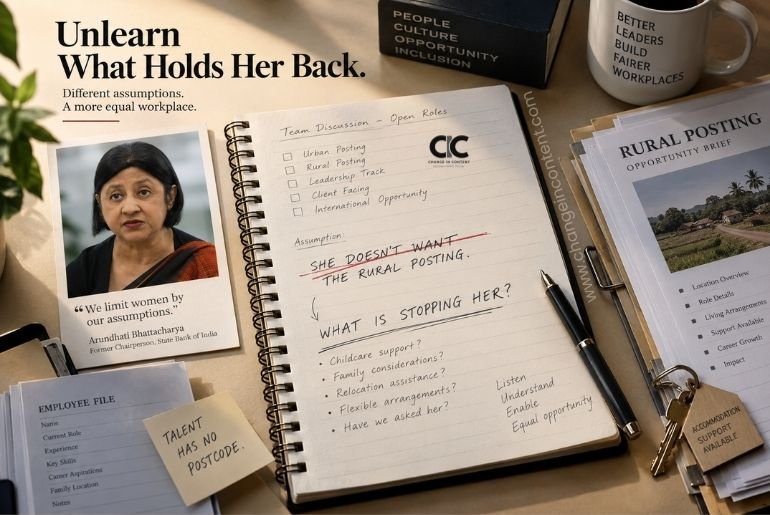
She first assumed women did not want rural postings
Bhattacharya recalled wondering why women officers were reluctant to take rural assignments even though such postings could help their careers.
Her initial interpretation was straightforward: perhaps they simply did not want to go.
A woman colleague challenged that assumption. The more basic problem was accommodation.
Single women could find it difficult to secure suitable housing in some rural locations. Once SBI provided central accommodation and mess facilities, more women became willing to take those postings.
That experience changed the question Bhattacharya asked as a leader. Instead of wondering why an employee would not do something, she began looking at what might be preventing them from doing it.
It is a small shift in language. It can produce a very different management decision.
Then she discovered bias in herself
Bhattacharya later underwent training at Salesforce and realised that she, too, could carry unconscious gender bias.
She recalled recognising that while assessing candidates, she might ask different questions depending on whether the person in front of her was a man or a woman.
Her conclusion was direct: “That shouldn’t be the case.” That admission is worth more than a generic statement about bias.
A woman who spent decades navigating male-dominated leadership structures still found that assumptions about gender could enter her own judgement. That is precisely why unconscious bias cannot sensibly be framed as something only men possess.
Workplace norms are learnt socially. Women can reproduce them too. Managers of any gender can interpret ambition, confidence, caregiving, mobility or leadership differently depending on who is in front of them.
Our earlier guide to gender equality concepts makes the same distinction: recognising bias matters only if it changes how decisions are made.
Her Gen Z view changed too
Bhattacharya also challenged another familiar workplace stereotype. After moving from SBI into Salesforce and working with a much younger workforce, she said the idea that Gen Z employees are entitled, impatient or unwilling to work hard is “totally wrong.”
Her observation was that younger employees are willing to work, but increasingly want a sense of purpose alongside employment. She pointed to younger workers’ participation in volunteering initiatives at Salesforce as one example of what motivates them.
That fits a wider generational debate in which Gen Z is frequently described through sweeping stereotypes despite significant differences within the generation itself.
Change in Content has also examined the growing gender divide inside Gen Z, where younger men and women often hold distinctly different views on feminism and workplace equality.
Bhattacharya’s argument offers a useful reminder: a generation can be different without being deficient.
The leadership lesson is really about changing your mind
It would be easy to read Bhattacharya’s remarks as three unrelated observations.
Women faced a housing problem. She discovered unconscious bias. Gen Z is misunderstood.
There is a common thread. In each case, the first explanation turned out to be incomplete.
Women did not lack ambition. An obstacle had been overlooked.
Being a woman leader did not eliminate the possibility of gender bias. And younger workers were not necessarily unwilling to work; their expectations of work had changed.
For leaders, that may be the most practical takeaway from the event. Experience matters. So does the ability to revisit what experience once taught you.
Change in Perspective
Leadership biographies usually collect the things somebody got right.
- The promotions.
- The difficult decisions.
- The crises handled.
- The firsts.
Arundhati Bhattacharya’s reflections are more interesting because she also named what she misunderstood.
That is not weakness. It is one of the more credible versions of leadership.
- A manager sees women declining rural postings and asks why they lack ambition. Another asks what is stopping them.
- A leader assumes she understands gender bias because she has experienced it herself. Then discovers that she has some assumptions of her own.
- An older executive dismisses Gen Z. Or works closely enough with them to revise the judgement.
Perhaps the useful leadership skill underneath all three is not certainty. It is the willingness to notice when your explanation no longer fits the evidence.
Editorial Note & Sources
This article is based on remarks by Arundhati Bhattacharya at the 10 September 2026 launch of Aparajita, the Hindi translation of her memoir Indomitable: A Working Woman’s Notes on Life, Work and Leadership.