
The Brief
- Extreme heat affecting female workers is a health and income problem, indoors as well as outdoors.
- Workload, humidity, clothing and access to cooling shape the risk alongside temperature.
- Pregnancy can increase vulnerability; insecure pay and unpaid care can limit opportunities to rest.
- Confusion, seizures or unconsciousness during heat exposure require emergency help and immediate cooling.
- Effective protection combines safer conditions, usable breaks and financial support for stopping unsafe work.
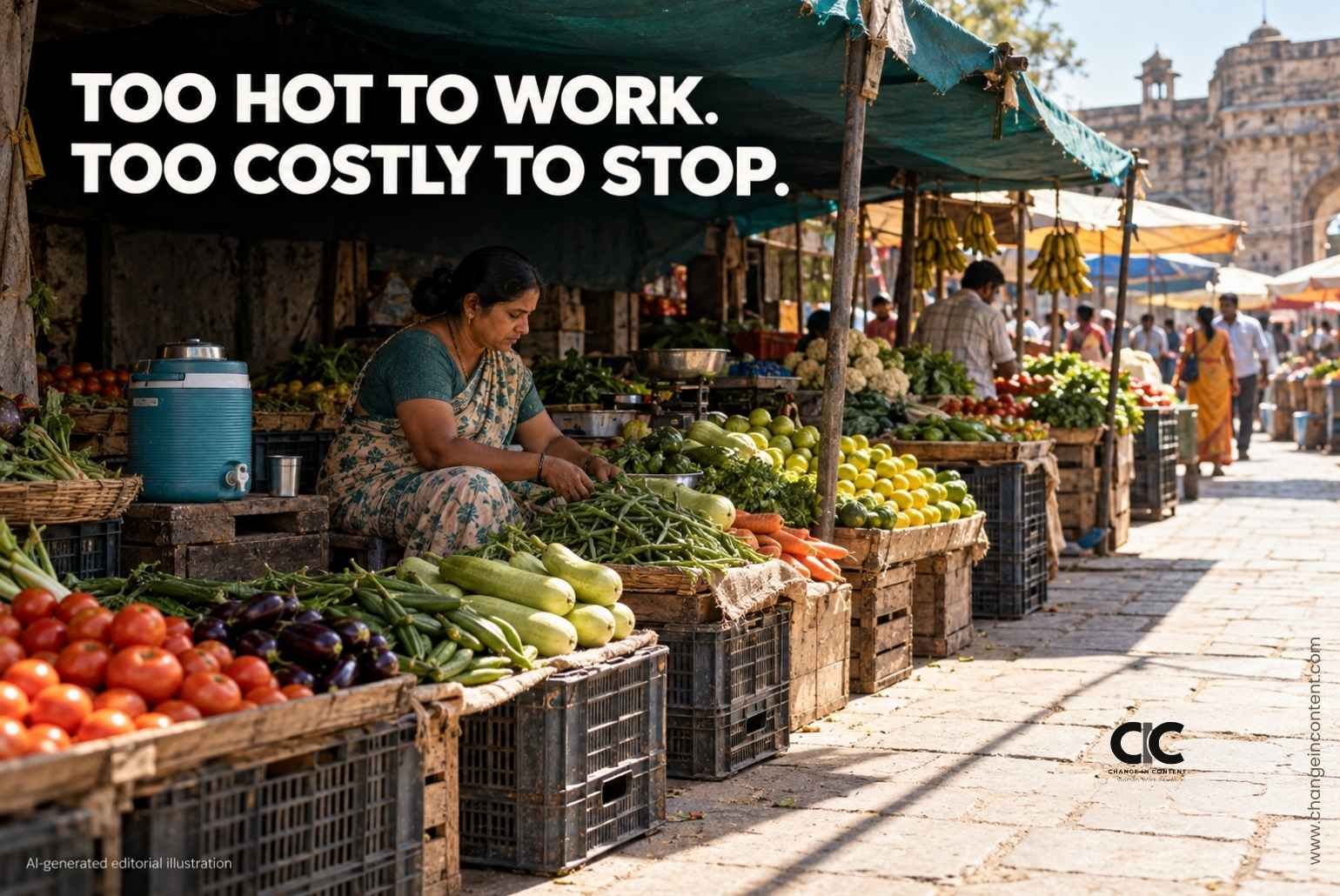
For a worker paid by the piece, a heat break can come with a price tag. Put down the sewing, close the stall or leave the field, and there may be less money to take home. Extreme heat is affecting female workers. That becomes easier to understand when we begin with that decision: what happens to her income when her body needs her to stop?
In Gujarat, photojournalist Ed Kashi and writer and producer Julie Winokur followed a street vendor, a home-based seamstress and a small farmer for their Pulitzer Centre-supported project, Overheated. Their reporting shows why a woman working inside her home belongs in the heat conversation alongside someone working under the sun.
The question travels well beyond India. The International Labour Organisation’s 2024 global assessment found substantial occupational exposure across Africa, the Arab States and Asia-Pacific. At the same time, Europe and Central Asia recorded the fastest growth in exposure between 2000 and 2020. Those findings cover workers generally, rather than women alone.
Understanding women’s work in the informal economy helps explain who can act on a heat warning. Having a weather alert on a phone is useful. Having permission, somewhere cool to go and enough income to stop working makes it usable.
What does heat actually do to a working body?
The body produces heat while it works. It must release enough of that heat to keep its internal temperature under control. Hot surroundings make this harder; physical effort adds to the load.
- Sweating helps when the sweat evaporates.
- High humidity makes evaporation less effective.
- Direct sunlight, hot surfaces and poorly ventilated rooms can add further strain.
- Protective clothing may also make cooling harder, although workers should never discard essential safety equipment without a safer arrangement.
This explains why the temperature on a weather app cannot tell the whole story. 2 people in the same town may face very different conditions: one sitting in a cooled shop, another carrying loads outside, a third working beside a hot stove.
WHO’s workplace heat guidance describes the combined effects of the environment, exertion and clothing. Workplace assessments may use wet-bulb globe temperature, or WBGT, to account for factors that an ordinary air-temperature reading misses.
The consequences can include dehydration, exhaustion, fainting and dangerous overheating. Repeated occupational exposure is also a concern for longer-term health, including kidney problems. A universal temperature at which every job becomes unsafe would miss differences in effort, humidity, clothing, health and acclimatisation. Protection should begin before someone becomes visibly ill.
Why can women face a different burden?
The explanation involves both health and the organisation of work. It would be misleading to suggest that every woman is less able to work in heat than every man.
Pregnancy is one important consideration. The US Centres for Disease Control and Prevention explains that pregnancy increases susceptibility to heat illness and dehydration. A pregnant worker needs an individual heat plan with her clinician and suitable adjustments at work. Protection must not become a pretext for excluding her from employment.
A wider view of working women’s health also brings control over the working day into focus.
- A worker may have water nearby but no clean, private toilet she can use.
- A scheduled break may be discouraged by a supervisor or financially costly under piece-rate pay.
- An earlier shift may avoid afternoon heat but create childcare or transport problems.
These are questions to investigate with workers, rather than assumptions to make about every workplace.
Recovery also depends on what happens after paid work. Cooking in a hot room, collecting water and caring for relatives can extend the day’s demands. WHO’s heat and health guidance identifies poor housing, limited cooling and gendered indoor tasks as relevant sources of exposure. The cost of unpaid work therefore belongs in any realistic account of heat protection.
What do workers’ experiences help us see?
In Harvard’s account of the Community HATS research, Jasiben, an agricultural worker from Rasnol village in Gujarat, is pictured with a wearable device and a temperature-and-humidity sensor. The research programme, developed with the Self-Employed Women’s Association, tracks conditions at home and work alongside measures including sleep, heart rate and wages. Women workers helped design the study and take part in collecting the data.
That approach asks a better question than whether a worker endured a hot afternoon. It examines the conditions surrounding her whole day. The programme description is evidence of what researchers are measuring, not a completed set of findings proving the effectiveness of every proposed intervention.
In northern Argentina, the Women of the Gran Chaco reporting introduces Wichí artisans, including Erica, Luisa and community leader Jorgelina, involved in efforts to cultivate chaguar, the plant supplying fibre for their crafts. The reporting connects scarcity with forest degradation and growing water constraints, and documents the community’s response.
This is a broader climate-and-livelihood story, rather than evidence that these named women have heat illness. It adds an important dimension: environmental change can threaten the materials a woman earns from, as well as the conditions in which she works. Women are also developing responses, as the reporting from Argentina and women’s climate initiatives in Jharkhand both illustrate.
The economic evidence extends across countries. FAO’s The Unjust Climate analysed more than 100,000 rural households across 24 low- and middle-income countries. It found greater heat-related income losses for female-headed households. Household-level findings cannot tell us exactly how much a particular worker loses, but they show why cooling advice needs an economic counterpart.
When does feeling overheated need medical attention?
Act on symptoms; do not wait for a thermometer or for a worker to collapse. The following is general first-aid guidance, drawn from NIOSH and the NHS.
| What you notice during heat exposure | What to do |
| Headache, dizziness, nausea, unusual weakness or heavy sweating: possible heat exhaustion. | Stop work, move to a cooler place, loosen unnecessary clothing and cool the skin with water and wet cloths. If fully alert and able to swallow, take frequent small sips of cool water. Have someone stay with the worker and arrange medical assessment. |
| Confusion, slurred speech, seizures or unconsciousness: possible heatstroke. The person may still be sweating. | Call the local emergency number immediately. Move to a cooler place if safe and begin rapid cooling with cool water, wet cloths and air movement while help comes. Stay with the person. Do not give drinks to someone confused, unconscious or unable to swallow safely. |
Suspected heatstroke is an emergency. Do not wait to see whether a break fixes it. If someone with milder symptoms worsens or remains unwell despite cooling, seek urgent help. Do not send an unwell worker away alone.
Access to care is part of helping women stay in work, rather than evidence that they cannot do the job. Employers and worker organisations should know in advance who calls for help, how responders reach the site and how the worker is supported afterwards.
What protection looks like in practice
NIOSH’s workplace recommendations combine changes to the work environment with changes to tasks and schedules. The following applies that approach to everyday settings; it is a planning guide, not a substitute for a site-specific assessment.
| Where the difficulty lies | A practical response | Who needs to act |
| A stall or work area has little relief from direct sun. | Provide effective shade and a cooler recovery space close enough to use. Check whether moving the work changes other risks. | Employers, market managers and local authorities, with vendors. |
| A kitchen, workshop or home used for paid work retains heat. | Assess ventilation, heat sources, roof shading or insulation, and suitable cooling. Check the actual indoor conditions after changes. | Employers, property owners, buyers and housing programmes, depending on the arrangement. |
| Taking a break reduces earnings or threatens a target. | Fund protected rest time and adjust output expectations. For self-employed workers, develop accessible income support for dangerous heat periods. | Employers, supply-chain buyers, governments and worker organisations. |
| Drinking water and toilets are difficult to access. | Supply safe water nearby and clean, private toilets, with time to use both. | Site operators, employers and municipalities. |
| A worker is new, returning after time away or facing a sudden hot spell. | Introduce hot work gradually, reduce initial demands and increase supervision and recovery time. | Supervisors and occupational-health teams. |
The financial measures above are policy recommendations. Their value lies in making the safer choice affordable. A heat break funded on paper will fail if a production target effectively cancels it. Self-employed vendors may need different support from employees because there is no payroll department to continue their wages.
Adaptation should also be designed with the women expected to use it. Earlier hours need workable transport. A cooling centre needs accessible opening times. A water point needs a reliable supply. Women’s climate responses in Jharkhand offer another reason to include women’s knowledge in planning, rather than consult them only after a scheme is announced.
For workers, useful steps include taking available cooling breaks, drinking regularly, reporting symptoms early and checking on colleagues. People with conditions affecting fluid intake, or medicines that may alter heat tolerance, should ask their clinician for tailored advice. Individual precautions remain limited when the job offers no real opportunity to take them.
Extreme heat affecting women workers: The change ahead
A workable heat plan should answer three ordinary questions: where can she cool down, can she stop without losing essential income, and who will help if she becomes unwell?
The answers will differ between a Gujarati market, an Argentine community enterprise and a European workplace. The responsibility to make work safer remains.
Success means a woman can respond to her body’s warning signs before an emergency, with the support to protect both her health and her livelihood.
Editorial note
This guide combines attributed reporting with occupational-health guidance from WHO, ILO, NIOSH, the NHS and CDC, and economic research described by FAO. Change in Content did not interview the named workers; their accounts are credited to the organisations that published them. The Gran Chaco material concerns broader climate and livelihood pressures, and the Community HATS description concerns ongoing research. First-aid information is general guidance, not an individual diagnosis or a substitute for emergency assistance. Workplace measures require assessment of local conditions and applicable rules.
Sources
- Pulitzer Centre: Overheated, women and India’s informal economy.
- Pulitzer Centre: Women of the Gran Chaco project, and the associated Infobae reporting, reproduced in Spanish with English key points.
- Harvard T.H. Chan School of Public Health: Community HATS research programme.
- ILO: More workers than ever are losing the fight against heat stress, 2024.
- WHO: Workplace heat stress, Heat and health, and WHO/WMO guidance on protecting workers.
- CDC: Heat and pregnancy.
- NIOSH: Heat-related illnesses and Workplace recommendations.
- NHS: Heat exhaustion and heatstroke.
- FAO: The Unjust Climate findings and research scope.
