
The Brief
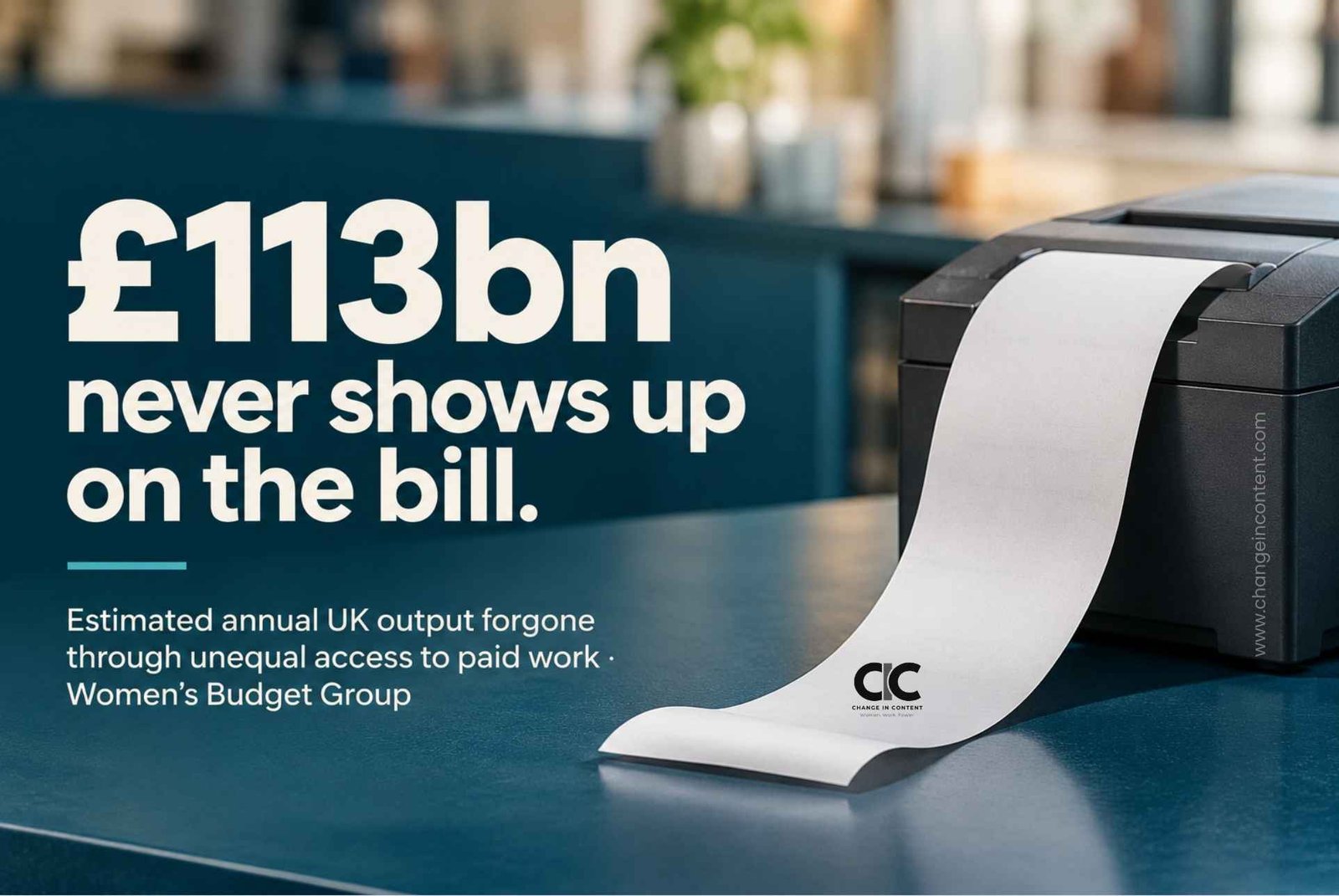
- The UK Women’s Budget Group estimates that barriers to women’s equal participation in paid work cost the country £113 billion in potential economic output each year.
- A separate World Bank study estimates that closing gender employment gaps could raise long-run output per person by almost 20% on average across countries. It answers a different question from the UK estimate.
- A field experiment in rural India found that changing where wages went, and helping women use the account, changed how much women worked. Implementation can make a measurable difference.
- One useful test for an employer: find out how many qualified people cannot take up an opportunity, change one condition and see who comes back.
The economic cost of excluding women
If a hospital pays an agency to cover a vacant shift, the invoice goes to finance. If an experienced nurse decides against returning because she cannot get childcare early enough for that shift, nobody sends an invoice for her absence. The economic cost of excluding women sits partly in that second set of accounts: the work people could have done under different conditions.
The hospital is an illustration. The £113 billion is a UK estimate.
In October, the Women’s Budget Group put that figure on the annual output Britain forgoes when women face barriers to participating in paid work on equal terms with men. The estimate features in An Unashamedly Female Agenda: A Political Economy for Women, an essay collection from Labour MPs, the Women’s Budget Group and the Good Growth Foundation. It raises a question well beyond Britain: how much useful work do we lose because the terms on which we offer it make it impossible to accept?
What does £113 billion actually buy us an understanding of?
Economists call the measure gross value added, or GVA. Think of a bakery. From the value of the bread it sells, subtract the flour, electricity and other goods and services it bought to make the bread. The remainder is the value the bakery added. It includes the contribution of the people doing the work; it is much broader than the owner’s profit.
In its earlier published methodology, the Women’s Budget Group and the Centre for Local Economic Strategies asked what additional output UK regions might generate if women participated in the labour market at the same rate as men. They used local estimates of output per worker to give that gap a monetary value. The October announcement gives the updated figure but does not set out a new calculation in full.
Read £113 billion, then, as an estimate of the distance between two possible economies. It is neither tax revenue waiting for the Chancellor nor a wage bill owed to individual women. Jobs must be available; care must still be provided. The estimate does not tell a council how much of the gap a new nursery would close. It does give that council a reason to include the costs of doing nothing when it considers the nursery’s price.
There is another accounting trap here. The nurse looking after her child is working. Most unpaid care for one’s own family sits outside conventional output measures, even though the rest of the economy depends on it. An increase in recorded output is worth understanding. So is the question of who takes over the care, on what terms, and whether the woman wanted that change. Our reporting on India’s working women explains why being counted as a worker and receiving an income of one’s own can also be different things.
If that is one country, what does the world lose?
There is a better answer than multiplying £113 billion by the number of countries. Start with each country’s own employment gap. A large economy with a small gap can forgo more output in money terms than a small economy with a much larger gap. The types of jobs available, productivity, and the time needed to create new jobs also matter.
World Bank economist Steven Pennings modelled what would happen if gender employment gaps closed. Across countries, GDP per person could be almost 20% higher on average in the long run. In plain language, the model compares the level of prosperity countries might reach with the level they would otherwise reach. It does not predict an extra 20% growth every year. Nor is a simple average across countries the same as a 20% increase in the world’s combined GDP.
That is about as far as an honest comparison should go. The UK estimate puts pounds on potential annual value added. The international study measures a potential percentage change in long-run output per person. They cannot be added together. What they establish independently is that excluding women from paid work is large enough to belong in an economic strategy, alongside questions of skills, infrastructure and investment.
Are the commitments only on paper?
Some survive contact with everyday life. Others stop at the point where someone must put money, staff or authority behind them. The World Bank’s Women, Business and the Law 2026 offers evidence of both. It records 68 economies introducing reforms between 2023 and 2025.
Across the 190 economies assessed, however, its global score for the policies and institutions needed to put rights into practice was just 47 out of 100. That score measures the supporting framework. It does not mean that 47% of women can exercise their rights.
Consider what researchers tested in 197 village clusters in northern Madhya Pradesh. In a study published in the American Economic Review, they examined what happened when women’s public employment wages could go into their own bank accounts rather than their husbands’ accounts. Some women also received training in how to use the account.
Compared with women offered accounts alone, women offered direct deposit and training did more paid work, both in the public programme and in the private sector.
An administrator counting accounts opened could have recorded progress in both groups. Following the wage payment revealed something the account tally missed: women’s ability to receive and use their earnings could change the value of taking a job. The experiment does not establish the effect of every financial inclusion programme across India. It does show why the apparently small question whose account gets credited? belongs in the design of one.
Start with the offer that was turned down
An employer need not calculate its own version of £113 billion. Start with one role that is hard to fill. Speak, with their agreement, to qualified candidates who declined it. An exit form saying “family reasons” gives a manager very little to work with. Learning that an employee could have covered four fixed shifts, but could not accept four shifts allocated at a day’s notice, gives the manager a decision to make.
Try publishing the rota earlier for one team. Track accepted shifts, agency cover and retention, alongside the cost of changing the schedule. Ask workers whether the new arrangement actually helps and check that it has not simply passed the short-notice shifts to somebody with less bargaining power. The months before a woman resigns are often the best time to discover which part of a job she needs to change.
The same discipline applies to the British essays’ proposals. Sarah Russell MP calls for a cap on childcare costs; Maya Ellis MP proposes at least six weeks of paternity leave at 90% of pay. These are proposals. If adopted, each would need its own test. Can parents obtain childcare for the hours they work? Can fathers afford to take the leave, and do they use it? A government can count the people it made eligible. A family can tell you whether Tuesday morning became any easier.
Change what goes into the accounts
Go back to the hospital. The finance director is right to ask what it would cost to make the shift workable. The incomplete decision is to compare that expense with zero. Put the cost of temporary cover beside it. Include recruitment and induction. Ask the nurse whether a different start time would have changed her decision before anyone claims it would have brought her back.
Women do not owe an economy more paid hours to improve its figures. They are entitled to decide how they use their time. What £113 billion puts a price on is the narrowing of that choice. The question for anyone who controls a budget is whether the cheaper-looking arrangement is genuinely cheaper, or whether someone else has been carrying the cost.
Editorial Note
This is a Mosaic commentary. The hospital and rota are illustrative, not reported cases. The Women’s Budget Group is a policy organisation making a case for reform; its UK estimate is attributed. We consulted its earlier method rather than claiming to have replicated the 2026 figure. We have not treated the difference from earlier cash estimates as an inflation-adjusted increase in exclusion. The international model, global institutional index and Indian field experiment each answer a separate question.
Sources
- Women’s Budget Group: October 2026 announcement and UK estimate; Good Growth Foundation: the essay collection.
- Women’s Budget Group and CLES: earlier regional GVA methodology, notes to editors.
- Steven Pennings, World Bank: A Gender Employment Gap Index; author’s explanation of the cross-country average.
- World Bank: Women, Business and the Law 2026. Legal rights, supporting institutions and perceptions of enforcement are scored separately.
- Erica Field, Rohini Pande, Natalia Rigol, Simone Schaner and Charity Troyer Moore: On Her Own Account, American Economic Review, 2021.
