Artificial intelligence is often introduced to the public as a force for efficiency, innovation, and awareness. The awareness campaign on greenwashing and dark patterns launched by the Advertising Standards Council of India marks a notable shift in how consumer protection is being communicated in the digital age. Instead of issuing only guidelines and compliance notices, ASCI is stepping directly into the influencer ecosystem to speak to consumers where they spend their time.
Announced in Mumbai on February 26, 2026, this is ASCI’s first influencer-led consumer awareness initiative. It is designed to help users decode sustainability claims, understand deceptive design practices, and question advertising narratives that subtly manipulate digital choices.
ASCI does not consider it a campaign against advertising. It is a campaign for informed participation.
Why ASCI is focusing on Greenwashing and Dark Patterns
Greenwashing and dark patterns are no longer niche concerns discussed only within policy circles. They are everyday realities embedded in online shopping, subscription models, app interfaces, and sustainability marketing.
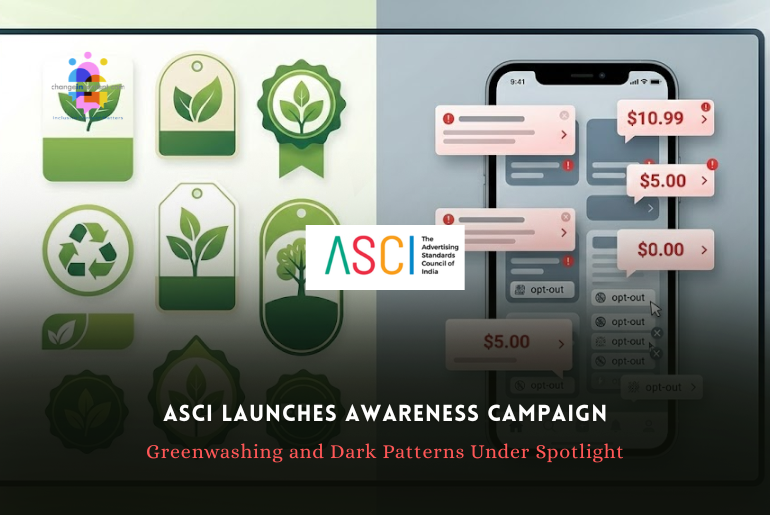
Greenwashing refers to the use of misleading or exaggerated environmental claims. Dark patterns refer to interface designs that trick or nudge users into decisions they may not have otherwise taken, such as hidden costs, pre-ticked boxes, confusing cancellation flows, or “basket sneaking” that adds items without clear consent.
Both practices distort consumer choice.
ASCI’s decision to centre its awareness campaign on these two themes signals how advertising regulation is evolving. It is no longer limited to claims made in television commercials or print ads. It now extends to digital architecture, sustainability positioning, and user interface design.
The influencer strategy: Meeting consumers in their digital habitat
In a significant first, ASCI has partnered with digital creators to lead this consumer education effort. The influencers associated with the campaign include Shraddha Jain (@aiyyoshraddha), Aalekh Kapoor (@aalekhkapoor), Sakchi Jain (@ca.sakchijain), Ashutosh Pratap Singh (@technical_sapien), Pankti Pandey (@zerowasteadda), Vinod Kumar (@techsupreme_), Aisha Ahmed (@aisharahmed), and Sangeeth and Kavya (@lifeonroads__).
This is not incidental. Influencers command credibility in the very ecosystem where dark patterns and sustainability marketing thrive. By working with creators trusted by digital audiences, ASCI is attempting to democratise advertising literacy rather than confine it to compliance documents.
Awareness campaign on Greenwashing and Dark Patterns: ASCI’s thoughts
The greenwashing segment of the campaign will encourage consumers to critically examine eco-labels, differentiate between credible sustainability commitments and marketing buzzwords, and ask practical questions before trusting environmental claims.
The dark patterns segment will spotlight tactics such as hidden charges, misleading countdown timers, privacy deception, and confusing opt-out mechanisms that impair user autonomy.
This move reflects a broader regulatory understanding that awareness must precede enforcement.
ASCI Academy and the consumer education mandate
The awareness campaign on greenwashing and dark patterns is being conducted under the ASCI Academy. It is the organisation’s flagship education and capacity-building arm, launched in August 2023.
According to Manisha Kapoor, CEO and Secretary General of ASCI, consumer education forms a central pillar of the Academy’s mandate. Through programs like Ad-Wise, which aims to build advertising literacy among school students, ASCI has already been working to expand awareness among younger audiences. The influencer campaign now extends that mission to mainstream digital consumers.
In addition, ASCI Academy recently launched an e-learning course titled Ethical UI and UX Designs. The course is aimed at advertisers and digital designers, offering practical tools to eliminate dark patterns and adopt compliant alternatives aligned with ASCI codes.
This dual approach, educating consumers while equipping advertisers, signals a structural strategy rather than a reactive one.
The data behind the intervention
Anecdotal concerns are not the drivers of the ASCI’s decision. The decision rather follows empirical research and case handling.
In 2024, ASCI released the Conscious Patterns report, which revealed that 52 out of the 53 top Indian apps studied employed dark patterns, including drip pricing and privacy deception. These design tactics were found to impair user autonomy and influence purchasing behaviour.
In 2024, ASCI introduced dedicated guidelines for environmental claims. Since its launch, ASCI has processed 236 cases related to environmental and green claims. All 236 cases required modification, indicating widespread misuse or exaggeration in sustainability advertising.
These numbers suggest systemic patterns rather than isolated incidents.
ASCI’s guidelines complement the Central Consumer Protection Authority’s regulations under the Ministry of Consumer Affairs, particularly on dark patterns. ASCI’s role, however, specifically targets advertising-linked design practices within its self-regulatory framework.
ASCI: A self-regulatory body with expanding relevance
Established in 1985, the Advertising Standards Council of India is a self-regulatory body committed to ensuring that advertisements are legal, honest, truthful, decent, and not harmful. Over the years, ASCI has handled complaints across media formats, including print, television, radio, digital, packaging, and promotional materials.
ASCI collaborates with government bodies such as the Department of Consumer Affairs, the Food Safety and Standards Authority of India, the Ministry of AYUSH, and the Ministry of Information and Broadcasting.
Its evolution from a complaint redressal body to an education-driven regulatory institution reflects the changing nature of advertising. Digital platforms have blurred the lines between content, commerce, and interface design. ASCI’s intervention acknowledges that regulation must adapt accordingly.
Organisations including Diageo India, Hindustan Unilever Ltd, Mondelez International, Nestlé, Cipla Health, Coca-Cola, Colgate, Games 24×7, PepsiCo, P&G, Kenvue, and Bajaj Auto support the ASCI Academy’s initiatives.
The larger question: Is consumer autonomy being undermined?
At changeincontent, we see the awareness campaign on greenwashing and dark patterns as part of a broader conversation about digital autonomy.
When sustainability becomes a marketing tactic rather than a measurable commitment, consumer trust erodes. Similarly, when user interfaces are engineered to mislead, transparency becomes performative. Over time, this shifts the balance of power between businesses and individuals.
We do not see consumer literacy as only about reading labels. It is about recognising design manipulation, understanding persuasive architecture, and questioning environmental narratives.
ASCI’s move to bring influencers into this conversation signals that regulatory bodies understand where persuasion now lives.
Awareness campaign on Greenwashing and Dark Patterns: Closing thoughts
The awareness campaign on greenwashing and dark patterns launched by ASCI represents a significant moment in India’s advertising ecosystem. It moves the conversation beyond compliance notices and into digital culture itself.
Greenwashing and dark patterns are not abstract regulatory terms. They shape everyday decisions, from subscription sign-ups to sustainability purchases. By combining influencer outreach, academic courses, research-backed guidelines, and regulatory alignment, ASCI is attempting to build a more informed consumer base.
Whether this campaign reshapes behaviour will depend on sustained engagement, platform cooperation, and advertiser accountability. But one thing is clear. Advertising literacy in 2026 must extend beyond slogans to include code, design, and digital intent.
Disclaimer: The views expressed in this article are based on the writer’s insights, supported by data and resources available both online and offline, as applicable. Changeincontent.com is committed to promoting inclusivity across all forms of content. We broadly define inclusivity as media, policies, law, and history. It encompasses all elements that influence the lives of women and marginalised individuals. Our goal is to promote understanding and advocate for comprehensive inclusivity.