
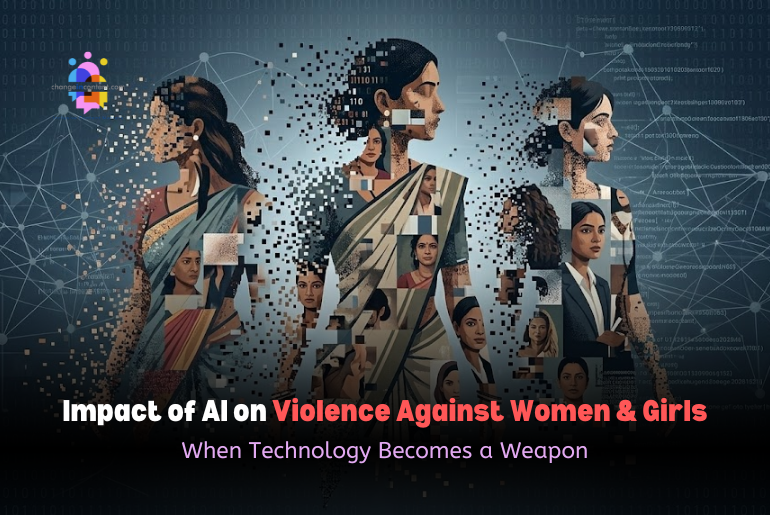
Artificial intelligence is often introduced to the public as a force for efficiency, innovation, and economic transformation. But another story is unfolding in parallel. It is less celebrated, less comfortable, and far more urgent. The growing body of research on AI on violence against women and girls shows that the same tools reshaping industries are also reshaping the scale, speed, and sophistication of gender-based harm.
Let us not mistake it as a fringe concern about online trolling. It is about how digital systems are amplifying abuse, distorting reputations, and eroding public trust in women’s voices. In some cases, escalating harm beyond screens and into real life.
AI on violence against women and girls: The numbers we can no longer ignore
The latest research examining AI-enabled harms presents stark findings. One global study cited in the paper found that 65% of women surveyed had experienced or witnessed disinformation-based abuse online. That means misinformation is not incidental. It is pervasive.
The statistics on deepfakes are even more alarming. Recent analyses estimate that 98% of deepfake content online is pornographic, and 99% of those depicted are women. These are not accidental patterns. They reflect targeted misuse of generative AI tools to create non-consensual intimate imagery designed to shame, silence, or intimidate women.
These harms are not theoretical. They are replicable at scale. AI systems can now generate hundreds or thousands of manipulated images or messages within minutes. They can impersonate voices, fabricate messages, scrape personal data, and distribute abuse across platforms with little friction.
Technology-facilitated violence against women existed before AI. What has changed is velocity, anonymity, and believability.
From digital attack to offline harm
One of the most important insights in the research is that online abuse does not remain online. It migrates.
Threats made in comment sections escalate into stalking. Fabricated content circulates among employers, families, and communities. Women who are targeted by coordinated campaigns often face reputational harm that disrupts careers and political participation. In extreme cases, digital harassment precedes physical intimidation or violence.
AI accelerates this trajectory. Automated tools can sustain harassment campaigns over long periods without significant human effort. The abuse becomes continuous rather than episodic. For victims, this creates a sense of inescapability. The phone does not switch off the threat. It carries it.
The realism of AI-generated images and videos also complicates legal responses. Deepfakes are difficult to disprove in environments already shaped by gender stereotypes. Women are forced into defensive positions, trying to discredit fabricated evidence while navigating legal systems that were not designed for synthetic media.
Disinformation as a weapon against women in public life
Women journalists, activists, politicians, and human rights defenders are among those most affected by AI-enabled disinformation.
When a woman challenges power structures or speaks on contentious issues, AI-driven campaigns can flood digital spaces with false narratives that question her credibility or morality. Fabricated images can be circulated to portray her as immoral or untrustworthy. Impersonation tools can mimic her voice or writing style to spread harmful statements.
It is not random cruelty. It is strategic silencing.
UN Women’s research on online violence in the public sphere has shown how persistent digital abuse influences women’s willingness to participate in political and public life. When AI is amplifying abuse, the psychological and professional cost of visibility increases sharply.
The impact extends beyond individual women. When women withdraw from public discourse due to harassment, communities lose representation. Democracies lose diversity of thought. Public debate becomes narrower and less inclusive.
AI on violence against women and girls and the shrinking of the digital public space
The research suggests we may be approaching a tipping point.
Digital spaces were once framed as equalisers that could expand access to public life. For many women, it is now contested terrain. Persistent abuse, disinformation campaigns, and AI-generated sexualised content create hostile environments that discourage participation.
Women from marginalised communities face compounded risks. Intersectional discrimination means that race, religion, ethnicity, disability, or sexual orientation can intensify the scale and nature of digital attacks.
The cumulative effect is a shrinking of women’s public space. The result is not only personal harm. It is structural exclusion.
The policy landscape: Norms are catching up, but slowly
International frameworks increasingly recognise that technology-facilitated violence is a form of gender-based violence. There is growing acknowledgement that AI governance must be gender responsive and rooted in human rights principles.
Emerging global initiatives, including the UN Global Digital Compact and the Council of Europe’s Framework Convention on AI, stress accountability, transparency, and risk assessment. These frameworks call for AI systems to be designed and deployed with safeguards against bias and harm.
However, enforcement remains inconsistent. Laws addressing non-consensual intimate images or online harassment often lag behind technological capabilities. Cross-border jurisdictional challenges allow perpetrators to exploit regulatory gaps.
The research emphasises that treating AI as a neutral or self-regulating sector is unrealistic. When systems can produce harm at scale, oversight cannot remain optional.
Beyond regulation: Can AI be part of the solution?
The research does not frame AI only as a threat. It also highlights how AI can be harnessed for prevention and response.
AI-driven tools can detect patterns of abuse, identify coordinated harassment campaigns, and flag non-consensual content for rapid removal. Chatbots and digital platforms can provide survivors with information, resources, and discreet support. Data analytics can help policymakers understand emerging patterns of technology-facilitated violence.
Structured collaboration between governments, technology companies, and women’s rights organisations is essential. Solutions designed without survivor input often miss critical realities. Co-creation is not symbolic participation. It is a practical necessity.
Singapore’s Digital for Life movement and Meta’s Global Women’s Safety Expert Group are examples of attempts to align digital literacy and platform policy with safety goals. The long-term effectiveness of such initiatives will depend on transparency and measurable accountability.
The changeincontent perspective
At changeincontent, we see the discussion around AI on violence against women and girls as central to the future of digital governance.
That is not simply about moderating comments or removing explicit content. It is about safeguarding women’s participation in public life. It is about ensuring that digital transformation does not deepen gender inequality.
Women leaders, entrepreneurs, journalists, and professionals are increasingly required to maintain online visibility. If that visibility carries disproportionate risk, then the digital economy itself becomes unequal.
We must ask serious questions.
- Are AI systems being stress-tested for gendered harms before deployment?
- Are reporting mechanisms accessible and survivor-centred?
- Are companies transparent about training data and content moderation algorithms?
- Are governments investing in digital literacy that includes awareness of AI-generated manipulation?
We cannot decide the future of equality only in legislatures or boardrooms. It will also be shaped by platform architecture and algorithmic design.
Also Read: The exploitation and trauma of India’s women moderators of AI content.
Conclusion: The choice ahead
The research on AI on violence against women and girls presents a stark reality. Artificial intelligence can amplify misogyny at scale, accelerate disinformation, and intensify image-based abuse. It can shrink women’s digital public space and undermine democratic participation.
But AI is not destiny. Governance, accountability, and inclusive design can shape its trajectory. The choices made now will determine whether artificial intelligence becomes a multiplier of harm or a tool that strengthens safety, transparency, and justice.
It is not a peripheral debate about technology. It is a defining challenge for gender equality in our time.
Disclaimer: The views expressed in this article are based on the writer’s insights, supported by data and resources available both online and offline, as applicable. Changeincontent.com is committed to promoting inclusivity across all forms of content. We broadly define inclusivity as media, policies, law, and history. It encompasses all elements that influence the lives of women and marginalised individuals. Our goal is to promote understanding and advocate for comprehensive inclusivity.
