
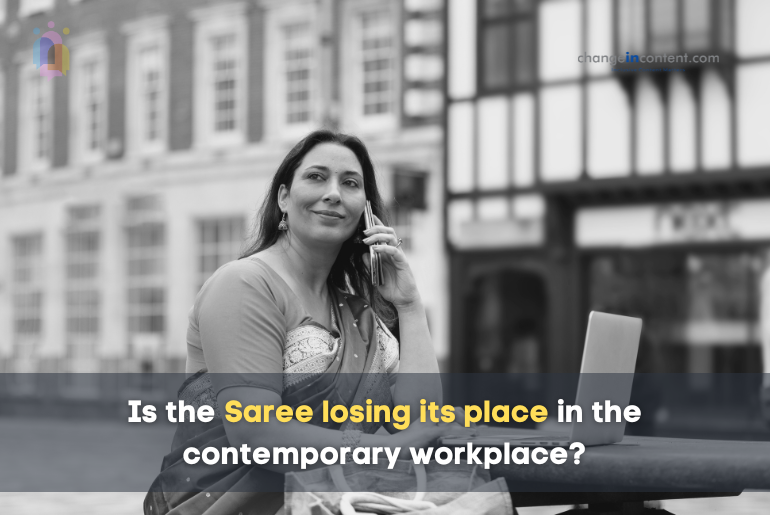
The saree is the most talked-about Indian garment. Alia Bhat wears a million-dollar handcrafted saree at the Met Gala. From a business perspective, new-age brands like ‘Suta’ are creating interesting sarees for today’s women. Traditional brands like Nalli are showing tremendous growth. We see celebrities wearing sarees to award functions. But do you see women wearing the saree in their daily lives? For example, if we stroll across an office floor, perhaps one in 100 women would be seen wearing a saree. This change in the narrative of the Saree calls for a discussion.
What happened to the saree-wearing population? Since I am not a GenZ or a millennial, I have grown up seeing most women wearing sarees. It was especially true in Bengal, where I grew up. In the 90s, all the women we knew would wear sarees. There were regular cotton sarees that one wore at home, a few chiffon or georgette ones inspired mainly by Bollywood carefully reserved for a visit to Park Street (Kolkata’s answer to high-end lifestyle) and silk sarees for special occasions like weddings. Sarees were bought at home with sareewalas coming to the doorstep. Also, there were traditional large retail outlets stocking sarees ranging from a meagre 200 rupees to thousands. Also, there were Govt emporiums. So, a saree connoisseur would have sarees from all states of India.
The saree was not only a staple; it reflected one’s social standing, cultural knowledge, sense of fashion, and much more. Saree also was something else. It kept girlhood separated from womanhood. So someday, when you wore a saree to the school function, your mother’s saree, sometimes with an ill-fitted blouse, you entered the world of grown-ups in your adult attire, complete with some jewellery and makeup.
Narrative of the Saree & liberalisation
No, this is not a piece where I am musing about an era. I am just thinking about what happened to the saree! From being so much, why is it now worn only during weddings or award functions? When did this change?
I sense that It changed with liberalisation somewhere between the 1990s and 2000s. Anarkalis, salwar kurtas, and certain Indo-Western fusion attires started replacing the saree. The saree started losing its supremacy. From being a daily staple, it started becoming a formal affair reserved for special occasions.
Women, saree, productivity
I think the decline of the saree can be compared to the sudden fall of an empire. In the 1990s, women started to join the workforce in bigger numbers. A saree took the position of a not-so-convenient garment. With organised retail becoming stronger, women had the option to wear formal western workwear to their workspaces. I remember, in early 2000, we loved our newfound identities in our new work look- pink shirt and grey trousers, a blazer if the weather permitted or your industry demanded it.
When I look back, the then workwear was stiff, dull and not feminine. I also felt that with traditional Indian body shapes, most of us did not look our best in these attires. But yes, in terms of ease, the shirts and trousers worked well. One could get ready in 5 minutes without bothering to look for petticoats and blouses. But we also started to lose our individual sense of style. Every saree that I own is different. Every formal trousers-shirt combo that I own is quite identical to what my colleague wears.
I see a relationship between women entering the workforce and the rise of organised retail that promotes workwear fashion. Workwear fashion has less individuality and helps women blend in. Therefore, can I establish a relationship between job creation and systemic suppression of individuality through structure and attire?
The narrative of the Saree and senior management
After 24 years, I see the saree being an invisible garment in the corporate world. The understanding of workwear has changed. In specific industries where creativity is at the centre, jeans or cargos are acceptable workwear. In other, more business-like formal environments, it’s long dresses with shrugs, jackets, trousers, coord sets, and sometimes even the humble salwar-kameez. On the contrary, wearing a saree creates a conversation at work. Usually, it goes like, “Is there something special today”? Now, the saree is officially reserved for festivals, conferences, and award ceremonies.
The saree has created hashtag-driven challenges. The popular ones are #Everydaywearasaree, #100sareepact, and #sareelove. How did the saree become an agenda? Does it require a facelift? Is this changing narrative of the saree really worth it?
Some think sarees help maintain appearances, too. A government sector employee is a symbol of Indianness, and so is a political leader. However, interestingly, some senior women in leadership roles are seen wearing crisp, cotton or handloom sarees. Also, I see some media professionals or government employees wearing sarees, too. However, barring these few women and a few in positions of power, the corporate sector does not see too many women employees going for a saree.
The rejection of Saree: Where does it come from?
The rejection of the saree comes from a lack of resources and time. Also, the uniformisation of corporate attire helps one fade into the background. Every ‘body’ looks similar in the readily available work wear. A saree makes one look distinctive and requires an investment. The investment of time to decide on a look, getting a petticoat and a blouse, and probably some bindi and eye makeup that goes with it. A senior manager with a particular package can afford to make that investment. She probably has house help and a driver. In contrast, a woman at a junior level who is in a hurry to catch public transport is in a hurry to get into something that she can slip into quickly.
The final thoughts on the changing narrative of the Saree
So, is the saree a symbol of a certain financial stability? Or is it worn by women in specific roles? Is the diminishing utility of a saree directly proportional to women’s fatigue? With liberalisation and privatisation, the air hostesses who wore elegant silk sarees earlier wore tunic-type outfits. Some of these uniforms remind us of our school uniforms. They kind of hide the curves. They are also low maintenance, which is like the economy brands they represent.
Something about the saree getting replaced by a shapeless dress is representative of the fact that women have less leisure time and less individuality. The uniforms or practical work wear clones women. They all have adapted to a world where fashion has become functional fashion and individual styles have become mass-produced fashion.
With more jobs, women have less time because of their workload. She now multi-tasks and takes care of her home and her income with the responsibility of raising her family, etc. Garments, mass-produced, colourless and stiff, made these women a class of new breed of Indian workers. She got her money, but she lost her leisure and her beauty.
Disclaimer: The views expressed in this article are based on the writer’s insights, supported by data and resources available both online and offline, as applicable. Changeincontent.com is committed to promoting inclusivity across all forms of content, which we define broadly to include media, policies, law, and history—encompassing all elements that influence the lives of women and gender-queer individuals. Our goal is to promote understanding and advocate for comprehensive inclusivity.

1 comment
I was recommended this web site by my cousin. It is interesting to read such details about the Saree. You are amazing!