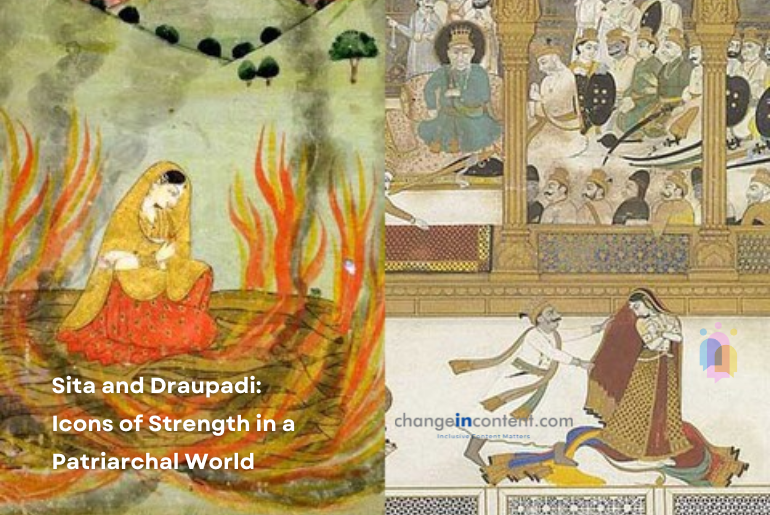
Ramayana and Mahabharata. The epic tales of India are an integral part of our lives. They are tales of love, revenge, responsibility, honour, friction, betrayal, and duty. We continue to talk about the protagonists, and that makes them part of our lives. Whether the epic is narrated by an elder or watched on TV, we feel enraged when Draupadi is dragged to the court and the Kauravas humiliate her. Similarly, we feel anger rushing through our veins when Ravana abducts Sita. The stories of Sita and Draupadi reflect the complexities of their times and their resilience in the face of adversity.
Sita and Draupadi: Different contexts, similar experiences
Let us talk about two iconic ladies from the Indian epics: Sita and Draupadi. These two have very distinct personalities, but they have similar experiences. However, their context and standings are different. Today, Sita is considered a goddess, and Draupadi is a firebrand of a woman who instigated the war. They both are victims of patriarchy. While Sita is divine, Draupadi is not.
We all know the stories: Sita, Rama’s virtuous and beautiful wife, follows him into exile. Draupadi, on the other hand—well, she had five husbands! She marries Arjun when he comes in disguise, not in the usual fanfare of an opulent prince-marries-the-princess kind of set-up. Draupadi sacrifices at many levels. From exile to having to live with five husbands.
Victims of patriarchy
Both Sita and Draupadi went through complex situations and challenges. Sita had to prove her innocence by performing an Agnipariksha, and finally, she gave up and went back to her mother, Mother Earth. She must have felt dejected and isolated in those years in Lanka. After all that, Ram, the most noble human being in Indian mythology, does not stand by her. She needs to go through the motions of allowing herself to sit through flames in front of all the men who matter and come out non-guilty.
Draupadi is violated by men in front of her five husbands. She is married to Bheem and Arjun, the most powerful men, but her situation on that ill-fated day is no different from that of a woman who has no one to look after her. Her marriage was part of a unique situation, and it wasn’t exactly her choice. As per the wish of her mother-in-law, Kunti, she ended up marrying all the Pandava brothers.
Sita was part of a regular marriage construct. She was the only wife of a king. Here’s the critical point to remember: the polyandry system in Draupadi’s case was exceptional. It wasn’t the norm, and it served a specific purpose in the story. Some interpret it as a classic move by Kunti to keep her sons together. Draupadi was so attractive and desirable that Kunti asked her five sons to marry her so that she would not create a rift among the brothers. Some also call it destiny. She was created to bring an end to the Kauravas.
Why Sita is idealised, and Draupadi is not
So, here’s the question: Why is Sita often hailed as the ideal wife, while we do not worship Draupadi in any temple? Is it just because she had five husbands? Draupadi was more human and more vocal than Sita. The fact that Sita does not speak up makes her divine. She just chooses to remove herself from the situation and this world. Sita went through the wrongs, and Draupadi was seeking revenge.
There are a few reasons. Sita’s story aligns with the traditional view of values, dignity and devotion. Draupadi is more fallible, and that makes her more human.
Relatability to modern women’s experiences
Here’s another thought: Draupadi experiences everything a common woman experiences even today. She gets molested in front of all the men. It is not a stand-alone incident. Her beauty had created a rift during her ‘Swayambhar’ from the beginning. Every man in the audience who experienced her humiliation had once wanted to possess her. But she chose Arjun. She was different as she was Krishna’s friend- her ‘sakha’. She was unattainable till Yudhishtir lost in a game.
Isn’t it relatable? Privileges mean dignity and protection for women. Bereft of all advantages, Draupadi became the symbol of women across generations who get physically violated by men who are meant to protect them- they come in the form of employers, neighbours, and sometimes near relatives.
The final thoughts
Sita and Draupadi were both subjected to oppression. Somehow, we give Sita’s sufferings the status of an epic virtue. That is a form of patriarchy. The collective conscience knows that Sita went through the wrongs and Ram was unfair in remaining quiet.
We also belittle Draupadi’s sacrifices because her sensuality takes centre stage. Both were women with agency. One was quiet; the other was vocal. One quietly asked Mother Earth to take her away; the other never tied her hair and finally bathed herself in her enemy’s blood.
Disclaimer: The views expressed in this article are based on the writer’s insights, supported by data and resources available both online and offline, as applicable. Changeincontent.com is committed to promoting inclusivity across all forms of content, which we define broadly to include media, policies, law, and history—encompassing all elements that influence the lives of women and gender-queer individuals. Our goal is to promote understanding and advocate for comprehensive inclusivity.