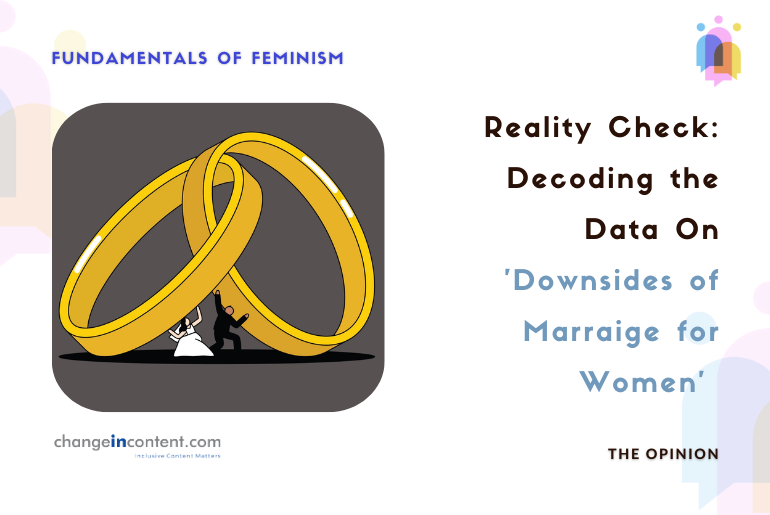
When you watch a romcom or read a satisfying novel, there is a strong chance that the female protagonists end up married or engaged by the end. It is often in the epilogue or final chapter. There is no doubt that this is the “happily ever after” (HEA) that most readers crave. Yes, the “HEA” is usually about her finding love and joy with a partner. But is marriage truly the ultimate happily ever after for women? Not, considering the data we come across. This thought-provoking data shows the downsides of marriage for women.
Single women: A powerful demographic to reckon with
Even today, when single women are a visible part of urban society, there is a perception that all single women are desperately searching for a partner. They are single because no one is looking to marry them. There is an association between doom, loneliness and sorrow. According to a study by Morgan Stanley, by 2030, it is estimated that 45% of women aged 25-44 will be single.
Are all these women looking for partners, or do they choose to remain single? It seems unlikely that all single women are not single by choice and are feeling sorry for themselves. With more agency and more purchasing power, the very foundation of marriage that stems out of economic servitude is changing. Data shows that single women are happier and fancy-free compared to their married counterparts. Therefore, ‘happily ever after’ might get replaced by ‘happily single’.
Are women better off with marriage or better off without?
What do women and men gain from marriage, respectively? Beyond companionship, intimacy, and perhaps a few laughs and fights, the prospect of motherhood is unique to women. However, marriage also comes with specific unspoken responsibilities and disadvantages, especially for women.
Some may argue that financial stability is a benefit, but that also assumes that men earn and women enjoy the benefits of that labour. On the other hand, women pay back by embracing the duties of running the household chores, raising the children, looking after the other family members and possibly upholding family values and traditions. Therefore, while men look after only the financial aspect of running a household, women get burdened with the numerous responsibilities of managing a home. Thus, in terms of responsibilities, it is pretty lopsided among both genders. However, since money represents power and stature, men’s work gets more recognition. A married woman’s work often goes unrecognised and unappreciated because it isn’t easily measured.
Unpaid labour: Another downside of marriage for women
Unpaid labour, such as caring for children, tending to the elderly, and managing household tasks, constitutes a substantial portion of economic activity, yet it is excluded from GDP calculations. On average, women perform two more hours of unpaid work per day than men, though this varies significantly between countries. Consequently, women bear a disproportionate share of the burden.
Marriage can benefit both men and women, but even then, the positive impact is generally much more substantial for men. Just look at the data. Single, child-free women are the happiest, while married women often face higher stress, burnout, and depression compared to their husbands.
Women shoulder a heavier load of domestic tasks and emotional labour than men. It includes housework, cooking, cleaning, and managing the emotional needs of the family. Burdened by these responsibilities, nearly 50% of urban women in India don’t leave their homes even once a day. In contrast, about 87% of men step out at least once daily.
Life after marriage and the multiplication in social circles
Once you get married, especially as an Indian woman, your circle of relatives seems to multiply magically. Suddenly, you are expected not just to manage your friendships but also to take on the responsibility of maintaining your husband’s social connections. With the ever-increasing household chores, keeping up with friends starts to slip lower and lower on your list of priorities.
It might explain why some studies suggest that women without partners tend to engage in more social activities and have more friends. Think about it. A married woman who isn’t working is often tied up with activities at home, leaving little time for outings. And let’s not forget that many of these tasks are unpaid and frequently undervalued.
So, what’s the real benefit for women in marriage?
Just to be clear, this is not meant to sound like an attack on marriages. This article takes a closer look at how marriage impacts women’s agency, for better or worse.
Downsides of marriage for women: The marriage paradox
Research indicates that marriage can be beneficial for women’s health, but there’s a catch. It is only when marital satisfaction is high. This study found that women in happy marriages tend to have lower levels of cardiovascular risk factors, including blood pressure, cholesterol, and body mass index, as well as lower levels of psychosocial risk factors like depression, anxiety, and anger. However, poor marital quality can nullify these health benefits. So, if a woman finds herself in an unhappy marriage (which, sadly, is quite common), it could increase her risk of various health issues.
Jessie Bernard’s data
Sociologist Jessie Bernard argued that marriage and family roles are less beneficial and often more harmful to women than men. Bernard’s book, “The Future of Marriage,” made a significant impact in the 70s by suggesting that marriage signals the end of a woman’s well-being.
Bernard’s data revealed that marriage improves men’s mental health compared to single men. They experience less depression, fewer severe neurotic symptoms, and fewer phobias. For women, however, marriage has the opposite effect, worsening their mental health and increasing depression and other psychological issues.
In The Future of Marriage, Jessie Bernard also says that marriage is split into “his” and “hers.” She pointed out that women do unpaid domestic work, which society values less than men’s office jobs. Men control the money, which conveniently gives them power over their wives. Ironically, married men also report being happier than both single men and their wives.
Research by the International Institute for Population Sciences (IIPS) and Tata Institute of Social Sciences (TISS) shows that marriage heavily burdens women. Married working-age women spend 331 minutes per day on unpaid domestic work, almost double the 187 minutes unmarried women spend. Women in nuclear families (four or fewer members) spend 320 minutes per day on unpaid domestic work, more than the 303 minutes women in larger multi-generational families spend.
Marriage and life expectancy
A woman’s life expectancy drops when there’s a significant age difference with her husband, whether she’s older or younger. However, a man with a younger wife enjoys a longer life. Women married to partners seven to nine years younger face a 20% higher mortality risk compared to those with same-age partners. Meanwhile, a man with a wife seven to nine years younger sees his mortality risk drop by 11%.
Men thrive in relationships where they are looked after and have minimal responsibilities while enjoying maximum freedom. It’s no wonder losing a spouse hits men harder. Dr. Maradee A. Davis, an epidemiologist at the University of California, San Francisco, reported that men over 70 faced a 20% higher risk of death in the year after losing their wives. Meanwhile, older women who lost their husbands saw a slight decrease in their risk of dying within the same period. Maybe some of them feel free and live the life of a “Merry Widow.”
Summing up the downsides of marriage for women
It’s ironic how society sells us this idea that all women dream of marriage and starting a family while men fear losing their freedom. But let’s face it: marriage is often different for men. Conditioning makes women take on more, and as a result, they assume the role of providers, not only of the men but also of their family and friends. Many times, women bear the brunt of an immense workload. Marriage often isn’t a bed of roses for many women. In other words, patriarchy was never about fairness. It was created to favour men, often at the expense of women.
Today, in certain sections of society, marriage and motherhood no longer hold the same implications. Many marriages are equal, and many women have agency over their incomes, their decision to bring children into the world, and whether to participate in any household chores. But how many women are so fortunate? Therefore, despite these changes amongst a privileged few, one thing remains constant: marriage places a hugely unequal burden on most women.
Disclaimer: The views expressed in this article are based on the writer’s insights, supported by data and resources available both online and offline, as applicable. Changeincontent.com is committed to promoting inclusivity across all forms of content, which we define broadly to include media, policies, law, and history—encompassing all elements that influence the lives of women and gender-queer individuals. Our goal is to promote understanding and advocate for comprehensive inclusivity.