
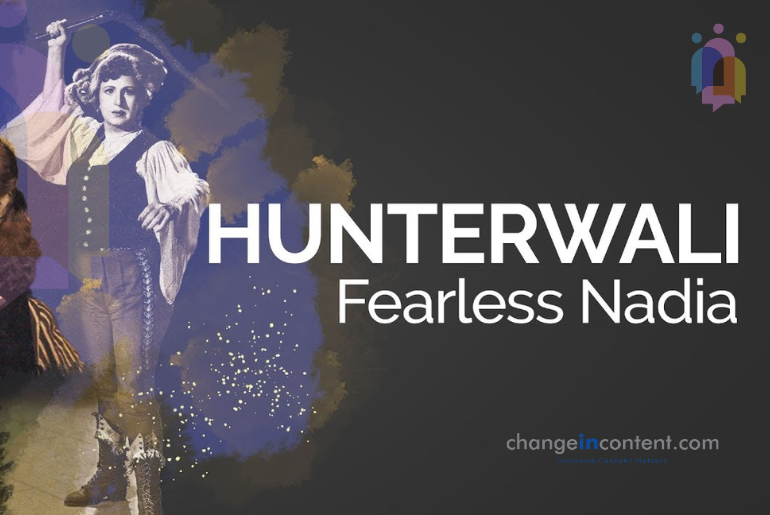
Back in the earlier days, especially until the late ’80s and ’90s, being a Bollywood’ heroine’ meant playing the perfect submissive woman or the damsel in distress, suffering in silence. Action movies loved to recycle the plot of the hero saving a woman or avenging her, often after the rape or attempted rape. Women were merely there to give the hero a reason to wear his shining armour and play the saviour. Fearless Nadia wasn’t just a heroine or a damsel in distress. She became the hero herself, showing that a woman could be the symbol of courage and empowerment in Indian cinema.
Becoming Nadia
Born in Australia, Mary Ann Evans, later known as Nadia, might have seemed out of place in the conservative 1930s Hindi cinema with her fair skin and blue eyes. Yet, she became an iconic presence in Bollywood history. Mary’s family moved to India when she was five. As a young woman, she joined the Russian dancer Madame Astrova’s troupe. While with the troupe, she met an Armenian fortune teller who advised her to change her name to one beginning with the letter N. She chose Nadia because she liked the “exotic sound” of it.
In addition to dancing with the travelling troupe, Nadia took on various jobs, including secretary, theatre artist, and circus trapeze performer. She trained as a gymnast and impressed fans with graceful cartwheels and daring stunts.
The journey to Bollywood
After leaving the Zarco Circus, Nadia returned to full-time dancing to Bollywood songs. Noticed by cinema owner Eruch Kanga, he recommended her to J. B. H. Wadia and Homi Wadia of Wadia Movietone. Impressed by her looks and fearless attitude, they tested Nadia, asking her to learn Hindi and giving her minor roles in their upcoming films Desh Deepak and Noor-e-Yaman. However, Nadia didn’t look convincingly Indian, and her name seemed too unusual for a Hindi movie star.
Nadia refused to change her appearance and name. She refused to wear a black wig with long plaits, explaining, “I am a white woman, and I’ll look foolish with long black hair.” She also declined to change her name to “Nanda Devi,” stating, “That’s not part of my contract. Nadia rhymes with Wadia, and besides… I’m no Devi.“
From Nadia to Fearless Nadia
Nadia was only on screen for three minutes, yet the audience well received her portrayal of a slave girl in Desh Deepak. The turning point in Nadia’s career arrived in 1935 when the Wadias decided to cast her as the lead in “Hunterwali.” Inspired by Douglas Fairbanks’ Robin Hood, the film follows a princess’s dramatic quest to rescue her kidnapped father and restore his empire.
The movie focused on Nadia’s fearless stunts and became India’s highest-grossing film of the era. Her stunts earned her the title “fearless.” Homi Wadia famously dubbed her “Fearless Nadia” after she fearlessly jumped off a studio rooftop during a shoot.
For a long time, Wadia Movietone was known mainly for Hunterwali, primarily due to Nadia’s daring stunts. For the film, she swung from a chandelier flawlessly during rehearsals but had a mishap in the final scene. She fell flat on her face from a great height. On another occasion, she narrowly avoided being swept away in the strong currents of Bhandardara Falls near Bombay. However, the main reason behind Nadia’s fame was her willingness to perform actions that were considered unconventional for women in Indian society at that time.
Nadia’s willingness to perform daring stunts, engage in physically demanding scenes, and portray roles traditionally reserved for male actors challenged societal expectations of women’s roles and behaviour. She was also renowned for performing her stunts without a body double, whether fighting on moving trains, jumping into waterfalls, mingling with lions, swinging from chandeliers, or taking on multiple men at once. Nothing was off limits for her.
Fearless Nadia: Bollywood’s first feminist icon
Nadia went on to become one of the highest-paid actresses in the Indian film industry during the 1930s and 1940s. She may have been the first foreigner to achieve cult status in Bollywood. However, despite her success, neither the press nor her peers saw her as a serious actor. This perception wasn’t just due to her Western appearance but also because Nadia emerged as a feminist icon. She boldly challenged male dominance with lines like: “Don’t think you can control today’s women. If the nation is to be free, women must be liberated first.“
Fearless Nadia’s roles in the stunt genre often conveyed messages of women’s rights and freedom. Her stunt roles may also have kicked off a storyline that celebrated the diversity of women’s bodies. Back then, most actresses were expected to fit a specific beauty mould: slim and fragile, often playing roles where they needed rescuing by male heroes. In Hunterwali and her many later roles, Nadia never played the typical dreamy, ladylike character. With her noticeably larger body compared to what was expected of Indian heroines at the time, she completely reversed this standard.
The final thoughts
Nadia’s impact went beyond entertainment, highlighting social issues through the power of cinema. In “The Diamond Queen,” Nadia takes down the villains trying to disrupt an education program that supports child labour in the diamond mine. She then lectures them on women’s rights, feminism, and literacy programs right after giving them a good beating. It’s a mix of action and humour, delivered with an impactful message.
Today, what remains of the Fearless Nadia film series and her “Hunterwali” character is the simple image of a daring woman in a mask on horseback. While Nadia’s legacy is often forgotten in the Indian film industry, her works are remembered in cultural memory. Cinema experts worldwide cherish and study her work. These also include those at the UK’s School of Oriental and African Studies.
Disclaimer: The views expressed in this article are based on the writer’s insights, supported by data and resources available both online and offline, as applicable. Changeincontent.com is committed to promoting inclusivity across all forms of content, which we broadly define as media, policies, law, and history—encompassing all elements that influence the lives of women and gender-queer individuals. Our goal is to promote understanding and advocate for comprehensive inclusivity.
