
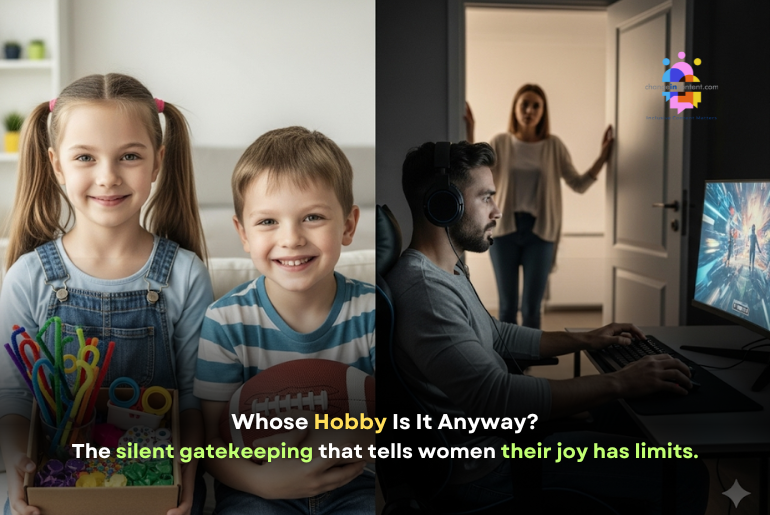
The issue of Gendered Hobbies runs deeper than free time. Even when women do have space for leisure, cultural norms often dictate which hobbies are “acceptable.” From childhood, girls are nudged toward crafts, dance, or domestic activities, while boys are encouraged to climb, compete, and create. That isn’t preference — it’s conditioning.
Understanding Gendered Hobbies
In one of our earlier pieces, we examined how the gender gap in leisure time deprives many women of the opportunity to pursue their hobbies. Unpaid care work, domestic chores, and childcare consume hours that could have been spent on activities like painting, yoga, or simply reading a book.
The lack of a support system at home forces women to take on more unpaid work, leaving little room for activities that bring personal joy. However, lost time is only part of the problem. There are also strong gendered expectations about what hobbies women are “allowed” to have, influenced by cultural norms and social approval.
Are women’s hobbies a choice or a result of conditioning?
Whether you have noticed it or not, certain hobbies have been stereotypically associated with either femininity or masculinity. From childhood, your choice of hobbies comes in two baskets: “girl things” and “boy things.” Football is clearly for boys. Gardening or baking is seen as a gentle pastime for girls. Any sport, craft, or pursuit considered physically demanding, risky, or competitive, such as weightlifting, rock climbing, or even carpentry, was often viewed as unsuitable for women.
All activities traditionally associated with men were called “too intense” or “too serious” for women, subtly implying that women should stick to gentler, decorative, or domestic hobbies instead.
Craft or creative hobbies are often stereotyped, almost dismissively, as “women’s work.” Girls receive drawing books and clay modelling kits, while boys are given car racing sets. While some men pursue creative hobbies, the majority hesitate, fearing it might damage their perceived masculinity. Even men who collect action figures get labels such as “nerd,” which is rarely meant as a compliment.
In 2009, researchers from the University of Iowa and the University of Illinois compiled a 27-page report based on studies dating back to the early 1900s. The report shows that men gravitated toward STEM-related pursuits, while women leaned toward people-centred activities. But do women genuinely prefer people-centred domestic activities, or have they been subtly guided through upbringing, media, and cultural norms to like what society deems appropriate for them?
Gendered hobbies: Is gender bias deciding hobbies early on?
In childhood, girls and boys gravitate toward gender-stereotypical toys. During adolescence, girls often take on service-oriented roles, while boys tend to prefer manual labour. Studies further reveal that men spend more time on physical activities than women, a pattern that extends into their adulthood hobbies.
Interestingly, parental preferences also play a significant role in a child’s decision to take up a hobby. In a research study comparing mothers’ and fathers’ interest ratings, activities rated higher by fathers, such as sports, building, hunting, fishing, watching television, social studies, mathematics, and science, were clearly identified as masculine. Activities that mothers favoured, such as dance, handicrafts, music, reading, writing, art, gardening, card games, walking, caring for pets, water activities, religious practices, and language arts, were feminine.
When one parent consistently values certain activities over others, it influences what children see as appropriate for their gender. As fathers show more enthusiasm for activities labelled as masculine, boys are encouraged, directly or indirectly, to align with those interests. Over time, children absorb these cues and internalise which hobbies are right for their gender, spreading the bias well into adolescence and adulthood.
Gaming, sports, and the ongoing gatekeeping of women
Now, take video gaming as an example, which is undoubtedly one of the most popular hobbies today. While 51% of women and 53% of men play games, the culture often makes it feel like women are visitors in men’s hobbies.
A 2025 survey of 1,000 women gamers in the UK reports that 41% look forward to gaming daily. At the same time, 29% feel guilty about it, and 16% even hide it to avoid judgment. Almost 60% believe they don’t play “enough” to call themselves gamers. Unfortunately, over 30% feel embarrassed to use the label at all.
Women still feel that the games and gaming culture are not intended for or open to them. As a result, women spend less time playing if they believe that gaming is a male pastime. This bias doesn’t stop at online gaming. Even in sports like football, cricket, or basketball, women often face the same gatekeeping.
The male hobbies and income generation
Many of these “male” hobbies can turn into serious income streams. Those who stream their gameplay on platforms like Twitch or YouTube can earn through viewer donations, monthly subscriptions, ad revenue, sponsorship deals, merchandise sales, and even affiliate marketing. However, for many women, entering this monetised space means facing online harassment and scepticism about their skills. Furthermore, it can lead to the constant expectation of proving their credibility in ways men are rarely required to.
Hobby gatekeeping does not merely limit access to recreational enjoyment. It also imposes a financial cost by excluding women from industries where leisure and income can coexist.
The final thoughts
What begins as “boys’ toys” and “girls’ toys” turns into a hierarchy of acceptable hobbies. It is a space where men are encouraged to explore, compete, and monetise their passions. At the same time, women are quietly steered toward gentler, less profitable pursuits. Normalise women’s participation in whatever hobby they choose. When a woman picks up a controller, watches a match, or streams content, it should not be treated as an exception or a novelty. Hobbies should reflect personal joy, not gender.
Changeincontent perspective
At Changeincontent, we see hobbies as more than pastimes; they are expressions of freedom, identity, and even economic opportunity. The reality of gendered hobbies reveals how subtle gatekeeping still keeps women away from lucrative and liberating pursuits. Normalising women in gaming, sports, or any so-called “male” space is not about breaking rules, but about reclaiming joy.
Also Read: Husbands in the kitchen: How Kerala’s textbooks are redefining gender roles.
Disclaimer: The views expressed in this article are based on the writer’s insights, supported by data and resources available both online and offline, as applicable. Changeincontent.com is committed to promoting inclusivity across all forms of content. We broadly define inclusivity as media, policies, law, and history. It encompasses all elements that influence the lives of women and marginalised individuals. Our goal is to promote understanding and advocate for comprehensive inclusivity.
