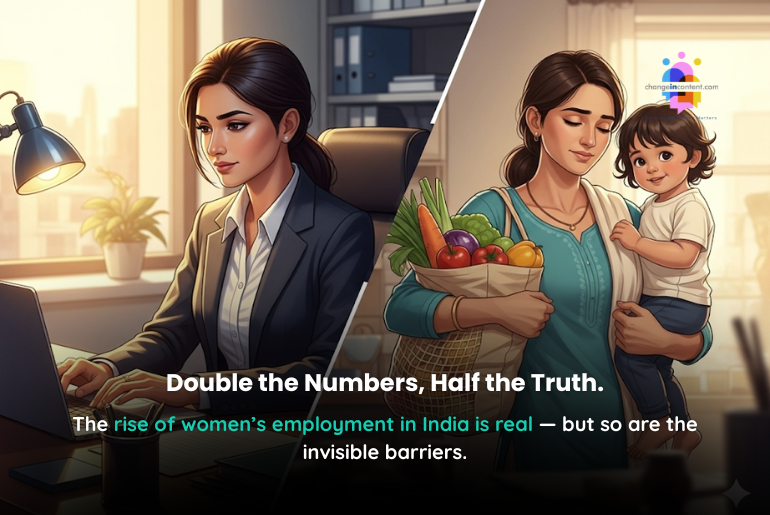
The rise in the women’s employment rate in India is being hailed as proof that the slogan ‘Nari Shakti Se Viksit Bharat’ is taking shape. But numbers alone never tell the whole story. Beneath the encouraging data lies a more complicated reality: where unpaid care work, marriage penalties, and persistent patriarchy continue to restrict how far women can go.
Women’s employment rate in India: Doubling in seven years
A few months back, on International Women’s Day, President Droupadi Murmu inaugurated a National Conference on the theme ‘Nari Shakti Se Viksit Bharat‘ in New Delhi. She highlighted that one of the key goals for achieving a developed India by 2047 is to ensure 70% women workforce participation in the country. President Murmu also stated that as India moves toward becoming the world’s third-largest economy by 2028, women in the workforce play a significantly larger role than one might imagine.
Encouragingly, it appears that we are making some progress towards Nari Shakti Se Viksit Bharat. The women’s employment rate in India has nearly doubled over the past seven years, reaching 40.3%, the labour ministry said on August 25, 2025.
Women’s workforce participation is on the rise
The Periodic Labour Force Survey (PLFS) reports that the women’s workforce participation rate rose from 22% in 2017–18 to 40.3% in 2023–24, while the unemployment rate declined from 5.6% to 3.2% in the same period. Moreover, the progress is most visible in rural areas, where women’s employment grew by 96%, compared to 43% growth in urban regions. It shows that economic empowerment is reaching women in marginalised and underserved areas.
More women are finding jobs that match their education. In 2013, approximately 42% of women graduates were employable, and by 2024, that number had risen to 47.53%. Women with postgraduate degrees or higher also saw a rise, from 34.5% in 2017–18 to 40% in 2023–24.
The India Skills Report 2025 says that by next year, 55% of Indian graduates will be ready for global jobs, up from 51.2% in 2024. EPFO payroll data indicate that 1.56 crore women have joined the formal workforce over the past seven years. Meanwhile, 16.69 crore women are registered with e-Shram, which links them to government welfare programs.
Government initiatives open doors for women entrepreneurs
The report also highlights that government programs have played a positive role in women-led economic progress. At the national level, 70 central government schemes, spanning 15 ministries, and over 400 state-level programs support women entrepreneurs. PLFS data show that women’s self-employment grew by 30%, increasing from 51.9% in 2017–18 to 67.4% in 2023–24.
Budget allocations for women-centric initiatives have also increased dramatically. Gender budgets increased 429% over the past decade, rising from ₹0.85 lakh crore in FY 2013–14 to ₹4.49 lakh crore in FY 2025–26.
The Startup India initiative has led to almost 50% of DPIIT-registered startups having at least one woman director in over 74,000 enterprises in total. Meanwhile, flagship schemes like Lakhpati Didi, Namo Drone Didi, and Deendayal Antyodaya Yojana – NRLM are providing training, resources, and income-generating opportunities for women across India.
Financial inclusion and entrepreneurial growth
Access to finance will always remain a necessity of women-led development. Under the PM Mudra Yojana, women received 68% of the total loans, amounting to ₹ 35.38 crore, worth ₹14.72 lakh crore. Similarly, under PM SVANidhi, which supports street vendors, 44% of beneficiaries are women, further boosting women’s self-employment and financial independence.
The Micro, Small, and Medium Enterprises (MSME) sector also shows favourable results. Women-owned proprietary establishments have grown from 17.4% in 2010–11 to 26.2% in 2023–24. Additionally, the number of women-led MSMEs nearly doubled during the same period, increasing from 1 crore to 1.92 crore. Between FY 2021 and FY 2023, these enterprises created over 89 lakh additional jobs for women.
Promising report, but barriers still remain
While the latest data looks promising, it doesn’t mean gender barriers have vanished. In a society as patriarchal as India, marriage continues to pose a significant challenge to women’s participation in the workforce. A recent World Bank study calls it the “marriage penalty,” since women’s employment drops by 12% points post-marriage, nearly one-third of what it was before, even when children are not a factor. However, men experience a 13-percentage-point “marriage premium,” meaning their chances of staying employed actually go up.
Then there’s the unpaid work trap. According to the Time Use Survey, women in India aged 15–59 spent an average of 315 minutes per day on unpaid domestic services in 2019, reducing slightly to 305 minutes in 2024. Moreover, 41% of women in this age group engage in caregiving for household members, compared to 21.4% of men.
Not to mention, women spend nearly twice as much time on caregiving tasks as men. On average, women dedicate 140 minutes daily, while men spend only 74 minutes per day. It shows that even when women join the workforce, they still carry most of the household responsibilities, leading to what’s often called double shifts. One at work and another at home.
Women’s employment rate in India: The final thoughts
More women are working, running businesses, and joining the formal economy than ever before. But imagine how much higher these numbers could climb if women didn’t have to shoulder such an unequal share of care work and household duties. Breaking these barriers is the next big step. Only then can India truly move from women’s development to women-led development and reach the goal of ‘Nari Shakti Se Viksit Bharat‘ by 2047.
Changeincontent perspective
At Changeincontent, we believe slogans must be tested against lived realities. The near doubling of the women’s employment rate in India is encouraging. Still, unless we tackle the unequal burden of domestic labour, marriage penalties, and systemic biases, women will remain undercounted and undervalued. Actual development must be women-led, not women-burdened.
Also Read: It is time to take Womenomics seriously: The future of global economies depends on it.
Disclaimer: The views expressed in this article are based on the writer’s insights, supported by data and resources available both online and offline, as applicable. Changeincontent.com is committed to promoting inclusivity across all forms of content. We broadly define inclusivity as media, policies, law, and history. It encompasses all elements that influence the lives of women and marginalised individuals. Our goal is to promote understanding and advocate for comprehensive inclusivity.