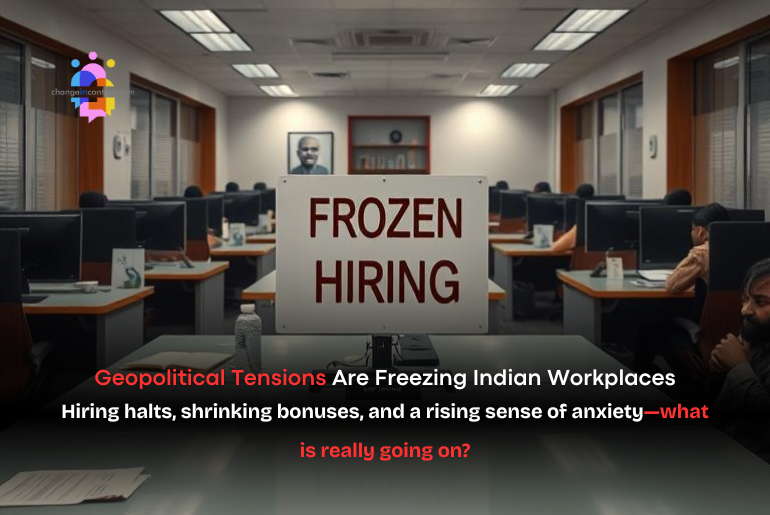
The war is not in India, but its tremors are being felt in our boardrooms, HR departments, and employee inboxes. Geopolitical tensions shake Indian workplaces like never before. According to a new survey by Genius Consultants, 63% of Indian companies have either frozen hiring or downsized due to escalating global geopolitical tensions, particularly conflicts in the Middle East.
This ripple effect goes beyond jobs—it is hitting morale, salary growth, team stability, and employee confidence. As the external world becomes more volatile, the internal world of work is beginning to feel less certain, less secure, and less supportive. This is not just a business story; it is a human story.
Geopolitical tensions shake Indian workplaces: Hiring freezes are just the beginning
The report, based on a survey of 2,006 employees across industries, confirms that over 60% of organisations are responding to geopolitical instability by putting recruitment on pause. Another 15% are leaning into contractual or freelance hiring, signalling a clear shift in employment norms.
While businesses respond to global risk, employees bear the brunt. They face uncertain futures, fewer opportunities, and fewer safety nets. This is not an isolated strategy. It is a structural reshaping of work.
Appraisals delayed, bonuses shrunk, pressure increased
The Genius Consultants report also highlights a drop in salary growth and bonuses for 36% of employees, while 21% reported a spike in workload and project delays. International travel is down, exposure to global projects is declining, and team morale is falling.
In short, the global economy may be recovering in pockets, but the mood inside many Indian offices is anything but optimistic.
Upskilling becomes the lifeline
Amid rising uncertainty, Indian professionals are not sitting idle.
- 55% of employees are upskilling or pursuing new certifications.
- 31% are actively exploring backup job roles or freelance opportunities.
This signals a dual movement: employers are retreating, but employees are evolving. The workforce is preparing not just for job loss, but for career reinvention. Skill development has become a survival strategy, not a growth plan.
However, the question remains: How long can individuals carry the burden of adaptation without systemic support?
Is this the new normal, or just a passing phase?
The macro outlook does not just affect C-suites or global supply chains. It is reshaping how junior executives, mid-level managers, and contract workers feel about their work, their value, and their future.
With 30% of employees saying they are ‘extremely worried’ and another 26% ‘mildly concerned’, it is evident that companies need to do more than tweak budgets—they need to offer clarity, transparency, and reassurance.
This is where Diversity, Equity, and Inclusion (DEI) must evolve. It cannot stop at representation or gender balance. In moments of geopolitical upheaval, true inclusion means being emotionally inclusive. It must acknowledge fear, fatigue, and anxiety among employees. Additionally, it must proactively create space for dialogue, support, and flexibility.
Conclusion: When geopolitical tensions shake Indian workplaces, equity must become the anchor
Geopolitical tensions may be sparked abroad, but their consequences are being absorbed right here, in Indian conference rooms, appraisal discussions, and family budgets.
This is not just about HR strategy or hiring charts. It is about the growing disconnect between employer decisions and employee realities. The Genius Consultants report does not just reflect a freeze in hiring; it reveals a freeze in hope, morale, and confidence.
If organisations are serious about resilience, they must first stabilise their people. In times like these, inclusion must be more than a metric—it must be a mindset.
For more on inclusive employment and overlooked labour sectors, read: This Environment Day, let’s ask: Where are women in green jobs?
Disclaimer: The views expressed in this article are based on the writer’s insights, supported by data and resources available both online and offline, as applicable. Changeincontent.com is committed to promoting inclusivity across all forms of content. We broadly define inclusivity as media, policies, law, and history, encompassing all elements that influence the lives of women and marginalised individuals. Our goal is to promote understanding and advocate for comprehensive inclusivity.