
The Quick Read
- The Global Employment Trends for Youth 2026 report says global youth unemployment rose to 12.4% in 2025. It represents about 67 million unemployed young people. The post-pandemic improvement recorded in 2023 has stalled.
- The global youth NEET rate (young people not in employment, education or training) increased from 19.7% in 2023 to 20% in 2025, adding 9 million people and taking the total above 257 million.
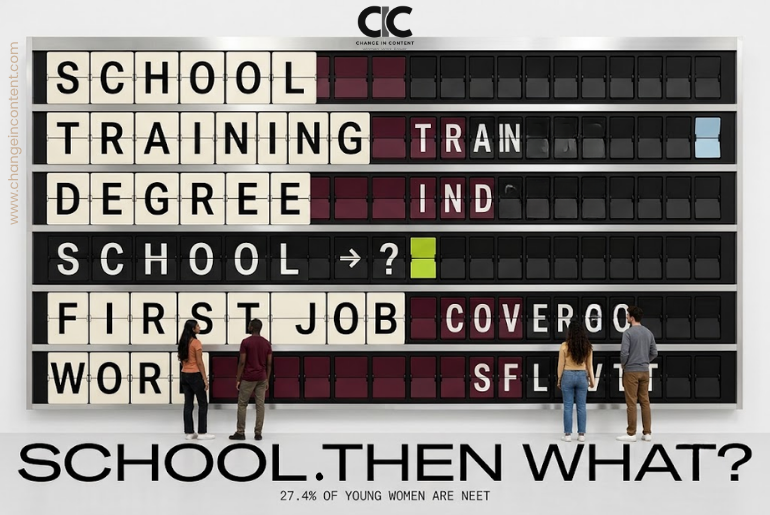
- More than two-thirds of young people in NEET status are women. The NEET rate among young women reached 27.4%, more than twice the 13.1% rate among young men.
- This gap can no longer be explained primarily by unequal access to education. The ILO finds young women and men are now close to parity in school and training participation globally. The employment gap is being driven largely by young women’s much higher inactivity.
- Southern Asia presents the widest gender divide: a young woman there was 3.5 times as likely as a young man to be NEET in 2025.
- The ILO points to unpaid care, childcare, discrimination, poor-quality jobs, and limited labour-market access, and explicitly calls for job-creation policies targeted at young women rather than relying on education and skilling alone.
The unemployment number is not where the women’s story is
The world entered 2026 with an uncomfortable reversal. For a short while after the pandemic, the employment outlook for young people appeared to be improving. Global youth unemployment fell to a more than two-decade low in 2023.
That progress has stopped.
The International Labour Organisation’s Global Employment Trends for Youth 2026 estimates that the unemployment rate among 15- to 24-year-olds rose from 12.3% in 2023 to 12.4% in 2025. Around 67 million young people were unemployed worldwide.
The deterioration reaches rich and developing economies alike. Youth unemployment rose in 8 of the 11 subregions examined by the ILO. There is a particularly sharp increase in Northern Africa and Northern America. In Northern America, it climbed from 8.3% to 9.8% between 2023 and 2025; Northern, Southern and Western Europe remained considerably higher at 15%.
That is the headline youth story.
For young women, though, another statistic reveals more. Their unemployment rate was 12.1% in 2025. Young men’s was 12.6%.
Young women appear to be doing slightly better. They aren’t.
You cannot be unemployed if the labour market has already lost you
Unemployment has a technical meaning.
To be counted as unemployed, someone must be available for work and actively looking for it.
A young woman who has stopped searching because childcare is unavailable, family responsibilities consume her day, jobs are inaccessible, or she has become discouraged does not necessarily appear in that unemployment number. She may instead be economically inactive.
And that distinction changes the entire picture.
The ILO reports that 257 million young people were not in employment, education or training in 2025, up by 9 million in just 2 years.
More than 2 out of every 3 were women.
The global female youth NEET rate stood at 27.4%. For young men: 13.1%.
The increase since 2023 was also larger for women: 0.5 percentage points compared with 0.2 points for men. So while the unemployment gender gap looks small, the disengagement gap is enormous.
That is the first important finding buried inside the report.
Girls reached the classroom. The labour market did not complete the journey.
For decades, one explanation for women’s weaker economic participation was straightforward. Girls received less education. That explanation is becoming harder to use.
The ILO estimates that roughly 42% of young women and 43.6% of young men are now in school or training globally. In other words, the world is approaching gender parity in getting young people educated.
Yet the employment-to-population ratio tells a very different story. In 2025, 43.3% of young men were employed. Only 30.6% of young women were. That leaves a gap of 12.7 percentage points.
The ILO reaches a significant conclusion from these numbers: the employment gap is no longer explained by women’s lower participation in education. It is explained by women’s much higher likelihood of entering NEET status.
That is where the policy conversation needs to move.
The world has made considerable progress on: girl → school
It has much more work to do on: school → first job → sustained employment
Change in Content recently found a related problem in India’s skilling system. Our analysis of women in formal jobs showed how education and skills can fail to translate into durable employment when transport, care, location, hiring practices, and weak employer connections intervene.
The ILO’s global evidence now places that transition problem in a much wider frame.
Southern Asia should make policymakers particularly uncomfortable
The regional differences are substantial.
Youth NEET rates exceeded 30% in both the Arab States and Northern Africa in 2025. Southern Asia’s overall rate was 25.8%. But gender magnifies the Southern Asian story.
The ILO finds that a young woman in Southern Asia was 3.5 times as likely as a young man to be outside employment, education or training in 2025. That is the widest gender ratio among the regions examined. It is also occurring in a region containing one of the world’s largest youth populations.
For Change in Content, this matters because India’s recent labour numbers have produced an encouraging macro story. Women’s labour-force participation has been climbing. Our analysis of the rise in women’s labour force participation in India showed the female LFPR reaching 40% under the PLFS usual-status measure in 2025.
Both facts can coexist. More Indian women can be entering work while an enormous regional pool of young women still struggles to make the transition into employment.
Progress does not cancel the remaining gap. It tells us where the next policy effort belongs.
And the report points directly at care
One section of the ILO report is unusually blunt.
More than 9 in 10 young women who are NEET are inactive rather than unemployed. That is 90%. And it deserves more attention. The report associates this with factors including childcare responsibilities, limited availability of affordable childcare and precarious employment opportunities.
Then it provides a striking example from Latin America.
Among young people in NEET status, young women were found to spend 40 to 75 hours every week on unpaid domestic and care work. Young men: Only 9 to 16 hours.
The presence of a child aged 5 or younger sharply increased the likelihood that unpaid domestic and care work became the young woman’s primary activity.
40 to 75 hours is not a small constraint surrounding employment. It is another working week. Sometimes considerably more than one.
That changes how we should understand a woman described as “inactive”.
She may be outside paid employment. Her day may be anything but inactive.
NEET can hide economic activity the market does not price
That is why the terminology requires care.
Not in employment. Not in education. And not in training.
The category says what a young woman is not doing. It often tells us remarkably little about what she is doing.
- Looking after a baby.
- Cooking.
- Cleaning.
- Supporting siblings.
- Caring for an older relative.
- Working informally in a family enterprise without recognition.
- Managing a household.
- Waiting for a job her family considers safe enough.
- Preparing to marry or moving after marriage.
- Trying to return after childbirth.
Some of these women want paid work. Some may not currently seek it. Their circumstances will differ significantly.
Good policy, therefore, cannot simply look at the NEET number and conclude, “Train them.”
Many of these women have already been educated. The report itself shows that. The intervention has to correspond with the reason she is outside the labour market.
This is where our recent “stay in work” argument becomes relevant
In our Knowledge Hub guide on helping women to stay in work, we argued that training programmes frequently concentrate on entry while paying less attention to the factors that determine continuity.
The ILO’s youth findings strengthen that argument from an earlier career stage.
- If the constraint is care, the solution may be childcare.
- If the constraint is transport, the solution may be mobility.
- If jobs are too insecure or badly paid, another short course may achieve surprisingly little.
- If hiring discriminates against young women, employers need to change recruitment.
- If a woman has a young child, working hours and care provision become labour-market policy.
- If she completed tertiary education but there are too few appropriate jobs, the problem sits on the demand side of the economy.
The young woman does not necessarily need another intervention performed on her. Sometimes the labour market needs the intervention.
The ILO says that explicitly: Create jobs for young women
One of the strongest sections in the report appears in a policy box whose title deserves attention: “Demand-side interventions should target directly (and with urgency) the creation of jobs for young women.”
The ILO describes young women as facing a double disadvantage: young enough to encounter the general problems of first-time labour-market entry, and female enough to encounter the additional gender barriers layered on top.
Its recommendations include:
- identifying sectors capable of creating better-paying jobs for young women;
- improving conditions and career progression in sectors where young women already work;
- encouraging women’s participation in STEM;
- removing discriminatory recruitment practices and gender bias;
- strengthening equal-pay measures and gender-sensitive social protection;
- and expanding access to affordable childcare.
The ordering matters.
Job creation appears alongside skilling. For years, youth-employment conversations have placed heavy emphasis on employability: make young people more job-ready.
The 2026 report raises the opposite problem too. Are economies ready to employ them?
The first-job problem is becoming tougher for everyone
This is not exclusively a women’s story.
The global labour market itself has become harder for young entrants.
The ILO identifies 18 countries where unemployment among 20- to 24-year-olds is now at a decade-long high, excluding the pandemic period. They include Canada, the United States, the United Kingdom, Sweden, Austria, Denmark, South Africa, Sri Lanka and others.
Southern Asia has another striking statistic. Nearly 80% of unemployed 20- to 29-year-olds in the region were first-time jobseekers in the latest available period, compared with 64.8% roughly a decade earlier.
For a young woman, that difficult first-job market can be compounded by another set of filters.
Safe location. Acceptable hours. Family expectations. Care. Transport. Hiring bias. Appropriate pay.
The first rung of the career ladder may therefore be farther away even before questions of promotion begin.
Education is also losing some of its insurance value
A degree still matters. But it does not automatically protect young people from unemployment.
The ILO finds that in many developing regions, youth unemployment actually rises with educational attainment, partly because economies cannot generate enough jobs suited to the qualifications young people acquire.
In Southern Asia, for example, unemployment among people aged 15–29 with tertiary education was 15.5% in the latest data used by the report, compared with 6.4% among those with secondary education and 3% among those with basic education.
We should not misread that as evidence that education is harmful.
Young people with less education in poorer economies frequently cannot afford unemployment. They accept whatever work is available, including informal and low-paid work. The statistic instead exposes a mismatch.
Education can increase aspirations and skills faster than an economy creates suitable jobs.
For young women, that creates a particularly frustrating outcome. A society can successfully educate its daughters and then fail to make productive use of their education.
Getting a job is only half the problem
Even among young people who work, the quality of employment remains deeply unequal across countries.
The report estimates that roughly 50.8% of workers aged 15–29 across countries with available data were informally employed in 2025 or the nearest year. In low- and lower-middle-income countries, the average was 85.6%.
Among young wage and salaried employees in those economies, 77.5% still held informal jobs.
Another measure shows that 66.1% of young adults aged 25–29 in low- and lower-middle-income economies were working in what the ILO classifies as insecure forms of employment.
So “employed” is not necessarily the happy ending.
The job may have:
- no durable contract;
- no paid leave;
- no meaningful social protection;
- unstable earnings;
- or no clear progression.
Our piece on women moving from unpaid family work into self-employment made a similar distinction in India: becoming economically visible is progress, but the next questions concern income, security, control and opportunity to grow.
Youth policy needs that same second layer.
There is one curious finding about young women and multiple jobs
The report also touches on the growth of multiple job holding.
A UK study cited by the ILO found that young women aged 16–29 were more likely to hold multiple jobs than older women or men, and that doing so was closely associated with low pay and insecure work.
That deserves attention as the language of “portfolio careers” and “side hustles” becomes fashionable.
- Sometimes several jobs represent freedom.
- Sometimes they represent ambition.
- Sometimes they mean one job no longer pays enough.
The labour-market statistic does not tell us which until we ask.
Then AI enters the first-job market
The report is appropriately cautious about artificial intelligence. It does not claim that AI has already caused mass youth unemployment. But it does identify a risk around the types of jobs young people traditionally use to enter the labour market.
The ILO estimates that 6.1% of jobs held by people aged 15–29 fall within occupational categories most exposed to AI. If only 10% of those exposed jobs disappeared completely, around 5.6 million young workers could have to change jobs, become unemployed or leave the labour force.
Middle-skilled occupations are already experiencing pressure. Clerical support. Administrative work. Service roles. Some technical and operational occupations. Many have traditionally served as first steps into employment.
There is an important caution for our analysis here. This report does not provide enough sex-disaggregated evidence to conclude that AI is currently destroying more young women’s jobs than young men’s globally.
We should not manufacture that conclusion. But we can ask a legitimate forward-looking question.
If young women already struggle more to make the transition from education into employment, what happens when some of the easiest entry points into formal work also become harder to find?
That is worth watching closely, particularly because women remain underrepresented in many of the higher-growth AI and technical roles. Our recent analysis of women and the AI jobs boom examined precisely that opportunity gap.
Yet there is good news hiding in the occupational data
Not every technology story is about disappearance.
The ILO finds continued employment growth for young people in knowledge-intensive technical occupations, including science, engineering, health and information and communication technologies.
In low- and lower-middle-income countries, youth employment in these occupations grew by 11.7% between 2023 and 2025 in the countries covered.
That is where women’s policy should become opportunity-led.
Do not only protect young women from disappearing jobs. Help them enter the growing ones. STEM education. Technical apprenticeships. AI capability. Healthcare. Engineering. Digital infrastructure. Green industries.
And make sure recruitment, workplace design and progression allow women to remain once they arrive.
The employment transition can be redesigned from both ends.
2027 does not promise an automatic correction
The ILO’s forecasts are subdued.
Global youth unemployment is projected to remain around 12.3% through 2027.
The global youth NEET rate is expected to edge upwards to 20.2%, with the number of NEET young people climbing from 257.1 million in 2025 to 264.5 million in 2027.
The report projects no improvement in youth NEET rates in any subregion.
Southern Asia is expected to move from 25.8% to 26.1%.
That means waiting for economic growth alone to solve the problem would be optimistic.
The gender gap has already proved remarkably persistent.
What employers should take from a global youth report
An ILO report naturally speaks mostly to governments and labour-market institutions. Companies should read it too. Young women do not enter employment in a vacuum.
Employers decide:
- which entry-level roles exist;
- whether “experience” is demanded for supposedly junior jobs;
- which degrees count;
- how apprenticeships work;
- whether career progression begins in low-paid female-dominated roles;
- whether shifts are usable;
- whether childcare support exists;
- whether discrimination survives inside recruitment;
- and whether new technology eliminates entry-level work without creating another route into the organisation.
It is especially important as businesses automate routine junior tasks.
Efficiency at the bottom of the organisation can create a pipeline problem later.
If AI performs the work that graduates once learned, where will the next experienced employee gain experience?
That question affects all young people.
A labour market already losing a larger share of young women should ask it with gender in mind.
The Change: We solved one part of the girls’ education story
For years, the global development question was whether girls would reach school. Millions more did.
Would they stay? Increasingly, yes.
Would they reach secondary education? University? Professional training? Progress continues.
Then comes the question we have not solved nearly as well: What happens next?
The Global Employment Trends for Youth 2026 report gives us a revealing answer.
Young women and men are now almost equally represented in education. They are nowhere near equally represented in employment. More than a quarter of young women globally sit outside employment, education and training. More than two-thirds of all NEET youth are female. And in Southern Asia, young women’s likelihood of being NEET is 3.5 times that of young men.
That is no longer primarily an education-access problem. It is:
- A transition problem.
- A care problem.
- A job-creation problem.
- A discrimination problem.
- A first-job problem.
- A workplace-design problem.
- And sometimes a social-norm problem.
Girls were told to study. They did.
The next promise has to become more credible: There will be somewhere meaningful for that education to go.
Editorial Note
This DEI Insights analysis is based on the International Labour Organisation’s Global Employment Trends for Youth 2026: Back to the Future. The report generally defines youth as people aged 15–24, although some sections expand the range to 15–29 or 20–29 to analyse labour-market entry and young adults in employment. Its latest global estimates predominantly refer to 2025, with projections through 2027. NEET means not in employment, education or training; it should not be treated as synonymous with unemployment. This Change in Content article separately analyses the gender dimensions of the report and does not imply that every global youth finding affects women and men identically. The ILO describes the report as an assessment of current labour-market vulnerabilities and policies needed to restore pathways towards decent work.
Source
International Labour Organisation — Global Employment Trends for Youth 2026: Back to the Future: The full report examines unemployment, NEET status, employment quality, AI, first-time labour-market entry and policy responses.
