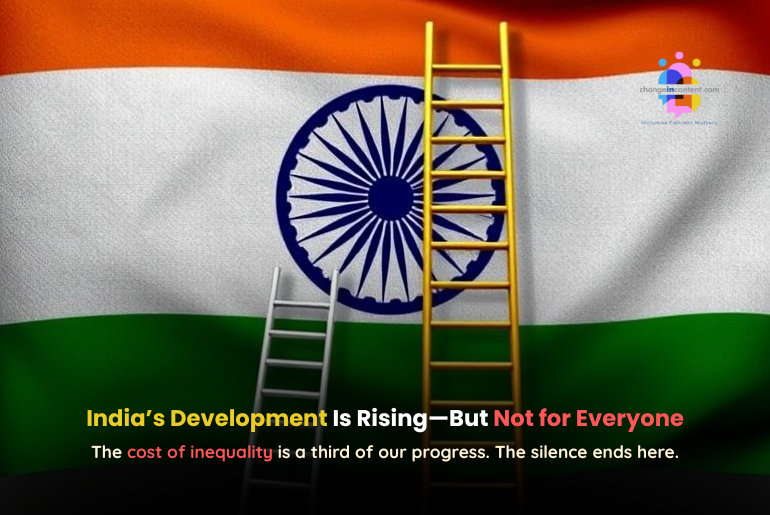
India’s rise in the Human Development Index (HDI) from 133 to 130 this year should have been cause for celebration. Yet, a closer look reveals a sobering truth: inequality still casts a long shadow over every metric of progress. According to the 2025 Human Development Report by UNDP, while India’s HDI has improved steadily over the years, persistent income and gender disparities continue to erode the country’s gains.
The numbers are frustrating. India’s HDI has grown by 53% since 1990, outperforming both global and South Asian averages. Life expectancy has risen to a record 72 years. Education indicators and income per capita have improved. Yet, inequality reduces India’s HDI by over 30.7%, one of the steepest drops seen in any South Asian nation. What should be a success story ends up feeling incomplete, like a glass half full and rapidly evaporating.
How does a country with a billion-strong workforce, soaring AI potential, and declining poverty still struggle to treat its women fairly and distribute wealth evenly? This article does not just present facts. It asks difficult questions. These are questions that must shape every future policy conversation around human development in India.
The progress that masks the pain
India’s HDI score has increased from 0.676 in 2022 to 0.685 in 2023, and the country is inching closer to the “high human development” category (≥0.700). Life expectancy is now at 72 years, the highest it has ever been. The mean years of schooling have gone up from 6.57 to 6.88. National income per capita has increased from $8475 to $9046.
These are not small wins. They reflect government interventions like the Right to Education Act, Ayushman Bharat, and the MGNREGA scheme. But behind this apparent upward trajectory lies a systemic failure to close the gap between groups. This failure raises hard questions about what kind of development we are truly pursuing.
Income inequality: The metric that drains progress
The most alarming figure in the report is this: inequality trims India’s HDI value by 30.7%. It means that nearly one-third of our developmental progress is wiped out by the uneven distribution of benefits. For comparison, most countries with similar or lower HDI scores have far fewer inequality losses.
Even as national income rises, the benefits of this growth remain skewed. India’s latest consumption survey shows a paradox. It shows that the rich are spending less while the poor are spending more. Income mobility is limited. Wealth concentration is rising. And digital inclusion, while improving, remains urban-centric.
Economic machinery may work harder than ever, but it does not work for everyone.
Gender disparities: A crisis still ignored
India’s female labour force participation remains one of the lowest in the world. Political representation is improving only now with the reservation bill, and gender pay gaps continue across sectors. Despite being half the population, women remain underrepresented in every space of power and productivity.
The UNDP report underscores that gender inequality is a critical reason why India hasn’t broken into the high HDI category yet. Even among women who are working, many are part of the informal sector with no social security or labour rights. The rise in women’s education hasn’t translated into proportional workforce entry.
Without systemic reforms, like affordable childcare, workplace safety, and career re-entry programs, India’s demographic dividend will continue to leave women behind.
Global context: India is not alone, but must lead
The 2025 report calls out a global slowdown in human development. The world is now witnessing the slowest pace of progress in the last 35 years, primarily due to the pandemic’s lingering effects, geopolitical instability, and rising inequality.
But India, with its youth population, AI readiness, and policy momentum, is uniquely placed to lead the world out of this stagnation. However, it is only possible if India addresses its internal disparities first.
Fixing income and gender disparities in India must come first
India’s development story is not just about ranking higher or ticking boxes on global indices. It is about ensuring that progress is not reserved for a few. It is about closing the gender wage gap, creating formal employment for all, and distributing resources fairly. Every step forward loses meaning if we keep dragging the weight of inequality behind us.
For India to become a truly developed nation, we must stop measuring progress in averages and start fixing what the averages hide. Income and gender disparities in India are not side issues; they are the issue.
At Changeincontent, we believe policies must begin by asking who gets left behind. Read our article on the New Labour Code 2025 and how inclusive reforms can change this trajectory: Read here.
Disclaimer: The views expressed in this article are based on the writer’s insights, supported by data and resources available both online and offline, as applicable. Changeincontent.com is committed to promoting inclusivity across all forms of content. We broadly define inclusivity as media, policies, law, and history, encompassing all elements that influence the lives of women and marginalised individuals. Our goal is to promote understanding and advocate for comprehensive inclusivity.