For a nation that often promises empowerment in speeches and headlines, India’s ₹4.49 lakh crore Gender Budget allocation for FY 2025–26 stands as a rare fiscal testament. Now, the government has added a new digital layer in the form of a national portal dedicated to Gender Budgeting. But the question lingers: Will better access to data lead to better outcomes?
Launched by the Ministry of Women and Child Development, the ‘Gender Budgeting Knowledge Hub’ is envisioned as a centralised digital repository. It will house tools, policy briefs, and gender-disaggregated data to help bureaucrats, researchers, and ministries integrate a gender lens into every stage of budgeting and planning. It is a necessary step, no doubt. But in a country where intent rarely translates into impact for its women, can a portal really bridge the gaps?
From budget line items to a governance mindset
Gender Budgeting in India is not new. It has been part of the nation’s fiscal framework since 2005–06. But for most of its journey, it remained limited to an annexure in the Union Budget. It was treated as an accounting formality rather than a governance imperative.
What the government seems to be signalling now is a transition, from a fiscal tag to a full-fledged strategic tool. Union Minister Annapurna Devi said it clearly: “Gender budgeting is not just a policy tool; it is our collective commitment to ensuring that every rupee spent carries the promise of equity, dignity, and opportunity for all.”
That rhetorical shift, backed by a significant allocation and a digitised platform, is meaningful. But will it reach the grassroots?
The gender budgeting portal: Promise or performance?
The newly launched portal, the ‘Gender Budgeting Knowledge Hub’, is aimed at government departments, researchers, and civil society organisations. It will include:
- Best practices from states and ministries
- Gender-disaggregated data
- Policy briefs and planning frameworks
- A newly drafted training manual on Gender Budgeting
But a portal, however ambitious, is only as powerful as the users behind it. Without widespread training, inter-ministerial cooperation, and State-level ownership, it risks becoming another digital archive that gathers bureaucratic dust.
₹4.49 Lakh Crore: But where does it go?
The Gender Budget allocation for 2025–26 is up 37% from last year, reaching ₹4.49 lakh crore. It is a massive jump from ₹0.98 lakh crore in 2014–15. On paper, it signals political will. But where is this money actually going?
Is it reaching self-help groups in rural Jharkhand? Or is it improving digital access for girls in Bihar? Is it strengthening infrastructure for working mothers in informal sectors? The portal cannot answer these questions; only grassroots audits can.
And that is the larger problem: gender budgeting often looks progressive on spreadsheets but falters in delivery on the streets.
The consultation that should have happened years ago
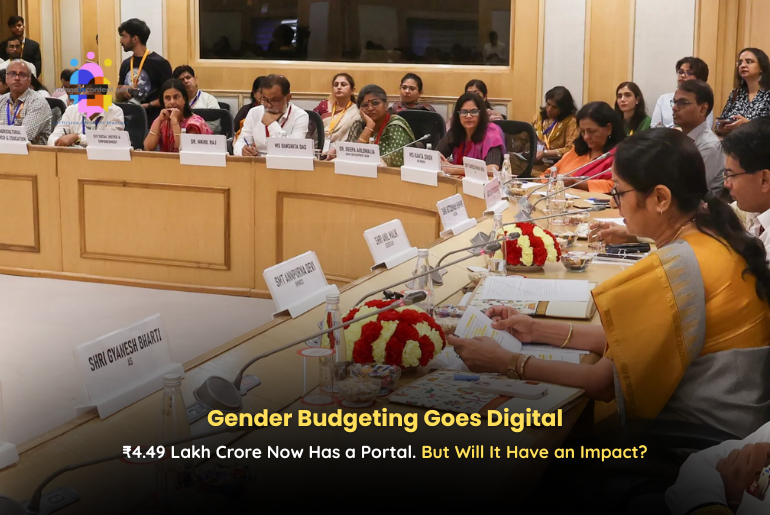
The government’s National Consultation on Gender Budgeting, held alongside the portal launch, saw participation from 40 central ministries, 19 states, UN Women, ADB, and policy think tanks. While it is a positive start, one wonders why it took two decades for such a consultation to happen at scale.
Shouldn’t inter-sectoral planning for gender equity have become routine by now?
The launch of a digital knowledge hub and a training manual shows intent. However, the lack of regular public reviews, citizen scorecards, or third-party evaluations reflects the gap between institutional knowledge and urgency in implementation.
Conclusion: Gender budgeting must leave the portal
The ₹4.49 lakh crore Gender Budget is impressive. The new knowledge hub is promising. The intent is well-worded. However, none of this guarantees results for India’s women unless data translates into decisions and funds meet the real lives they were meant to serve.
True gender budgeting is not about announcements. It is about outcomes. It is about asking: who benefits, who is left behind, and what needs to change?
To read our breakdown of Budget promises for women this year, check out: The Union Budget 2025: Big promises for women, but will progress remain slow?
Disclaimer: The views expressed in this article are based on the writer’s insights, supported by data and resources available both online and offline, as applicable. Changeincontent.com is committed to promoting inclusivity across all forms of content. We broadly define inclusivity as media, policies, law, and history, encompassing all elements that influence the lives of women and marginalised individuals. Our goal is to promote understanding and advocate for comprehensive inclusivity.