
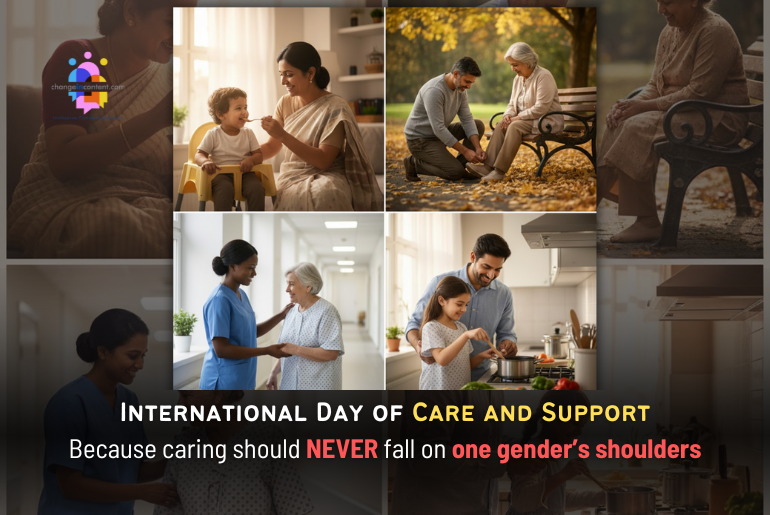
iOctober 29 marks the International Day of Care and Support. It is a reminder that behind every healthy family, growing child, and functioning community lies unseen labour: Care Work.
International day of care and support: The introduction
In 2023, the United Nations General Assembly declared October 29 as the International Day of Care and Support. The day highlights the importance of the care economy and the need to value both paid and unpaid care work.
Care work is one of the most essential yet overlooked parts of daily life. Millions of people, mostly women, spend their time caring for children, the elderly, people with disabilities, and others who need help. Despite its importance, this work often goes unrecognised and underpaid.
The 2025 theme, “Care and Support for All – Addressing All Rights-Holders, Including Those Providing and Receiving Care and Support,” focuses on building a fair system that supports both caregivers and those who receive care. It encourages countries to invest in better social protection, working conditions, and public services for care workers.
Earlier in March 2025, the UN Commission on the Status of Women (CSW) also emphasised this issue. The CWC decided that the priority theme for CSW72 in 2028 will be “Recognising and Strengthening Care and Support Systems to Achieve Gender Equality and the Empowerment of All Women and Girls.“ It shows a growing global commitment to make care and support a shared responsibility between governments, employers, and families alike.
What is care work?
Care work includes both direct and indirect forms of care tasks. Direct care involves looking after children, the elderly, or people with physical or mental illnesses and disabilities. Indirect care includes daily household tasks such as cooking, cleaning, and washing, the essential work that keeps families and communities running.
Care work can be paid or unpaid. Paid care work includes jobs such as domestic work, teaching, and nursing. Unpaid care work happens at home or within communities, where family members, often women, take on these responsibilities without financial reward.
The work that keeps the world running
This kind of work, sometimes called domestic or reproductive labour, supports others’ physical, emotional, and social needs. Yet, the society severely undervalues it.
The care economy covers all activities related to providing care and support, from childcare and eldercare to education and healthcare. It meets vital material and emotional needs but remains largely invisible in traditional economic systems, creating what many call a “hidden care economy.”
Unlike the monetised economy, where goods and services are exchanged for money, the care economy relies heavily on unpaid labour. Women and girls mostly do this unpaid labour. Because of long-standing gender roles, they continue to carry the greatest share of this work, often without recognition or support.
Why is care work still seen as a woman’s issue?
Most women, or maybe every woman, grew up hearing that caring is “women’s work.” The society tells women that looking after others comes naturally to them and that women are born to care. But is that really true? Or have they just been taught to believe it?
For generations, society has expected women to care for children, the elderly, and the home, while men go out to earn. These roles have been repeated for so long that they seem normal. But they are not natural. They are patriarchal beliefs passed down in the name of gender roles. This belief has made care work seem like a woman’s duty rather than everyone’s responsibility.
The global gender gap in care work
According to the International Labour Organisation (ILO), about 748 million people aged 15 and older are outside the labour force because of unpaid care responsibilities. Of these, 708 million are women, while only 40 million are men. This means that nearly 95% of those unable to work due to care duties are women.
The burden of unpaid care work is one of the biggest reasons women remain excluded from the global labour market. It limits their access to education, income, and financial independence.
The Indian reality
The Time Use Surveys by the Ministry of Statistics and Programme Implementation reveal how deeply unequal unpaid work still is in India. In 2019, about 109.8 million women and 47.3 million men in urban areas were involved in unpaid care work. At the same time, In rural areas, the numbers were even higher: 265.8 million women and 121.7 million men were engaged in the same.
In 2019, women spent an average of 299 minutes a day on unpaid domestic work, while men spent only 97 minutes. By 2024, the pattern remained much the same. Women spent about 289 minutes per day on unpaid household work, while men spent only 88. Women’s average unpaid caregiving time increased slightly from 134 to 137 minutes, while men’s dropped from 76 to 75 minutes.
Women’s participation in unpaid domestic work rose from 81.2% in 2019 to 83.9% in 2024. Men’s participation, although improving, reached only 45.8%. When it came to caregiving, 41% of women and just 21.4% of men were involved in 2024. Even with minor changes, women continue to do most of the unpaid work, both in cities and in villages.
How time is spent
The 2024 data also show apparent differences in how men and women spend their time each day. Men spend about 19.9% of their day on paid work, while women spend only 4.9%. For unpaid household tasks, women spend 16.4% of their time, and men spend just 1.7%. Women also spend more time on unpaid caregiving, around 3.3% compared to 0.9% for men.
When it comes to education, men spend about 6.5% of their time learning, while women spend 5.8%. Social activities are almost the same, with women spending 8.8% and men 8.6%. However, men spend more time on leisure and hobbies (about 11.7%) while women spend only 10.3%. This shows that while men have more time for paid work and relaxation, women continue to spend much of their day managing unpaid responsibilities.
Do women really have a choice?
Most surveys today only measure how much time women spend on care work, not why they do so in the first place. The data tells us how long women cook, clean, or care for others, but not why they are the ones doing it.
It rarely explores whether women take up these roles by choice or because they have no real alternative. Many are pushed into unpaid care due to family expectations, a lack of affordable childcare, or limited flexible job options. In most homes, if someone has to step back from paid work to care for children or the elderly, it is almost always the woman.
These surveys often ignore the social pressure behind unpaid care work. In many families, people still believe that a good woman must always put her family first, while men should focus on earning. From childhood, girls are taught to cook, clean, and care for others, while boys are told their main job is to provide. Society praises women who give up their own time or dreams for family, but when men help, it is seen as a favour or sacrifice, not a duty.
So, while knowing how many hours women spend on unpaid work is useful, it is not enough on its own. We also need to understand why women do it, what limits their choices, and how it affects their lives. Without that, the actual cost of care work (and the inequality behind it) remains hidden.
International Day of Care and Support: The closing thoughts
When care work is seen only as a woman’s job, it becomes invisible. Families, societies, and even economies depend on it, yet it is rarely counted or valued. The truth is, care work supports everyone. It is time to see it as a shared duty between men and women, families and the state. Only when care work is recognised, reduced, and fairly distributed can true equality begin to take shape.
Changeincontent perspective
At Changeincontent, we believe the accurate measure of equality lies not in what women can do, but in what society shares.
For generations, women have carried the invisible weight of care — unpaid, unrecognised, and unquestioned. Yet, the problem is not that women care too much. It is that men, systems, and economies care too little.
The International Day of Care and Support should remind us that equality is not achieved when women learn to balance it all — but when the load itself is balanced.
Real empowerment begins when care work is counted, respected, and shared.
Also Read: The gender sleep gap: Are you getting enough sleep, women?
Disclaimer: The views expressed in this article are based on the writer’s insights, supported by data and resources available both online and offline, as applicable. Changeincontent.com is committed to promoting inclusivity across all forms of content. We broadly define inclusivity as media, policies, law, and history. It encompasses all elements that influence the lives of women and marginalised individuals. Our goal is to promote understanding and advocate for comprehensive inclusivity.
