
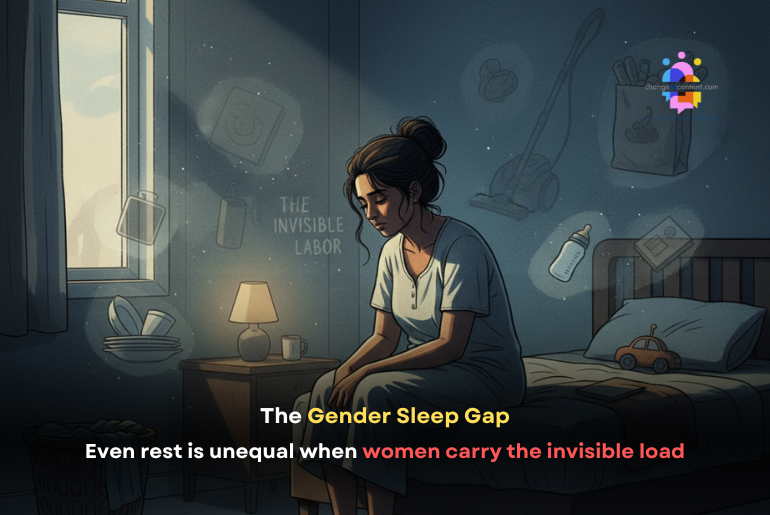
There has always been talk about the gender pay gap, the glass ceiling, or the unpaid labour women silently perform every day. Last time, we even broke down how hobbies aren’t the same story for men and women, whether it’s the time women have for them or the hobbies they can’t access while men can freely pursue them. Who would’ve thought? But what if I told you that inequality shows up in a place as ordinary, as universal, and as essential as sleep? Yes—The Gender Sleep Gap is real. Women consistently sleep less than men, and even when they manage to rest, it is often broken, delayed, or stolen by responsibilities no one else will claim.
From India to the U.S., from young professionals to ageing caregivers, women are running on less sleep while shouldering more. And the ripple effects go far beyond fatigue.
The gender sleep gap you never noticed
Time Use in India, 2024, a report by the Ministry of Statistics and Programme Implementation covering over 450,000 people, shows working women in India sleep about 10 minutes less per day than working men and get fewer continuous hours of sleep. On average, women sleep for under eight hours, while men sleep for roughly 20 minutes more.
Globally, adults need 7–9 hours of sleep, but fewer than half of Indian women in their 20s and 30s get enough uninterrupted sleep. Men fare slightly better, with over 60% of them across all age groups sleeping eight hours.
This isn’t just an Indian story. In the UK, a survey found women get three hours less sleep per week than men, with nearly half reporting constant sleep deprivation. Across seven survey rounds, researchers collected 57,141 observations on sleep loss and found that women are twice as likely as men to experience sleep loss. This meant that, for every man struggling with sleep, roughly two women reported the same issue. In the U.S., almost half of women (49%) sleep less than seven hours a night, compared to 41% of men, according to a February 2024 survey by SleepFoundation.org.
Women not only get slightly less total sleep, but their sleep is also less continuous and more delayed, which can affect how rested they feel. Women are more likely than men to experience sleep disruptions at night. Specifically, 33% of women wake up during the night, compared to 27% of men. Plus, 31% of women stay up late, while only 20% of men do the same.
Women sleep less, even when they need more.
Researchers sought to determine whether women actually require more sleep than men, or if the observed difference is primarily due to responsibilities such as work and family. They studied sleep patterns in men and women, from childhood to late adulthood, and compared the duration of sleep on weekdays versus weekends. They analysed data from 340 pairs of men and women.
The results show women often report needing more sleep than men, and when left to choose their own sleep schedules, they usually get it. When women are not bound by outside demands, such as work, school, or family schedules, they naturally give themselves more sleep. On weekends, women squeeze in a little more rest, going to bed earlier and waking up later. However, on weekdays, it changes. Work, school, and family leave little room for that extra rest.
Look around you for the gender sleep gap.
Honestly, you don’t need a detailed study to see this. Look around you. A new mom, a single mom, a mother of teens or college kids, even a grandmother, or a woman without children who still carries family responsibilities, her sleep is never just hers. She may catch an extra 15 minutes on a Sunday, but during the week, she’s the one who preps breakfast, packs lunches, and wakes up before everyone else.
The whole routine of the house depends on the woman. The day really starts only when she wakes up. She’s the one who turns on the lights, cooks, cleans, does laundry, and sets everything in motion. By the time the rest of the family’s alarm rings, she’s already finished a big chunk of her morning chores.
How household and care responsibilities cost women sleep
So, why are women sleeping less? There are actually several reasons, but the most common are household chores and caregiving. In Time Use in India, 2024, the report also included a section that asked participants what they did right before sleeping. Up to 18% of rural women and 16% of urban women cleaned the kitchen as their last activity of the day. Men don’t even come close to spending half as much time on domestic responsibilities.
Domestic work and care work add significant extra pressure on women. Approximately 12% of women wake up during the night to care for someone, which is twice as many as men. This constant responsibility affects their mental health. Women in this group are more likely than men to lose sleep, with 9% more due to worry about caregiving and 13% more due to household chores.
Work, Kids, Family. Repeat Forever
Women with children are three times more likely than women without children to lose sleep worrying about caregiving. They are also slightly more likely than men with children to lose sleep over these same responsibilities.
Did you know that during the lockdown, women were twice as likely as men to report losing “much more than usual” sleep? School-age kids at home were part of the reason. Suddenly, women had to balance paid work, endless childcare, and homeschooling all at once. The gendered allocation of childcare means that in most households, it is the mother who carries the bulk of the load.
No, the responsibilities don’t stop with school-age children. Many mid-life women also take care of ageing parents and sometimes grandchildren, all while maintaining their own paid work. They constantly manage multiple responsibilities simultaneously, ensuring everyone’s needs are met, schedules are followed, and the household runs smoothly.
Blame the Hormones?
We also cannot ignore a common but often overlooked reason women lose sleep: their hormones. Around 37% of women report that a female hormone-related condition currently affects their sleep. For younger women, about 23% of those aged 18–24 lose sleep due to premenstrual syndrome (PMS). As women age, hormonal changes continue to have a significant impact. By the 45–54 age group, more than half (53%) report losing sleep due to perimenopause or menopause.
Conclusion: A mind that never clocks out
A woman’s mind is always busy. Even when she finally collapses into bed from exhaustion, the middle of the night can turn into a mental whirlwind. Thoughts about unfinished chores, work tasks, kids’ schedules, bills, or tomorrow’s errands start racing through her head, making it hard to fall back asleep. It’s like her brain runs a round-the-clock management system for everyone else, and there’s no “off” switch.
Any discussion of women’s insufficient sleep is incomplete without acknowledging the mental load they bear.
Changeincontent perspective
At Changeincontent, we believe the conversation about The Gender Sleep Gap is more than about bedtime routines or hormonal changes. It is about justice. A woman’s right to rest is not a luxury; it is a matter of equity. Every hour of sleep lost to unpaid care, invisible labour, or systemic neglect reflects the deeply ingrained biases in how society values women’s time. If we want true gender equality, we must start by asking: why must women sacrifice rest just to keep the world running?
Disclaimer: The views expressed in this article are based on the writer’s insights, supported by data and resources available both online and offline, as applicable. Changeincontent.com is committed to promoting inclusivity across all forms of content. We broadly define inclusivity as media, policies, law, and history. It encompasses all elements that influence the lives of women and marginalised individuals. Our goal is to promote understanding and advocate for comprehensive inclusivity.
