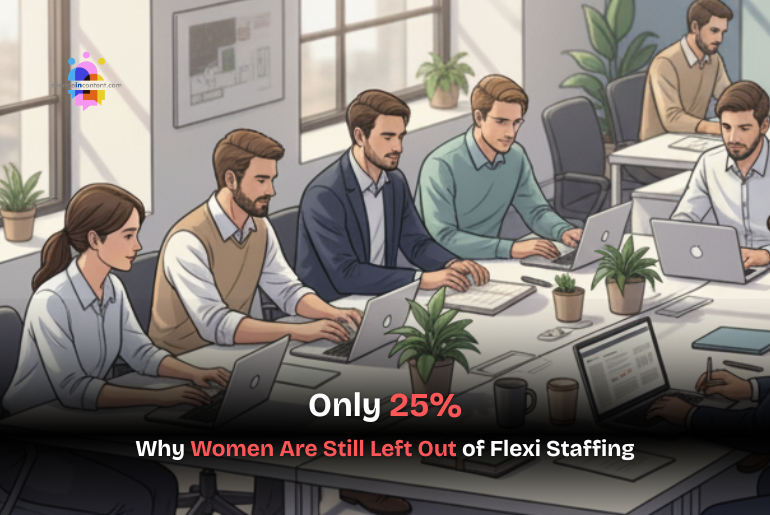
Flexi staffing in India is hailed as a modern and adaptable way of working, offering a range of options from short-term contracts to freelance and project-based roles. For many, it is a convenient entry point into the workforce. In theory, this should make it a natural fit for women, who often juggle personal and professional responsibilities. Yet, the numbers tell a sobering story: women in flexi staffing represent only 25% of the workforce, far below the national average of 34%.
This persistent gap raises a bigger question: Why is one of India’s fastest-growing employment models still failing its women?
Five years, and we have never reached even 30% women in flexi staffing in India
The Indian Staffing Federation (ISF) reports that women comprise only 25% of the country’s flexi-workforce, compared to the national average of 34%. This gender gap is primarily because of male-dominated roles in sectors such as logistics, automotive, and IT, which are among the fastest to adopt flexible staffing models. As a result, men hold more than 75% of flexi jobs.
In 2020, men held 79% of flexible jobs, while women had 21%. In 2021, the share of women rose to 27%, while the share of men dropped to 73%. The numbers stayed the same in 2022, but in 2023, men’s share increased to 75% and then to 77% in 2024. For women, representation stood at 21% in 2020, 27% in both 2021 and 2022, then slipped to 25% in 2023 and 23% in 2024.
The rising opportunities in the flexi-staffing industry
Now, why do we need better representation of women in the flexi workforce? The most obvious reason is the industry’s future potential. Take a look at the way this sector is growing. Flexible staffing is one of the fastest-expanding parts of India’s job market.
Projections indicate that the flexi workforce will increase from 7.23 million in FY25 to 8.09 million in FY26. It will further grow to 9.16 million by FY27, with a CAGR of 12.6%. Additionally, projections show that the revenue from formal flexi staffing will grow from ₹1.9 lakh crore today to ₹2.2 lakh crore in FY26, with an additional ₹68,000 crore added by FY27.
Learning and upskilling
One of the biggest advantages is the opportunity to upskill. Fresh graduates, women returning to the workforce after a career break, and even dropouts can gain practical knowledge that prepares them for industry demands. On-the-job training, exposure to real-world challenges, and guidance from experienced mentors help women acquire skills that are in high demand.
The industry has the potential to create 5.6 million jobs across sectors by 2030. Many of these roles are frontline positions in areas such as retail, hospitality, IT, and manufacturing, roles that often suit women seeking flexible yet meaningful work.
E-commerce, retail, and hospitality will create seasonal demand and more short-term jobs. At the same time, IT, manufacturing, and allied industries will continue to provide steady opportunities. Companies now hire temporary staff to manage peak workloads and short projects. Formal staffing is also moving into specialised roles. As companies create more flexible roles across industries and cities, these opportunities can give women the chance to enter or re-enter the workforce on terms that suit their needs.
Security and stability
Unlike typical gig work, the flexi staffing industry provides formal employment benefits. Women receive standard wages and enjoy social security through registrations under the Employees’ Provident Fund Organisation (EPFO) and the Employee State Insurance Corporation (ESIC). These protections provide them with a sense of financial stability and security. It ensures that they are not left vulnerable while pursuing flexible roles. Fixed wages, guaranteed leave, and fair work practices make these jobs a reliable option. It is especially beneficial for women who require a steady income while managing family responsibilities.
Lohit Bhatia, President of the Indian Staffing Federation, explains that flexi staffing is gaining momentum with a growing pool of skilled workers in Tier 2 and 3 cities. Some of these cities are Coimbatore, Mysuru, Salem, Hosur, Indore, Bhopal, Noida, Kanpur, Surat, and Vadodara. Karnataka leads with 24% of its formal workforce in flexi roles, followed by Haryana at 16% and Maharashtra at 15%.
In terms of revenue, Maharashtra (₹41,204 crore), Karnataka (₹32,423 crore), and Tamil Nadu (₹15,703 crore) collectively contribute nearly half of the industry’s turnover. The IT, BFSI, automotive, and ITeS sectors are driving this revenue. Overall, five states (Maharashtra, Karnataka, Uttar Pradesh, Tamil Nadu, and Telangana) make up the core of India’s flexi-staffing market.
Flexi staffing in India: The final thoughts
The flexi-staffing industry, despite its rapid growth and potential, appears to be a significant missed opportunity for enhancing women’s participation in the workforce. The flexible nature of these jobs, including temporary roles, contracts, and on-demand work, makes them a perfect fit for women seeking to balance their personal and professional lives. Yet, women’s representation in this sector has hovered stubbornly around 25-27% for the past five years. It is far below the national average.
Perhaps it’s a lack of awareness that women aren’t fully aware of the formal benefits and opportunities available in the flexi workforce. Or perhaps it’s that companies aren’t actively seeking to hire women for these positions, especially in male-dominated, high-growth sectors like logistics, IT, and automotive. If this continues, the gender gap will never close. That will leave a generation of capable women underutilised.
Changeincontent perspective
At Changeincontent, we believe that flexi staffing should not just be another industry riding on growth numbers. Instead, it should be a driver of real inclusion. When women are systematically excluded from roles in logistics, IT, or manufacturing, it is not just their loss, but India’s. A booming industry without equal representation is a missed opportunity. The flexi model was built for flexibility, and now it needs to be rebuilt for fairness. Until women are seen as core participants, not optional extras, this sector will continue to reflect the inequalities it was supposed to solve.
Read More: The 2025 Gender Snapshot: Why gender equality by 2030 is slipping out of reach.
Disclaimer: The views expressed in this article are based on the writer’s insights, supported by data and resources available both online and offline, as applicable. Changeincontent.com is committed to promoting inclusivity across all forms of content. We broadly define inclusivity as media, policies, law, and history. It encompasses all elements that influence the lives of women and marginalised individuals. Our goal is to promote understanding and advocate for comprehensive inclusivity.