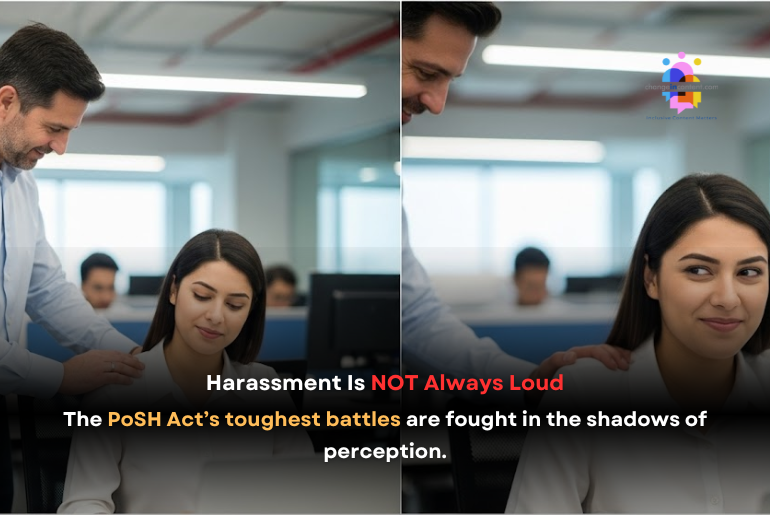
The Grey Area of PoSH is where intent, perception, and legality collide, and where far too many workplace harassment cases go unreported. While the Act is a landmark protection for women at work, subtle behaviours, misinterpretations, and systemic gaps mean many victims remain silent. They make women unsure if their experiences “count” as harassment in the eyes of the law.
The Sexual Harassment of Women at Workplace (Prevention, Prohibition and Redressal) Act, 2013, commonly known as the PoSH Act, is one of India’s most significant laws for workplace safety. It aims to protect women from sexual harassment at work, prevent such incidents, and provide a proper system to address complaints.
The Act defines sexual harassment as unwelcome physical contact, verbal or non-verbal remarks, sexual advances, requests for sexual favours, showing pornography, or any other behaviour that creates a hostile environment. This protection applies to all women, whether they work in organised or unorganised sectors, in public or private workplaces, and even includes domestic workers.
While the Act is clear in its intent, it has certain grey areas that make implementation and justice more complicated.
The challenge of the Grey Area of PoSH
One of the biggest challenges is that workplace harassment is not always black and white. Pallavi Pareek, Founder and CEO of UNGENDER, an equity-focused organisation committed to ensuring that workplace sexual harassment laws are effectively implemented and experienced, shared on LinkedIn that “workplace sexual harassment is a thousand shades of grey.”
Different people can see the same incident in very different ways, which often leads victims to doubt themselves and stay silent instead of filing a complaint. What feels uncomfortable or intimidating to one person might be brushed off as normal behaviour by another. This difference in perception often makes victims question whether their experience is “serious enough” to report.
For example, suppose a woman faces constant belittling remarks, exclusion from meetings, or subtle intimidation from a colleague or manager, to the point where she feels forced to quit her job or hand over a major project. In that case, that is still workplace harassment, even if there is nothing sexual involved.
Small things, comments, jokes, or gestures, may seem harmless, but they often sit in the grey area of harassment. The short film Nazariya by UN Women Asia-Pacific brings this grey area to light.
Nazariya by UN Women
The short film Nazariya by UN Women Asia-Pacific shows how the same incident can look completely different depending on who is telling the story, and how this difference in perspective can prevent victims from speaking up.
In the film, a woman employee confides in a colleague that she feels uncomfortable with the way a male coworker interacts with her. At the same time, the male coworker recounts the same interaction to his male colleagues, presenting it as casual and harmless.
The scene unfolds with the man stopping her before lunch, suggesting she join him, complimenting the colour of her dress, and then making an insulting remark when she politely refuses. He tells her that there are more attractive women in the office and accuses her of “thinking too much” of herself. Later, when he narrates the incident to his male colleagues, he leaves out the inappropriate remarks. He attempts to make himself appear innocent.
To an outsider, especially without full context, the woman’s discomfort might seem like an overreaction. But when all the details come out, the behaviour clearly crosses the line into harassment. The film reflects an everyday reality in workplaces, where inappropriate conduct is downplayed, reframed, or normalised. That makes it harder for victims to report it and harder for others to recognise it for what it truly is.
The PoSH Act still excludes women in political parties
In Centre for Constitutional Rights Research and Advocacy v. Union of India (2022), the Kerala High Court examined a Public Interest Litigation seeking directions to bring political parties under the ambit of the PoSH Act by mandating them to constitute Internal Complaints Committees.
The Court carefully analysed the statutory definitions of “workplace,” “employee,” and “employer”. It concluded that political parties cannot be treated as workplaces because their members are not in an employer–employee relationship. It also held that political parties do not fall within the meaning of “appropriate government” or “local authority” under Section 2(g)(i) of the Act.
Supreme Court refuses expansion, leaving another grey area of PoSH.
This matter reached the Supreme Court by way of a Special Leave Petition. In September 2025, the Court refused to expand the scope of the Act. The court observed that joining a political party does not equal employment, as no salary or formal service is involved. The Bench, led by Chief Justice Sanjay Gavai, noted that extending the Act in this manner could “open a Pandora’s box,” raising concerns about misuse and blackmail.
It can undoubtedly be seen as a limiting ruling for women in politics. Women in political parties often work in highly male-dominated, informal spaces where there is a high risk of harassment. This is also very much a grey area within the PoSH Act. Consider the day-to-day work of women in political parties, campaigning, organising events, and attending meetings, which closely resembles what we see in a typical workplace. On the one hand, the law excludes political parties because there is no employer–employee relationship. On the other side, the spirit of the law or the real purpose of the law, which is to protect women from harassment at work, does fit these spaces because women in politics often face harassment and an unequal power hierarchy.
Thus, while the ruling adheres to the law as written, it highlights a significant policy gap. Women in political spaces remain without the statutory protection that their counterparts in offices, schools, or even film sets enjoy. For true equality, either Parliament needs to amend the PoSH Act or political parties must adopt suitable internal grievance mechanisms of their own.
Time limits for complaints.
The PoSH Act currently gives an aggrieved woman three months from the date of the incident to file a written complaint. If it involves a series of incidents, the time is counted from the last incident. The Internal Committee (IC) or Local Committee (LC) can extend this limit by three more months if they believe the delay had valid reasons. That makes six months the maximum time allowed.
In 2024, a bill was introduced in the Rajya Sabha proposing an extension of the time limit to one year. It also has provisions for further extensions, depending on the circumstances. However, this bill has yet to be passed.
Strict time limits pose significant challenges in harassment cases. It is especially true when the incident falls into the grey area where it is not immediately recognised as harassment. Many women delay reporting because of fear of losing their jobs, damaging their future career prospects, facing social judgment, or dealing with the perpetrator’s influence.
In some cases, the victim spends weeks or months questioning whether what happened “counts” as harassment. It is especially true when the behaviour is subtle or easily dismissed by others. This self-doubt, combined with the fear of retaliation, often delays reporting. By the time she recognises the conduct for what it is, the legal time limit may have expired. When the law forces victims to act within a narrow timeframe, it risks excluding those whose experiences take longer to process. That ultimately denies them the chance to seek justice.
The issue of “Zero Cases”
A worrying trend in PoSH compliance is the number of companies that consistently report zero cases of sexual harassment. In FY 2022–23, 27 of India’s top 100 companies reported no complaints at all. Even more concerning, fourteen of these companies have never reported a single case since the PoSH Act came into effect in 2013.
On paper, these figures might suggest a perfectly safe workplace. In reality, experts caution that “zero cases” often signal a workplace where employees are either unaware of their rights. They may also signal that workers are too afraid to report, or lack faith in the complaint system. In such environments, the absence of cases is not a sign of safety but a sign of silence.
What worsens the problem
The problem becomes worse when companies fail to meet even the basic requirements of the PoSH Act. Some examples are forming a properly functioning Internal Committee, conducting awareness sessions, and making mandatory disclosures in their annual reports. Without these systems in place, employees have no safe or confidential channel to raise complaints.
A report by the Martha Farrell Foundation showed that more than half of India’s districts did not share data about their Local Committees. In formal workplaces, 31% were found non-compliant with PoSH requirements.
We should not be automatically celebrating these “zero cases.” That is because proper compliance is not about keeping numbers at zero. It is about ensuring that we acknowledge every incident, no matter how small or grey it may appear. Moreover, it is about addressing and resolving them.
Closing thoughts on the Grey Area of PoSH
The PoSH Act remains one of India’s most important workplace protection laws. However, its impact is limited by uncertainty, misinterpretation, and poor awareness. The grey area in harassment cases, where behaviour is subtle, easily dismissed, or viewed differently by each party, often leaves victims questioning themselves. Many never file a complaint. It is not because the incident was insignificant, but because they doubt whether others will see it as harassment. Until organisations and institutions address the grey areas and close the awareness gap, the promise of the PoSH Act will remain only partly fulfilled.
The Grey Area of PoSH: Changeincontent perspective
At Changeincontent, we believe that the power of the PoSH Act cannot be limited to just punishing clear-cut cases. Instead, it must protect those whose experiences fall in the grey area. Harassment does not always announce itself with obvious words or actions. It is often in the patterns, silences, and micro-behaviours that make a workplace unsafe. Until organisations treat these grey areas with the same seriousness as overt violations, proper workplace safety will remain an unfinished mission.
Read more: 11 years of POSH Act: 5 crucial judgements under the POSH Act.
Disclaimer: The views expressed in this article are based on the writer’s insights, supported by data and resources available both online and offline, as applicable. Changeincontent.com is committed to promoting inclusivity across all forms of content. We broadly define inclusivity as media, policies, law, and history. It encompasses all elements that influence the lives of women and marginalised individuals. Our goal is to promote understanding and advocate for comprehensive inclusivity.