
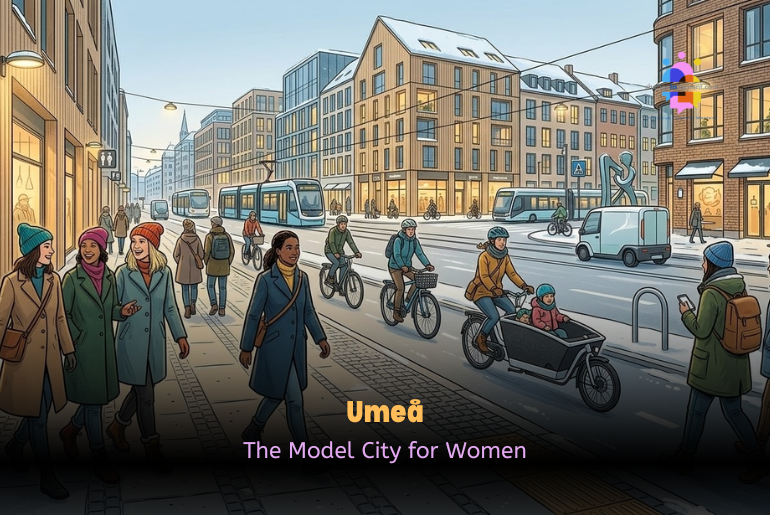
Cities rarely become famous for how safe they feel to women. They become famous for skylines, finance districts, or cultural festivals. Yet in northern Sweden, the city of Umeå has earned international attention for something more fundamental. The world widely recognises it as a model city for women. That is not because of symbolic campaigns, but because the city builds gender equality into its planning of streets, housing, transport, education, and public life.
Over the past three decades, Umeå has turned gender equality into a practical urban policy. Its story shows how everyday design choices can reshape the experience of safety, mobility, work, and participation for women.
Introduction
The story of Umeå becoming a model city for women begins with a simple but radical question. What happens when a city plans itself from the perspective of women’s everyday lives rather than from abstract infrastructure models?
In the early 1990s, Umeå faced a series of sexual assaults that shocked the community and forced local leaders to rethink the core meaning of safety. Instead of responding only through policing, the municipality launched one of the world’s earliest gender-focused urban planning initiatives. The goal was not simply to reduce crime. The goal was to redesign the city so that women’s experiences shaped public policy.
Three decades later, Umeå has become an international reference point for gender-equal cities.
How Umeå became a model city for women
Umeå’s transformation began in 1994 when the city introduced a gender equality programme known as the Gendered Landscape initiative. The programme examined how urban spaces are used differently by men and women and how planning decisions often ignore those differences.
Urban planning traditionally assumed a standard commuter pattern. A person travels from home to work and back again. Research in Umeå revealed that women’s travel patterns were far more complex. Women were more likely to combine commuting with childcare, shopping, elder care, and other responsibilities. Their journeys involved multiple stops rather than a single route.
When planners recognised this pattern, transport systems changed. They adjusted public transport routes to better connect neighbourhood services. At the same time, they redesigned walking paths to reduce isolation and improve lighting. The planners also reconsidered parks and public spaces through a safety lens that reflected how women actually experience urban environments.
These changes did not require dramatic architecture. They required a shift in perspective.
Model city for women: Umeå’s approach to urban design
Umeå’s urban planning approach has become internationally known for its gender-mainstreamed design concept. That means gender equality is not a separate policy category. Instead, Umeå treats it as a policy integrated into every stage of decision-making.
One example that people often cite is snow clearing. In many cities, roads used primarily by cars are cleared first, while pedestrian paths and cycling lanes are addressed later. Umeå changed this priority after analysing accident data. Women were more likely to walk, cycle, or use public transport, which meant icy sidewalks posed greater risks to them.
By clearing pedestrian routes first, the city reduced injuries and improved accessibility for the groups most affected.
Another example involves lighting and spatial visibility. Studies showed that poorly lit paths discouraged women from using public spaces after dark. The city redesigned several routes to improve lighting, sightlines, and activity levels around public areas.
These interventions might appear modest. Yet they change how comfortable women feel as they move through the city.
Education, research, and the role of Umeå University
Umeå’s reputation as a model city for women is also closely linked to its academic ecosystem. Umeå University has played an important role in researching gender equality, social policy, and urban development.
The university hosts a strong tradition of gender studies research and collaborates closely with the municipality. This partnership allows policy ideas to be tested, measured, and refined through data rather than intuition.
Researchers and city officials frequently work together on pilot projects that examine how policies affect women’s participation in public life. These projects range from public transport accessibility to representation in cultural institutions.
This relationship between academia and governance has helped Umeå maintain a long-term focus on equality.
Women’s representation and civic participation
Urban equality is not limited to infrastructure. Representation also matters.
Umeå has consistently maintained strong female participation in municipal leadership and public institutions. Gender balance in local governance ensures that policy discussions include women’s perspectives at the decision-making level.
The city also supports initiatives that encourage women’s participation in cultural and economic life. Programs that support female entrepreneurs, creative industries, and youth participation have contributed to a broader ecosystem where women’s voices are visible in public discourse.
These initiatives reinforce the city’s broader philosophy. Equality must be visible both in the streets and in institutions.
Safety as an urban planning principle
Safety often appears in urban planning as a policing issue. Umeå approaches it as a design challenge.
The city’s gender equality strategies recognise that many factors influence women’s perception of safety. Lighting, public transport frequency, housing density, and social activity all shape how secure a space feels.
Active, visible public spaces tend to feel safer. Areas that appear isolated can discourage participation, particularly after dark. Umeå’s planners use these insights to shape neighbourhood design.
When you embed safety in planning, the result is not only reduced fear but also greater public participation. Women are more likely to use parks, cultural spaces, and public transport when they feel comfortable doing so.
To know what it means to experience something opposite, read our piece on the Gendered use of public spaces: Why women are still treated as visitors, not citizens.
Global recognition of Umeå as a model city for women
Umeå’s approach has drawn international attention from urban planners, researchers, and gender equality advocates. Delegations from cities around the world have visited to study how gender-responsive planning works in practice.
One reason the city attracts so much attention is that it demonstrates that equality does not depend solely on national legislation. Local governments can influence everyday experiences through planning decisions.
The city’s model constantly influences discussions on gender mainstreaming in urban design across Europe and beyond. In many policy circles, people cite Umeå as evidence that gender equality can be operationalised rather than simply declared.
The changeincontent perspective
At changeincontent, the story of Umeå resonates because it moves the gender equality conversation from slogans to systems.
Cities often announce commitments to inclusion. Yet the daily realities of transport, housing, and safety still reflect planning models that ignore women’s needs. Umeå shows that equality becomes tangible when embedded in everyday decisions.
Street lighting. Snow removal priorities. Bus routes. Public space design. These details shape who feels welcome in a city and who does not.
For policymakers around the world, Umeå offers a powerful lesson. Gender equality does not emerge from isolated programs. It emerges when planning processes ask different questions about whose lives they are designed to serve.
The final thoughts
Umeå’s reputation as a model city for women did not emerge overnight. It developed over decades of collaboration among municipal leaders, researchers, and citizens who believed that urban planning could reflect the realities of women’s lives.
The result is a city where noone treats equality as an abstract value. Instead, equality is embedded in infrastructure, governance, and everyday experiences.
In an era when cities are searching for models of inclusive development, Umeå provides a compelling example. Its approach reminds us that the most transformative urban policies are often the ones that begin by listening carefully to those who have historically been overlooked.
Disclaimer: The views expressed in this article are based on the writer’s insights, supported by data and resources available both online and offline, as applicable. Changeincontent.com is committed to promoting inclusivity across all forms of content. We broadly define inclusivity as media, policies, law, and history. It encompasses all elements that influence the lives of women and marginalised individuals. Our goal is to promote understanding and advocate for comprehensive inclusivity.
