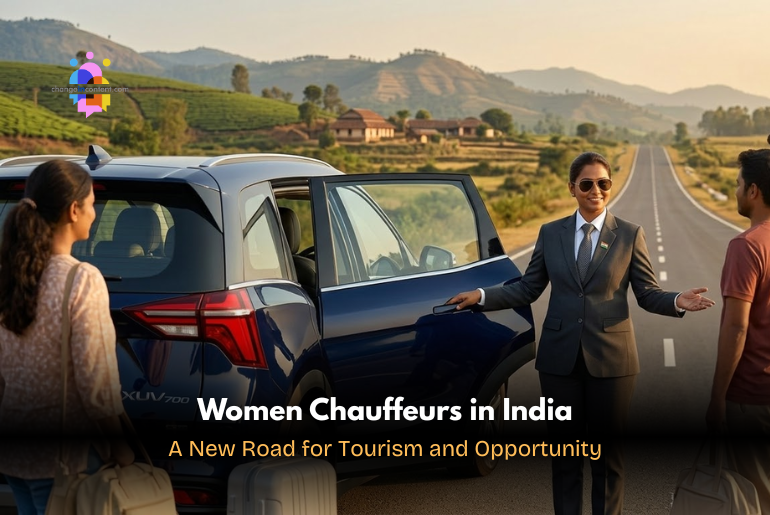
India’s tourism sector is witnessing a small but meaningful shift with the introduction of women chauffeurs in India for long-distance and multi-day travel. Cholan Tours, a destination management company based in Tiruchirappalli, has announced a new programme to train and deploy women drivers to operate on extended tourism routes across the country.
The initiative signals a broader change within the travel industry. For years, chauffeur-driven tourism has remained one of the least accessible mobility roles for women. Long travel hours, safety concerns, and social perceptions kept most women out of commercial driving roles. This programme attempts to open that door while placing equal emphasis on safety, professional training, and driver wellbeing.
Women chauffeurs in India enter long-distance tourism driving.
Traditionally, chauffeur-driven tourism in India, particularly for multi-day routes, has been overwhelmingly dominated by men. The work demands extended travel, night driving, route familiarity, and high levels of client interaction. Historically, the society framed all these as barriers to women’s participation. Cholan Tours’ programme is attempting to normalise women’s participation in a role that has long been viewed as inaccessible.
Through a public-private partnership with the Tamil Nadu government, the company plans to train and recruit 100 women drivers for tourism operations across the state. That will mark one of the most organised entry efforts for women into this segment of the travel industry. Women will be training to operate in a high-responsibility tourism environment, focusing on safety, reliability, and customer experience.
Equally important is the attention to driver wellbeing. One of the biggest barriers that has historically discouraged women from entering long-distance driving roles is the lack of safe accommodation. To address this, Cholan Tours will include safe accommodation arrangements on tours.
A meaningful step toward gender-inclusive tourism
India’s travel economy is quietly undergoing a gender shift. Women now plan 7 out of 10 leisure trips in the country. Based on an analysis of 212,000 itineraries and 8.9 million planning signals, women today influence or directly impact 72% of leisure travel in India.
Travel planning data already shows that women apply 3x more safety filters when booking. It indicates a more cautious and detail-oriented approach to trip design. When given the option, many planners naturally gravitate toward services that visibly prioritise safety and trust. So, it is reasonable to expect that many would prefer the option of a woman chauffeur.
Tourism employment opportunities for women
Tourism today is a USD 11 trillion global industry, and India is one of its fastest-growing markets. A sector this large creates millions of jobs across hotels, transport, tour operations, logistics, and customer service. Despite this, women’s contributions continue to be relegated to invisible service roles.
Only in recent years have we begun to see more women stepping forward as tour operators and tour guides. Ground mobility, however, has remained one of the slowest areas to diversify.
Commercial driving as a new career path for women
Commercial driving has long been seen as men’s work due to social norms, safety concerns, and the demanding nature of the job. Because of this history, even qualified women often had few entry points. Initiatives like this help break that cycle by proving that, with the right training and support, the role can be more gender-inclusive.
The changeincontent perspective
Tourism often markets itself as an industry of exploration and freedom. Yet the jobs that move travellers from one destination to another have historically excluded women. The entry of women chauffeurs into long-distance tourism challenges that imbalance. Moreover, it widens the idea of who belongs in mobility roles.
This development should not remain a symbolic milestone. For meaningful progress, tourism companies must invest in structured training programmes, safe accommodation during travel routes, access to commercial vehicle financing, and long-term career pathways.
When women begin to drive the industry’s mobility network, tourism becomes not only more inclusive but also more responsive to the growing number of women travellers shaping travel decisions across the country.
Conclusion: What the rise of women chauffeurs in India could mean for tourism
Cholan Tours has taken an important first step toward making tourism more inclusive. By bringing women into long-distance chauffeur roles, the initiative not only opens new job opportunities but also responds to the safety concerns that more women travellers are already facing. The next big move could be helping more women own tour vehicles, get easier access to loans, and run their own tourism travel services.
Also Read: The 80% gender gap in blue-collar jobs: The underrepresentation of women continues.
Disclaimer: The views expressed in this article are based on the writer’s insights, supported by data and resources available both online and offline, as applicable. Changeincontent.com is committed to promoting inclusivity across all forms of content. We broadly define inclusivity as media, policies, law, and history. It encompasses all elements that influence the lives of women and marginalised individuals. Our goal is to promote understanding and advocate for comprehensive inclusivity.