The Short Read
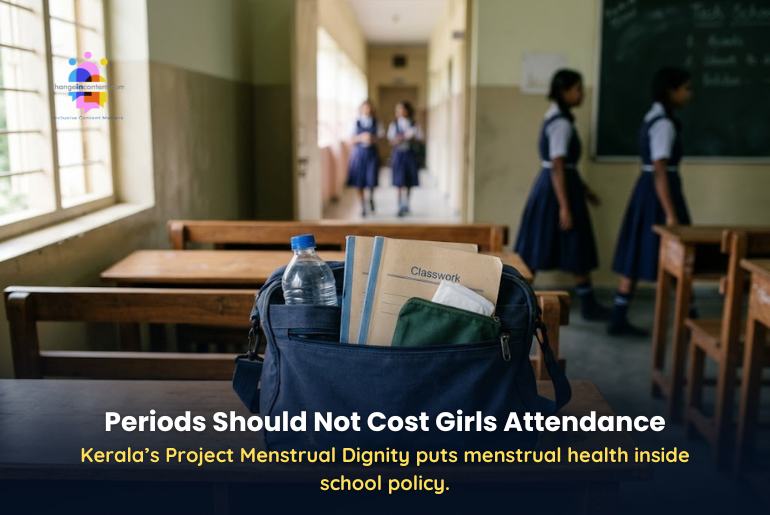
- Kerala has proposed Project Menstrual Dignity as part of a wider women and child-friendly policy push.
- The plan includes up to 3 days of menstrual leave per month for schoolgirls.
- The government has also proposed weekend catch-up classes so students do not fall behind academically.
- The policy aims to make educational institutions and public spaces more friendly for girls and women.
- The proposal comes at a time when menstrual health is increasingly being recognised as a dignity, education and equality issue in India.
- The real test will be implementation. ‘Leave’ alone will not solve the problem unless schools also provide clean toilets, sanitary products, privacy, waste disposal, counselling and stigma-free support.
Kerala puts menstrual dignity on the school policy table with Project Menstrual Dignity.
For generations, schoolgirls have been told to manage periods quietly.
- Carry a pad secretly.
- Do not stain the uniform.
- Do not ask too many questions.
- Do not miss class.
- Do not make anyone uncomfortable.
- Above all, do not let menstruation become visible.
Kerala’s proposed Project Menstrual Dignity challenges that silence.
As part of the new government’s policy address in the State Assembly, Kerala has proposed up to three days of monthly menstrual leave for schoolgirls. The plan also includes weekend catch-up classes to help students make up for lessons missed during menstrual leave.
That second part matters.
The proposal is not asking girls to disappear from education for a few days every month. It is trying to recognise a biological reality while protecting academic continuity. In a country where menstruation is still surrounded by shame, jokes, discomfort and misinformation, that is a significant policy signal.
It tells girls that pain does not have to be hidden. At the same time, it tells schools that menstrual health is not a private inconvenience. It tells families that attendance cannot be more important than dignity.
But Project Menstrual Dignity will need careful design. If implemented poorly, menstrual leave can become another reason to mark girls as weak, absent or academically unreliable. If implemented well, it can help schools become more humane, more informed and more gender-sensitive.
That is the difference between a headline and real change.
What Kerala has proposed under Project Menstrual Dignity
Project Menstrual Dignity is part of Kerala’s wider women and child-friendly policy announcements.
The proposal includes up to three days of menstrual leave every month for schoolgirls. The government has also spoken about making educational institutions and public spaces more friendly for girls and women.
Along with menstrual leave, Kerala’s policy address mentioned weekend catch-up classes, access to sanitary napkins, footwear and other necessities for women. It also included broader measures such as safe, high-quality daycare centres and crèches in workplaces with more than 50 employees, as well as public restroom facilities in major towns.
That makes the proposal bigger than a leave policy. It sits within a larger question: what does a woman-friendly state actually look like?
A woman-friendly state cannot be built only through slogans.
- It needs toilets that work.
- It needs sanitary products that are available.
- It needs teachers who do not shame girls.
- It needs public spaces where women can move, rest, study and work without being treated as exceptions.
Project Menstrual Dignity may have started as a school leave proposal, but its success will depend on whether Kerala treats menstrual health as infrastructure rather than charity.
Also read: Supreme Court rejects plea seeking menstrual leave policy for women.
Why menstrual leave for schoolgirls is different from workplace menstrual leave
Menstrual leave is often debated in the context of workplaces. Supporters call it a matter of health and dignity. Critics worry about hiring bias, misuse, productivity and whether such policies could reinforce stereotypes about women being less reliable.
Schools are different.
A schoolgirl is not negotiating wages, promotions or performance ratings. She is trying to learn while dealing with pain, cramps, heavy bleeding, nausea, fatigue, anxiety or the fear of staining her uniform in front of classmates.
For many girls, the problem is not only the period. It is the ecosystem around it.
- Does the school have clean toilets?
- Is there running water?
- Is soap available?
- Can she change a pad privately?
- Is there a dustbin or disposal system?
- Can she ask a teacher for help without embarrassment?
- Do boys in the classroom understand menstruation beyond jokes and whispers?
A leave policy can help, but only when these basics are fixed. Otherwise, menstrual leave becomes an escape from poor infrastructure rather than a dignified choice.
The policy arrives at an important national moment
Kerala’s proposal comes months after the Supreme Court recognised menstrual health in schools as a matter linked to dignity, education and equality.
The Court’s 2026 directions pushed states and institutions to treat menstrual hygiene as part of the right to life, dignity and access to education. The judgment highlighted that girls should not be denied meaningful education because of inadequate menstrual hygiene facilities.
That is the larger context in which Project Menstrual Dignity must be seen.
India is no longer discussing menstrual health only as a hygiene issue. It is slowly becoming a rights issue. That shift is important.
When menstruation is treated solely as a hygiene issue, the solution becomes a pad.
When it is treated as a matter of dignity, the solution expands. It includes privacy, toilets, safe disposal, pain support, school counselling, gender education, teacher training, affordability and freedom from shame.
For a schoolgirl, dignity can be as simple as not having to ask permission in front of the whole class.
- It can mean not being mocked for carrying a pad.
- It can mean not being marked absent without support.
- It can mean not being told to “adjust” when her body is asking for rest.
The catch-up classes idea needs careful handling.
Kerala’s proposal includes weekend catch-up classes so girls who take menstrual leave do not fall behind.
On paper, this is thoughtful. It addresses a common concern that menstrual leave could lead to learning loss. But it also needs sensitivity.
If catch-up classes become compulsory only for menstruating girls, they may create a new layer of stigma. Students may feel exposed. They may also lose time for rest on weekends, especially if they are already dealing with household responsibilities.
A better model would be flexible academic support.
Schools can offer recorded lessons, peer notes, teacher-led revision hours, optional weekend support, digital learning material and confidential academic follow-up. The goal should be to support girls, not quietly punish them for taking leave.
The system must remember one thing clearly: menstrual leave is not a holiday.
A girl who takes leave because of severe cramps, heavy bleeding or discomfort is not skipping school. She is responding to her body.
Also read: Karnataka menstrual leave bill put on hold.
What could go wrong if the policy is poorly implemented?
Project Menstrual Dignity has promise, but it also carries risks.
The first risk is stigma. If schools do not protect privacy, girls may avoid taking leave even when they need it. Attendance registers, classroom remarks, casual jokes and staff behaviour can quickly turn a supportive policy into a source of embarrassment.
The second risk is stereotyping. Menstrual leave should not teach society that girls are weaker. It should teach society that bodies have needs and institutions must respond with intelligence.
The third risk is uneven access. Urban schools may implement the policy better than rural or under-resourced schools. Private schools may create smoother systems than government schools. Students from marginalised communities may still struggle if infrastructure remains poor.
The fourth risk is performative compliance. A school may announce menstrual leave but fail to provide clean toilets, sanitary products or trained staff. That would miss the point completely.
The fifth risk is silence around pain. Some girls experience severe menstrual pain because of conditions such as endometriosis, polycystic ovary syndrome or other health concerns. Schools need referral systems and awareness, not only leave forms.
A menstrual dignity policy must accommodate both normal menstruation and medical distress.
What Kerala must get right
If Kerala wants Project Menstrual Dignity to serve as a model, it should build a simple yet robust implementation framework.
- First, privacy must be protected. Girls should be able to access menstrual leave without public disclosure or classroom-level embarrassment.
- Second, schools need proper menstrual hygiene infrastructure. That means clean toilets, running water, soap, sanitary products, disposal bins, incinerators or safe waste systems, and emergency supplies.
- Third, teachers must be trained. A supportive policy can fail in one insensitive remark.
- Fourth, boys must be included in menstrual education. Period stigma will not reduce if half the classroom is kept ignorant.
- Fifth, data should be collected carefully. Kerala should track usage, attendance, learning support, infrastructure gaps and student feedback without turning girls into surveillance subjects.
- Sixth, schools should provide flexible catch-up systems instead of rigid weekend burdens.
- Finally, the policy must include girls’ voices. No menstrual health policy should be designed without listening to the students who will use it.
Also read: Menstrual leave and workplace justice in India.
Why this matters beyond Kerala
Kerala’s proposal will be watched closely because menstrual leave remains a contested issue in India.
Some people see it as progressive. Others fear it may create fresh discrimination. Some argue that leave is necessary only for those with severe symptoms. Others say menstruation is common enough to be built into school and workplace design.
The debate is not going away.
But Kerala’s school-focused proposal offers a useful way to rethink the issue. Instead of asking whether menstruation makes girls less capable, the better question is whether institutions are capable of supporting menstruating girls.
That shift changes everything. It moves the burden from the individual to the system.
For years, girls have adjusted to schools. Now, schools must learn to adjust to girls.
The Changeincontent perspective on Project Menstrual Dignity
Project Menstrual Dignity should not be reduced to a three-day leave headline. Its real value lies in what it asks us to confront.
- Why are schoolgirls still expected to hide pain?
- Why are toilets still central to girls’ education?
- Why does menstruation still invite shame?
- Why do we treat dignity as an extra, not a basic condition for learning?
Kerala’s proposal is important because it places menstrual health inside public policy. But leave cannot become the whole solution. The larger goal must be menstrual dignity in everyday school life.
Editorial Note
This article is based on publicly reported information about the Kerala government’s policy address delivered on 29 May 2026. At the time of writing, the measure has been reported as a proposal under Project Menstrual Dignity. Changeincontent will update the framing if the Kerala government issues a formal government order, an implementation guideline, or a notification.
The article is written as a news-analysis piece for the Policy Pulse section. It does not present menstrual leave as a single-point solution. It examines the policy through the lens of education, dignity, public infrastructure, stigma reduction and gender-responsive governance.
Sources
- The New Indian Express reported that the Kerala government proposed three days of monthly menstrual leave for schoolgirls under Project Menstrual Dignity, along with weekend catch-up classes, crèche facilities in workplaces with more than 50 employees, public restrooms and other women-friendly measures.
- The Supreme Court Observer’s analysis of the 2026 Supreme Court ruling explains how the Court linked menstrual health facilities in schools to dignity, substantive equality and access to education.
- The Supreme Court judgment dated 30 January 2026 addressed free sanitary pads for schoolgirls and the wider relationship between menstrual hygiene and education.