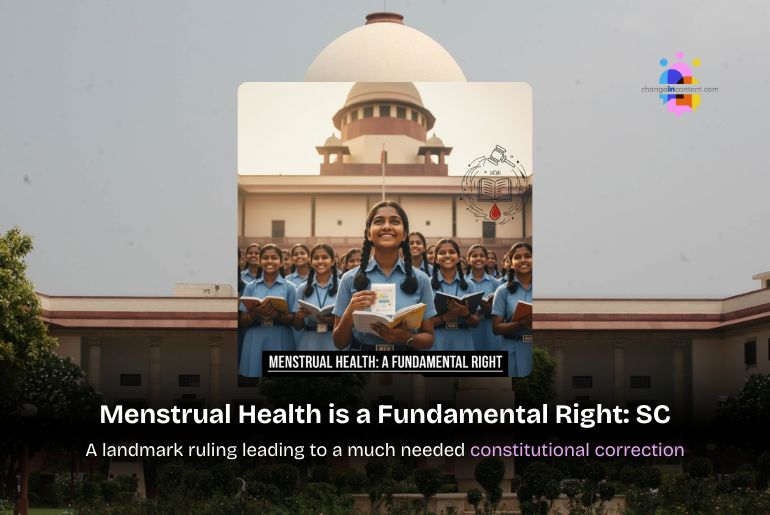
In a ruling that will alter the everyday realities of millions of girls and women, the Supreme Court of India has declared the Right to Menstrual Health a fundamental right under Article 21 of the Constitution. The Court’s judgment goes far beyond symbolism. It mandates free sanitary pads, separate and hygienic toilets, disability-friendly infrastructure, and comprehensive sensitisation programmes in schools.
The court directs that menstrual health be treated not as welfare but as a constitutional guarantee tied to dignity, equality, and life itself.
This is one of the most consequential gender-justice rulings India has seen in years.
Right to Menstrual Health: What the Supreme Court has declared
The Supreme Court held that menstrual health is inseparable from the right to life, dignity, privacy, and equality under Article 21. The bench made it clear that denying access to menstrual hygiene products, sanitation facilities, and safe spaces effectively pushes girls out of schools and women out of public life. That amounts to structural discrimination.
Crucially, the Court rejected the long-standing tendency to treat menstruation as a “women’s issue” or a policy afterthought. Instead, it recognised menstrual hygiene as a public health, education, and human rights issue that the State is constitutionally obligated to address.
What the Court has ordered: Beyond recognition, into enforcement
This landmark ruling extends beyond legal philosophy. The Court issued concrete, time-bound directions to governments and institutions across India.
It mandated the free distribution of sanitary pads in Government and aided schools, with a clear preference for safe and biodegradable products. The Court also ordered the construction and maintenance of separate, functional toilets for girls, including facilities accessible to students with disabilities.
Equally significant is the Court’s insistence on sensitisation programmes for boys and men in schools. The judgment acknowledges that stigma, silence, and misinformation (especially among male peers and teachers) are primary reasons menstruation continues to disrupt girls’ education.
It is a structural intervention, not a token measure.
Why this ruling matters: The reality behind the law
The background to this judgment is stark. Multiple studies cited before the Court highlighted that a significant number of girls in India miss school or drop out altogether due to a lack of access to sanitary products, clean toilets, and privacy. In rural and low-income urban areas, menstruation often means isolation, humiliation, and lost opportunities.
The Court explicitly noted that menstrual poverty is not accidental. It is the outcome of neglect, gender bias, and policy failure. When the State fails to provide basic infrastructure, the burden falls disproportionately on girls. It forces them to compromise education, health, and self-worth.
By framing menstrual health as a fundamental right, the Supreme Court has shifted responsibility squarely onto the State.
Right to Menstrual Health and the Constitution: A long-overdue link
The Court grounded its ruling firmly in constitutional values. It linked menstrual health to:
- Article 21: Right to life with dignity, bodily autonomy, and privacy
- Article 14: Equality before law, recognising how systemic neglect affects girls differently
- Article 15: Prohibition of discrimination on the basis of sex
In doing so, the Court made an important observation. It says that when policies ignore menstruation, they indirectly institutionalise gender discrimination. Silence, the bench noted, is not neutrality; it is exclusion.
What changes now: Schools, states, and systems under scrutiny
This ruling will require immediate recalibration of policy and budget at both the central and state levels. Education departments will have to ensure the procurement and distribution of sanitary products. School infrastructure audits will become unavoidable. Teacher training and curriculum frameworks will need to incorporate menstrual education without shame or euphemism.
Implementation, however, remains the real test.
India has seen progressive judgments before that faltered at the execution stage. The Supreme Court acknowledged this risk and emphasised that compliance will be monitored. This is not advisory. It is a constitutional duty.
The changeincontent perspective: This is bigger than we see
At Changeincontent, we see this ruling for what it truly is. It is a recognition that the nation cannot exclude women’s health from constitutional protection.
For decades, we have been treating menstruation as a private inconvenience rather than a public responsibility. Girls adapted. Women adjusted. Institutions stayed silent. This judgment finally disrupts that pattern.
But let us be honest: the fact that India had to wait until 2026 for such recognition is telling. Progress should not require litigation for something as basic as hygiene and dignity.
This ruling is a beginning, not a closure. Laws can mandate access. Only sustained accountability can ensure dignity.
Right to Menstrual Health: The final thoughts
The Supreme Court’s declaration of the Right to Menstrual Health as a fundamental right is not merely a legal milestone. We must see it as a moral correction. It forces India to confront how deeply gender bias is embedded in public systems, and how often women are expected to endure rather than demand.
Menstruation is not a disruption to public life. Denial of access is.
History will remember this judgment not for what it said, but for what it finally made unavoidable.
Also Read: Menstrual Leaves in India: How states and companies are redefining workplace equality.
Disclaimer: The views expressed in this article are based on the writer’s insights, supported by data and resources available both online and offline, as applicable. Changeincontent.com is committed to promoting inclusivity across all forms of content. We broadly define inclusivity as media, policies, law, and history. It encompasses all elements that influence the lives of women and marginalised individuals. Our goal is to promote understanding and advocate for comprehensive inclusivity.