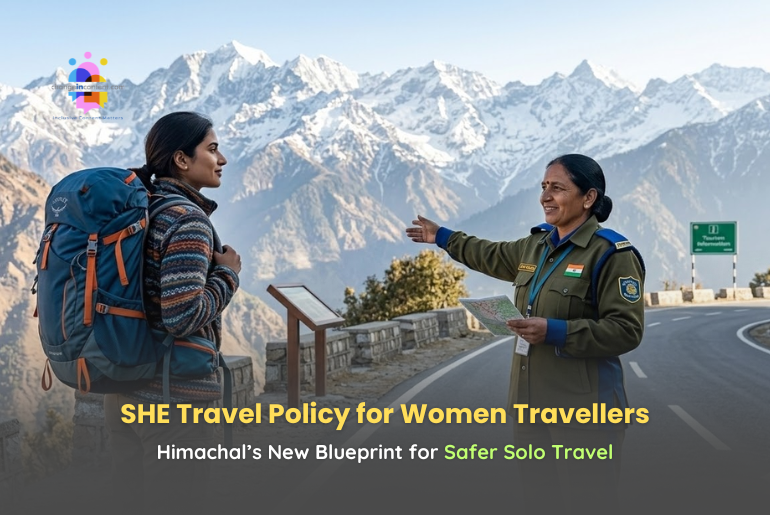
The SHE Travel Policy for women travellers marks a new step in how Indian states approach tourism safety and gender inclusion. We recently covered how long-distance tours with women chauffeurs are being introduced to make travel more comfortable and secure for women. Recently, the Himachal Pradesh government introduced the She Travel Policy. The policy focuses on creating safer travel experiences and better support systems for solo women travellers.
Solo travel is no longer a niche trend among women in India. More women now pack their bags, book their tickets, and set out to explore the world on their own terms. The number of solo women travellers jumped by 135% between 2023 and 2025, rising from 90,700 in FY23 to over 2.13 lakh in FY25. Online searches for solo female travel have also surged by 72% year over year, reflecting growing curiosity and confidence among women who want to experience travel independently.
At the same time, safety remains a top priority. Many women say they are willing to spend more if it means better security, safer accommodation, or trusted transport options. This demand has prompted the travel industry and governments to reassess their support for women travellers.
How the SHE Travel Policy for Women Travellers aims to transform tourism
The state tourism department has proposed the SheTravel Policy 2026. As per reports, the policy aims to make the region one of the safest and most welcoming destinations for solo women travellers in the country. Currently, women travelling alone account for approximately 18% of visitors. Through this policy, officials want to increase that number to 35% by 2028.
Women should be able to explore new places without constantly worrying about safety. Tourism officials say the policy focuses on building systems that support women travellers at every stage of their journey. It includes safer accommodation, better on-ground support, improved infrastructure, and clear travel information that women can rely on when planning their trips.
Safety audits across 200 destinations under the SHE Travel Policy
One of the first steps under the policy involves a detailed safety review of nearly 200 tourist destinations across the state. Authorities plan to review existing security arrangements and identify areas for improvement. This review will examine street lighting, surveillance cameras, entry and exit routes, and the overall security presence at popular tourist spots.
Officials want to understand where gaps exist and fix them quickly. If a destination lacks proper lighting, CCTV coverage, or safe access points, the government plans to introduce upgrades. These improvements aim to create an environment where women can comfortably explore markets, trekking trails, cafes, and local attractions, even in the early mornings or evenings.
SheGuard Marshals to support women travellers.
Another major feature of the policy is the introduction of trained women safety marshals called SheGuard. These marshals will work as tourist safety assistants and stay stationed at key tourist hubs. Their role will include helping women travellers with directions, offering guidance, and responding quickly if someone needs support.
Some marshals will also stay close to major tourist accommodations and transport points. Their presence aims to give women travellers a sense of reassurance, especially when they visit a destination for the first time. Officials believe that visible support on the ground can make a huge difference in how safe a traveller feels.
Women-friendly hotels and homestays under the SHE Travel Policy for women travellers
The policy also plans to introduce certification for women-friendly accommodation. Hotels, homestays, and guest houses that meet certain safety standards will receive this certification. These standards may include proper lighting, secure entry points, emergency contact systems, and trained staff who know how to assist women travellers.
To make trip planning easier, the tourism department also plans to launch a dedicated section on its official website specifically for women travelling alone. This sub-portal will bring together important travel information in one place. Women will find safety tips, travel guidance, recommended stays, emergency contact numbers, and details about local support services.
How the SHE Travel Policy for women travellers creates jobs for local women in tourism
The policy does not focus only on travellers. It also aims to create more opportunities for women who live in the region. Tourism officials plan to train thousands of local women to serve as tour guides, homestay hosts, and tourism service providers. The idea is to ensure that women become visible participants in the tourism economy rather than being limited to informal or behind-the-scenes work.
Through training programmes and skill workshops, women will learn how to manage homestays, guide visitors through local attractions, and run small tourism businesses. These opportunities can open new sources of income for many families, especially in hill communities where tourism already plays a big role in the local economy.
Officials also believe that travellers often feel more comfortable when they see women actively involved in the tourism ecosystem. When visitors interact with women guides, stay in women-run homestays, or buy products from women entrepreneurs, it creates a more inclusive and welcoming travel experience. At the same time, it helps local women build financial independence while becoming active contributors to the region’s growing tourism industry.
The changeincontent perspective
Tourism has always been about freedom of movement, yet many women plan their trips with safety as the first filter. Policies such as the SHE Travel Policy for women travellers recognise that travel infrastructure should respond to that reality rather than ignore it. When governments build systems that prioritise safety, information access, and visible support on the ground, they remove many of the invisible barriers that limit women’s mobility.
What makes this initiative particularly significant is that it connects traveller safety with economic participation. By encouraging women to become tour guides, homestay hosts, and tourism service providers, the policy expands both opportunity and representation within the tourism ecosystem. If implemented carefully, this approach could serve as a model for other states seeking to grow tourism alongside gender inclusion.
Conclusion: Why the SHE Travel Policy for women travellers could reshape women’s travel in India
From better infrastructure and on-ground support to women-friendly stays and digital resources, the SheTravel Policy focuses on making solo travel feel more accessible and reassuring for women. The policy also highlights another important change. Tourism not only benefits visitors.
When local women step in as guides, homestay owners, and entrepreneurs, the industry becomes more inclusive and community-driven. If implemented well, this approach could show how the tourism sector can grow while creating more opportunities for women both on the road and within the industry itself.
Disclaimer: The views expressed in this article are based on the writer’s insights, supported by data and resources available both online and offline, as applicable. Changeincontent.com is committed to promoting inclusivity across all forms of content. We broadly define inclusivity as media, policies, law, and history. It encompasses all elements that influence the lives of women and marginalised individuals. Our goal is to promote understanding and advocate for comprehensive inclusivity.