
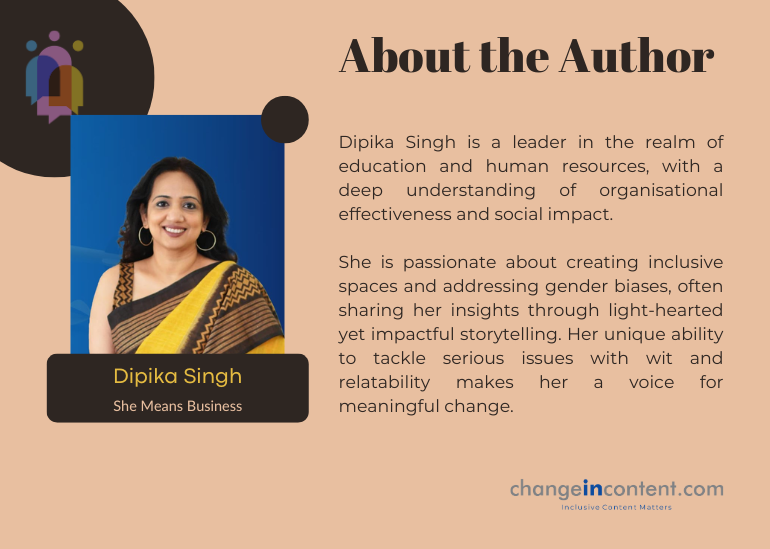
The Superwoman Syndrome is a term often used to describe the relentless pursuit of perfection by women who are juggling countless responsibilities. Dipika Singh’s narrative takes on a humorous yet thought-provoking lens. It is not just about doing it all; it is about the guilt that lingers when something feels less than perfect.
From kitchen conundrums to societal conditioning, Dipika Singh highlights how deeply ingrained gender roles create unseen pressures on women. Her article offers refreshing insights on how to break free from them.
The case of the cold fried egg: Kissa Thande Ande Ka!
For the 23-odd years that we have been married, my husband has mostly had the same breakfast on weekdays – Fried eggs and toast.
He’s pretty fuss-free that way.
The drill is simple. He comes back from the gym and gives himself precisely 15 minutes to bathe, get dressed, eat breakfast, and leave for the office. So, loosely, breakfast and he reaches the table at the same time—well, mostly.
Sometimes, the breakfast has to wait, and sometimes, he. Which means the breakfast reaches him with varying degrees of warmth. This process is in the capable hands of Suvarna, my cook, and her estimate of when ‘bhaiya’ will be ready.
I have never really interfered in this process, so why upset what is working?
Except. One. Day. My husband casually remarked – the eggs are pretty cold nowadays, no?
Oh.My.God
Three women died of guilt. Me, Suvarna, and Laxmi, my house help, literally had no role to play in breakfast preparation.
Three women with superwoman syndrome.
Bhaiya ko thanda anda kaise diya?
The next day, a strategy was in place. My role was to keep a strict eye on when ‘Bhaiya‘ would come out of the bath. Ignore ‘self’ completely. Focus on ‘Bhaiya’.
At that point, I had to signal Suvarna to start preparing the eggs. Laxmi, who had no role to play, also hung around in the kitchen, passing around stuff and generally pottering around uselessly. The eggs appeared at the dining table precisely at the same time as my husband. We would have put the Japanese to shame. Kaizen.
This madness continued for some time, and then I gave up. To his credit, my husband, too, noticed something was up. The eggs were getting too much love. He mentioned it one day amusedly. And things promptly went back to non-kaizen days.
That was my tryst with superwoman syndrome.
And if you are a woman, you will get this.
The dinner should be served warm. You have to tuck the kids in even if you have a pending presentation that is crying for attention. The rotis have to be ‘gol’ because how dare they not? You have to raise your hand for a project only if you are 1500% ready.
But you have to ask yourself—what are a couple of cold-fried eggs in the larger scheme of things?
My thoughts
Why did I fret over eggs? Because traditional values emphasise women’s roles as homemakers. In India, food is cooked daily and has to be served hot and fresh, and despite all our progress, it remains the responsibility of women. My husband, a totally supportive man who has no expectations of piping hot rotis from me, has no role to play in my guilt.
Family members may reinforce expectations, making women feel responsible. However, I have no family members staying with me. Stereotypical portrayals of women in media perpetuate caregiving roles. However, I do not consume media that can shape such narratives in my head. Women are socialised to prioritise relationships and family from a young age.
The Superwoman Syndrome: Our conditioning
As women, we are conditioned to prioritise family over personal goals. We are socialised to manage emotions, maintain relationships, and ensure harmony. We grew up seeing household chores and childcare are disproportionately assigned to women. It is so ingrained in us that the kitchen becomes an extension of our existence. Therefore, his mention of eggs made me feel tizzy.
The superwoman syndrome: The consequences we should be aware of
I am reminding myself not to forget this incident. However innocuous this incident may be, breaking free from guilt, multitasking, and societal expectations requires a collective effort, self-awareness, and support. Also, shouldering certain responsibilities leads to physical and mental strain. In our perfect construct, things were seamless till I orchestrated this act of serving hot eggs. The tiny weeny additional work was putting stress on not only the three women but also my husband, who experienced this whole exercise as a bystander. The moment it was over, there was a sigh of collective relief. All four were happy in their own ways. Therefore, the burden of extra work is not always a productive solution.
Strategies for change
Just Recognise and ‘let go’ internalised expectations that are brewing in your head. I should have told my husband that eggs take 7 minutes to cook and that when you start changing and getting into work clothes, give us a shout. Some men work as perfect partners and enablers to our success. He is one of them. From my experience, I am telling all women not to overthink, to have clear communication, and to let go of guilt, whether at home or work, and you will be eggstatic.
The changeincontent perspective
Dipika Singh’s story of the superwoman syndrome, with its relatable humour and sharp observations, reflects a much larger issue of gendered expectations and societal conditioning. At Changeincontent, we believe that these conversations are vital in creating inclusive spaces. This is not just about workplaces but also about our homes and the weight of expectations placed on women. Breaking free from these norms is a collective responsibility. Through candid narratives like Dipika’s, we hope to inspire a change where women can live and lead without the burden of guilt—and men can play their part in challenging outdated roles. Let us all aim for a future where ‘superwomen’ can just be human.
Disclaimer: The views expressed in this article are based on the writer’s insights, supported by data and resources available both online and offline, as applicable. Changeincontent.com is committed to promoting inclusivity across all forms of content, which we define broadly to include media, policies, law, and history—encompassing all elements that influence the lives of women and gender-queer individuals. Our goal is to promote understanding and advocate for comprehensive inclusivity.