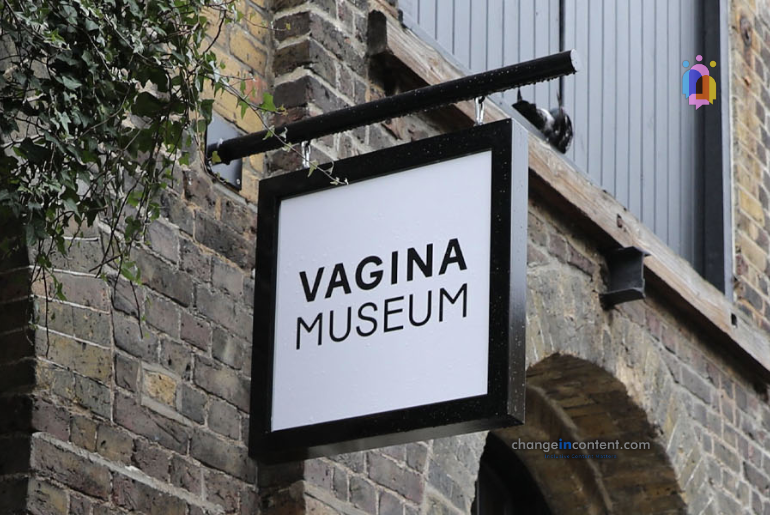
In 1997, Iceland opened the world’s first phallological museum dedicated entirely to penises. However, there was no equivalent for vaginas anywhere in the world. Inspired by this discrepancy, London-based scientist Florence Schechter decided to take matters into her own hands and create the Vagina Museum to challenge societal taboos and stereotypes surrounding female genitalia. In 2019, her vision became a reality as she opened the doors to the world’s first Vagina Museum dedicated to the vagina, vulva, clitoris, and gynaecological anatomy.
Institutional patriarchy and the Vagina Museum’s location hunt
The Vagina Museum initially opened in Camden Market, North London, in 2019. However, the landlords declined to renew their lease, opting to transform the space into a clothing shop. The landlords refused to renew the lease because they found the name “Vagina” off-putting. Instead of allowing the museum to continue in its current space, they proposed relocating it to a top-floor location where it would be less visible to the public. But one should not treat “vagina” as a taboo or dirty word that they have to hide away.
Ironically, the penis museum never encountered the challenges the vagina museum did. They weren’t denied space or asked to relocate to a place where they had to hide their name.
The Journey of the Vagina Museum
The Vagina Museum approached several property owners in London, but each one turned down their proposals without giving an apparent reason. Florence Schechter, the museum’s founder, criticised “institutional patriarchy” for its ingrained biases, which make it difficult for spaces like the Vagine Museum, focused on female anatomy and empowerment, to succeed.
The Vagina Museum relocated to its first Bethnal Green location in 2022, where it showcased exhibitions like “Periods: A Brief History” and “From A to V,” focusing on gynaecological anatomy and activism. However, in February 2023, authorities abruptly asked the museum to leave due to a property guardianship scheme.
Following a successful fundraising effort that exceeded an £85,000 target, the museum relocated to a larger space on Poyser Street, Bethnal Green, which opened on November 4, 2023. Over 2,500 people contributed to the fundraising campaign.
Inclusivity and education: The mission of the Vagina Museum
The museum’s main objective, Schechter says, is to counter taboos. “We can’t be fighting for abortion rights, fighting for access to obstetric care, fighting rape culture… if we can’t even say the word vagina.”
Shockingly, there are still many who confuse the vulva with the vagina, remain misinformed about periods, cling to outdated beliefs about the hymen and virginity, and perpetuate absurd notions about women’s biological functions. This is not helped by the fact that over the past 25 years, nearly half of scientific papers focused only on male animals, while a mere 8% bothered to look at female ones.
What research says
A 2014 study by Eve Appeal shows that only half of UK women aged 26 to 35 could accurately label a vagina on a diagram. 65% of young women admitted difficulty using the words “vagina” and “vulva,” with 40% of 16 to 25-year-olds preferring terms like “lady parts” when discussing their gynaecological health. Why shame or hesitation when it comes to saying “vagina” or “vulva” out loud?
The Vagina Museum believes it’s high time to eliminate taboos surrounding gynaecological anatomy and stereotypes. The museum’s 2019 exhibition “Muff Busters: Vagina Myths and How To Fight Them” attracted over 110,000 visitors. After their exhibition on periods, 89% of visitors said they had gained a better understanding of the history of menstruation.
“Gynaecological anatomy is nothing shameful; we want to get rid of that stigma,” Schechter explains. “We want people to know that there’s nothing to be ashamed of, there’s nothing to be embarrassed about. You can ask any question you want, that’s the overarching message in everything we do.”
The Vagina Museum rejects traditional gender roles and binaries. Everyone is welcome, whether cisgender or transgender, regardless of race, ethnicity, religion, age, or economic status.
The final thoughts
Society doesn’t discuss vaginas enough. On the other hand, penises are openly discussed or joked around in stand-up comedy, art, and media without shame or taboo. The social stigma surrounding female genitalia has persisted for centuries. Even when the Vagina Museum was forced to close temporarily and relocate, the Icelandic penis museum remained open.
As times change, so should our attitude towards female genitalia. In a society where female genitalia remains taboo, a vagina museum boldly aims to confront these outdated and demeaning attitudes towards women. It’s not just a museum. It’s an educational place that promotes respect, empowerment, and inclusivity because, sadly, these values are still lacking in this day and age.
Disclaimer: The views expressed in this article are based on the writer’s insights, supported by data and resources available both online and offline, as applicable. Changeincontent.com is committed to promoting inclusivity across all forms of content, which we define broadly to include media, policies, law, and history—encompassing all elements that influence the lives of women and gender-queer individuals. Our goal is to promote understanding and advocate for comprehensive inclusivity.