
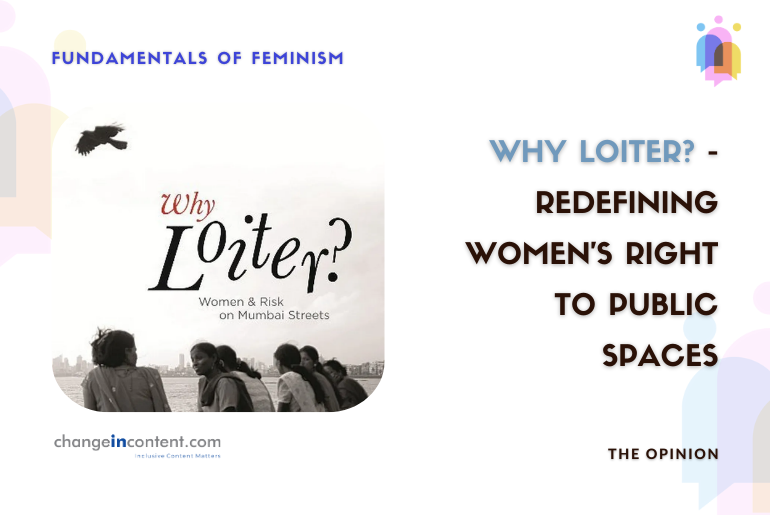
Why Loiter? Women and Risk on Mumbai Streets, written by Shilpa Phadke, Sameera Khan, and Shilpa Ranade, offers a profound examination of women’s safety and their right to public spaces in twenty-first-century urban India. Through over three years of research in Mumbai, the authors map out the exclusions and negotiations that women from various classes and communities encounter in urban public spaces.
Why Loiter? About the book
Shilpa Phadke initiated the project. However, Sameera Khan, a Mumbai-based journalist, and Shilpa Ranade, an architect, later joined the project. Their main aim was to highlight the social issues women face regarding the usage of public spaces in Mumbai. The book was first published on February 15, 2011.
The book has four parts:
- City Limits
- Everyday Spaces
- In Search of Pleasure
- Imagining Utopias
1. Mumbai and Her Fearless Women
The first part, “City Limits,” explains the choice of Mumbai as the setting for their research. People often laud Mumbai as one of the most progressive cities in India concerning women’s rights. Yet, the authors reveal how, even in a modern city, both explicit and implicit rules constrain women’s freedoms. These rules, born out of fear of physical violence and damage to reputation, dictate when, where, and how women may access the city. The authors note, “The women in Mumbai may appear to be modern and brazen. However, they actually operate according to very specific internal and external rules. These rules negotiate how and when and where they may access the city.”
2. Women and public spaces
The second part, “Everyday Spaces,” provides insights for urban planners on how to design public spaces that consider women’s hygiene and comfort. The authors argue that poorly designed public spaces, combined with male dominance, make it difficult for women to access these areas. They emphasise that creating inclusive and safe environments is crucial for enabling women to use public spaces freely.
3. Women and pleasure
The third part, “In Search of Pleasure,” delves into the experiences of various categories of women—young, old, rich, poor, Muslim, working women, sex workers, and lesbians—and how they navigate public spaces for enjoyment. The book highlights how societal judgments and the fear of being labelled as “bad women” restrict women’s movements. They also talk about how it limits their ability to enjoy public spaces.
4. The necessity of Loitering
The final part, “Imagining Utopias,” discusses the necessity of loitering for women and how this act can make public and semi-public areas more women-friendly. The authors advocate for a society where women can use public spaces without having to justify their presence. They argue that creating a genuinely egalitarian city requires challenging gender biases and enabling women to take risks for their enjoyment.
Safety and underlying complexities
The book challenges the traditional notion of safety. It argues that the denial of access to public spaces is a greater threat to women than the potential for sexual assault. As the authors assert, “We believe that it is only by claiming the right to risk that women can truly claim citizenship. To do this, we need to redefine our understanding of violence in relation to public space–to see not sexual assault, but the denial of access to public space as the worst possible outcome for women.”
The limitations
While the readers praise the book for its well-cited arguments and practical discussion of urban planning, it has faced criticism. The criticism comes for its cursory treatment of transwomen. Although mentioned, the writers have not explored these groups in depth. That leaves a gap in the otherwise comprehensive approach to women’s issues in urban spaces. Furthermore, the book’s treatment of lesbian and butch identities is seen as conflated and confusing.
What is still relevant?
The focus on women’s safety as a reason to keep them off the streets harms women in multiple ways:
- It perpetuates the idea that a woman should be able to keep herself from harm, making any harm she encounters a result of her lack of judgment.
- It absolves the city of its responsibility to create infrastructure that supports women in public, allowing the urban environment to remain hostile.
- It neglects the fundamental right of women to enjoy themselves in public spaces in any manner they choose.
Why Loiter? The relevance in today’s time
One of the central themes of Why Loiter? is the act of loitering without purpose as a radical claim to public space. The authors argue, “Loiter without purpose and meaning. Loiter without being asked what time of the day it is, why we are here, what we are wearing, and whom we are with. That is when we will truly belong to the city and the city to us.” This act of loitering challenges societal norms and asserts women’s right to the city on their terms.
The discussion of risk in the book extends beyond physical violence to include the societal implications of women being seen in public spaces. The authors argue that choosing to take risks, including the risk of sexual violence, undermines a sexist structure that prizes women’s virtue over their desires or agency. This stance challenges the antiquated values that continue to constrain women’s freedoms.
Why Loiter? The final thoughts
In today’s world, we need to make public spaces that can have every kind of person in a particular proportion of male, female, kids, old aged, disabled, and not just one gender dominated. And as genuinely stated in the book, we cannot suddenly reduce the rate of harassment in public spaces. Still, we need to stop asking the victims being there, at what time, in which kind of clothes and with whom because we have the freedom to take the risk for some amount of enjoyment and if not, then the city doesn’t deserve the bold and liberal women.
Why Loiter? concludes with a call to recognise the pursuit of fun as a fundamental right for women. The authors push back against the notion that women should only seek fundamental survival freedoms. They also argue that true equality includes the right to enjoy and engage with public spaces. The question, “Is it possible for good girls to have fun?” explores the cultural biases surrounding labels like “good girl” and “bad girl.”
Why everyone should read ‘Why Loiter?’
Why Loiter? is a powerful and engaging book that challenges traditional notions of safety and citizenship for women in urban India. It calls for a radical rethinking of how cities are designed and how women’s rights to public spaces are understood and valued. Despite its shortcomings, this work remains a crucial contribution to feminist literature and urban studies. It pushes for a more inclusive and egalitarian society.
“Imagine our streets full of women, talking, strolling, laughing and gesticulating. Visualise parks and beaches dotted with young women sitting alone. Imagine street corners taken over by old women reflecting on the state of the world. Think of maidans occupied by the women workers planning their next strike for a raise in minimum wages.
If one can imagine all of this, one can imagine a radically altered city!”
Disclaimer: The views expressed in this article are based on the writer’s insights, supported by data and resources available both online and offline, as applicable. Changeincontent.com is committed to promoting inclusivity across all forms of content, which we define broadly to include media, policies, law, and history—encompassing all elements that influence the lives of women and gender-queer individuals. Our goal is to promote understanding and advocate for comprehensive inclusivity.

1 comment
If you are gоing for best сontents like me, just pay a
visit this website everyday as it gives feature contents, thanks