
Words we throw at women often come wrapped in casual conversations, jokes, and even well-meaning compliments. Yet, these words shape how society views women, limiting their choices and defining their roles in ways that rarely apply to men.
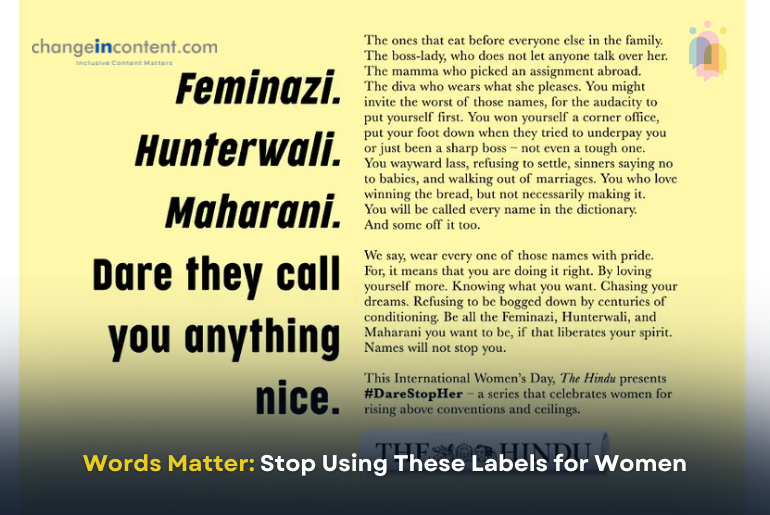
The other day, I came across The Hindu’s 2022 Women’s Day campaign. Words like Feminazi, Hunterwali, and Maharani were printed boldly in the newspaper ad. These are, of course, very famous labels, adjectives, or whatever society throws at ambitious women. But are these really just words, or are they a convenient way to police women who dare to live on their terms? More importantly, do they ever come from a place of good intent? In the words of Ariana Grande from the musical Wicked, “Don’t make me laugh!”
/afaqs/media/post_attachments/a74b2b1b851f585f458b1cebab8a7276d6265864888eaed2a5280106cbd9ccb3.png)
The misogynistic labels we throw
Maharani, for example. It literally means “queen,” but when someone hurls it at a woman, it’s rarely a compliment. It’s a sarcastic jab, a way to mock confidence and authority. Then there’s Feminazi, a term that somehow equates wanting equal rights with extremism. Hunterwali is now used to describe women who refuse to be docile.
That is precisely what the campaign calls for, too. The Hindu’s campaign is a by-product of what women have been enduring in society for simply wanting more for themselves. Women don’t need a title, sarcastic or not, to justify their right to exist on their terms.
Why is assertiveness seen as leadership in one gender but arrogance in another? I always wonder why ambition earns men respect but labels women bossy or entitled for the same behaviour. Sooner or later, we have to admit that these labels do more harm than good.
Words we throw at women: The burden of ‘Fearless’ names
There is something else we refuse to reconsider or perhaps conveniently overlook, how we turn rape victims into martyrs as if that somehow justifies their unjust deaths. The late Jyoti Singh Pandey’s parents have publicly used her name since 2013, making it clear they want her identity acknowledged. Yet, the media insists on calling her Nirbhaya.
Nirbhaya, meaning “fearless,” was an alias given when her name remained undisclosed. It was chosen to frame her as a warrior, a survivor fighting for her life. But even after her death, and even after her real name became known, whether intentionally or by accident, this label stuck. What started as admiration morphed into an SEO keyword for rape victims, a sanitised narrative that conveniently ignores the horror of what happened to her.
On the third anniversary of the gangrape that led to the Criminal Amendment Law Act of 2013, her mother, Asha Devi, told the media, “My daughter’s name was Jyoti Singh, and I am not ashamed to name her. Those who commit heinous crimes like rape, their heads should hang in shame, not the victims or their families. You should take her name too.“
The name “Abhaya,” too, carries a similar fate. When we tag these “fearless” names to victims of rape, we are doing more than simply labelling them. We are imposing an unrealistic and damaging ideal on these women. Would we, as a society, show less respect to these victims if we acknowledged that they, too, were afraid, even for a moment?
The humanity we ignore
Fear is a natural human response, particularly when faced with extreme violence. Rape victims, like anyone else, are human. They feel fear. They are scared. Yet, by continuing to call them “fearless” posthumously, we ignore the raw humanity of their suffering. It allows society to forget the brutality of their assault, the violence inflicted upon their bodies, and the lasting trauma that follows such an ordeal.
The brutality Jyoti Singh faced, along with countless other women and children, gets lost under the weight of a name that demands heroism instead of justice.
The hypocrisy of labels
Certain words seem to exist solely for women as if society keeps a separate dictionary just for us. Some sound like compliments until you realise they come with expectations that box women into predefined roles. Take ladylike, a word that serves as a polite way to hand women a rulebook on how to behave. Sit properly, speak softly, don’t swear.
Then come the classics: hysterical and emotional. A man passionately argues his point, and he’s assertive. A woman does the same, and she is hysterical. And, of course, society reserves drama queen for women (and gay men) who are supposedly too emotional or attention-seeking. But have you seen Mercedes boss Toto Wolff screaming and smashing his headphones after Lewis Hamilton crashed at a dramatic Saudi Grand Prix?
He slammed his hands on the table, pushed his chair back with force, and yelled “no” twice before letting out a furious “fuck!” Then, just to drive the point home, he shouted it again. Not a single person called him a drama queen.
Funny how that works.
Words we throw at women: The final thoughts
Career woman, working mother, girl boss, She-E-O, mumpreneur. Meanwhile, men are just CEOs, never boy bosses. No one calls them working fathers, either.
It is time we stop turning women into symbols, whether to shame them for their ambition or to rewrite their suffering into something palatable. Women don’t need to be fearless to deserve respect, nor should they be reduced to caricatures for simply wanting more. The stories we tell about women should not be overshadowed by unrealistic ideals that are far from empowering.
Disclaimer: The views expressed in this article are based on the writer’s insights, supported by data and resources available both online and offline, as applicable. Changeincontent.com is committed to promoting inclusivity across all forms of content. We broadly define inclusivity as media, policies, law, and history—encompassing all elements that influence the lives of women and gender-queer individuals. Our goal is to promote understanding and advocate for comprehensive inclusivity.
