
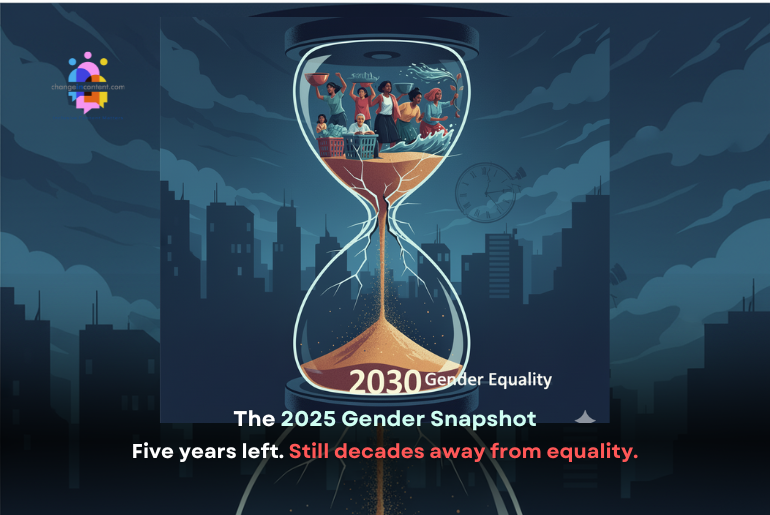
The 2025 Gender Snapshot paints a sobering picture: five years away from the 2030 deadline for the SDGs, gender equality is nowhere near reality. From unpaid care work to political underrepresentation and the deepening impact of the climate crisis, women and girls continue to carry a disproportionate burden. It is not just a failure of policy, but also a failure of justice.
The 2025 Gender Snapshot: Where do we stand?
In 2015, world leaders committed to the Sustainable Development Agenda, setting 17 Sustainable Development Goals (SDGs) and 169 targets to be achieved by 2030. The goals and targets under this agenda promise human rights for all, gender equality, and the empowerment of women and girls. As 2026 approaches, just five years remain to fulfil these commitments.
However, the latest Gender Snapshot report by UN Women and UN DESA shows that we are far from achieving the SDGs. Covering more than 100 data sources, the 2025 Gender Snapshot report reveals that serious setbacks remain in women’s health, education, paid work, and political representation.
Poverty and food insecurity disproportionately affect women.
In 2025, around 9.2% of women and girls live in extreme poverty, compared to 8.6% of men and boys. If nothing changes, this means about 351 million women and girls could still be struggling to survive on the bare minimum by 2030. But there is hope that if governments and societies act faster, the number of women in extreme poverty could drop sharply, falling from today’s levels to just 2.7% by 2050.
Today, 64 million more women than men lack sufficient food. Poor diets lead to serious health problems, and one of the most common conditions is anaemia. Among women aged 15 to 49, cases of anaemia are expected to rise from 31.1% in 2025 to 33% in 2030.
The unpaid burden of domestic work on women
Across the world, women and girls spend far more time than men on housework and caregiving. On average, they give up two and a half times more hours each day. Unfortunately, in regions such as Northern Africa and Western Asia, women spend more than 4X as many hours as men on unpaid tasks. During COVID-19, for example, 62% of women with disabilities over 60 said their childcare duties increased. At the same time, 33% of women without disabilities reported the same.
Because so much of their time is spent on unpaid work, around 708 million women remain outside the labour force altogether. Even those who do have jobs cannot match men’s paid hours. In 2024, women in paid work spent six hours and twenty-five minutes less per week than men.
Care work, or unpaid domestic work, should not fall solely on women. Societies need to share these responsibilities more equitably so that women can participate fully in education, work, and public life.
The gendered impact of the climate crisis
Women are among the most affected by the climate crisis. Under the worst climate scenarios, up to 158.3 million additional women and girls could be pushed into extreme poverty by 2050. These women will be living on less than $2.15 per day. When considering poverty thresholds of $3.65 and $6.85 per day, over 422 million women and girls are at risk. That is 16 million more than men and boys.
Food is becoming harder to access, and the climate crisis is expected to leave around 236 million more women and girls struggling with hunger. Yet even while they bear the worst of the crisis, women are rarely represented in climate policies. Out of 64 countries, only 25 have established effective systems to incorporate gender equality into their climate policies.
Money that could change this is barely reaching the right places. In 2022–23, less than 1% of global aid intended for climate and gender goals was allocated to women’s rights groups. These are the very organisations working closest to the ground. Still, they are left underfunded and overlooked.
Peace, security, and humanitarian action
By 2030, women’s full, equal, safe, and meaningful participation in peace and security actions should be the global norm. Reality, however, is that in conflict-affected countries, women hold only 20% of parliamentary seats. That number is significantly lower than the global average of 27%. Their involvement as negotiators, mediators, and signatories in peace processes remains far below the United Nations’ one-third target.
113 countries have adopted national action plans on women, peace, and security. However, only 55% of these countries make long-term commitments to women’s participation in peace negotiations. The report says that representation remains symbolic without women at the decision-making table.
Leadership and decision-making
Representation in political and institutional leadership has grown but remains uneven. As of August 2025, only 29 countries had a woman serving as Head of State or Government. This number is up slightly from 22 five years earlier. While women have achieved parity in lower courts, their representation in constitutional and supreme courts remains at just 0.75, relative to their population share. Managerial roles are projected to show only modest improvement, rising from 30% in 2025 to 32% by 2050.
Decision-making continues to rest in men’s hands across most levels. In national parliaments, women hold just 27.2% of seats. Unfortunately, their representation in local governments is stagnated at 35.5% in both 2023 and 2024. Progress has slowed to an annual average of only 0.5% points since 2020.
The gender snapshot report warns that as the world marks 30 years since the Beijing Declaration and enters the final five years before the 2030 deadline for the SDGs, setbacks must not erase the progress already made.
Sima Bahous, executive director of UN Women, in a statement, said, “I encourage all leaders to make commitments and investments towards this. I also encourage them to choose a world where women’s rights are delivered at scale and the returns are shared by all.“
The 2025 Gender Snapshot: The final thoughts
We are far from reaching gender equality by 2030. Millions of women remain trapped in extreme poverty. They carry the heaviest share of care work, and struggle to access opportunities that others take for granted. Political representation and leadership roles continue to be dominated by men. Even when women are present, their participation often remains symbolic rather than meaningful.
With just five years left to achieve the Sustainable Development Goals, action cannot wait. Governments must commit to implementing meaningful policies and investments. At the same time, communities and societies must support and challenge unfair norms. Every individual can make a difference in small, everyday ways. For example, sharing chores, childcare, or household duties at home takes some burden off women. Simple actions like these help women have more time for work, education, or even self-care. All these will add up to real change over time.
Changeincontent perspective
At ChangeInContent, we believe the 2025 Gender Snapshot should be treated as more than a report; it is a wake-up call. The numbers prove what women already live daily. However, equality remains a distant promise unless governments, businesses, and individuals take decisive action. Achieving gender equality by 2030 is still possible, but only if we start treating it as a priority, not an optional goal.
Also Read: It’s almost 2025, and gender equality is still a distant dream.
Disclaimer: The views expressed in this article are based on the writer’s insights, supported by data and resources available both online and offline, as applicable. Changeincontent.com is committed to promoting inclusivity across all forms of content. We broadly define inclusivity as media, policies, law, and history. It encompasses all elements that influence the lives of women and marginalised individuals. Our goal is to promote understanding and advocate for comprehensive inclusivity.
