
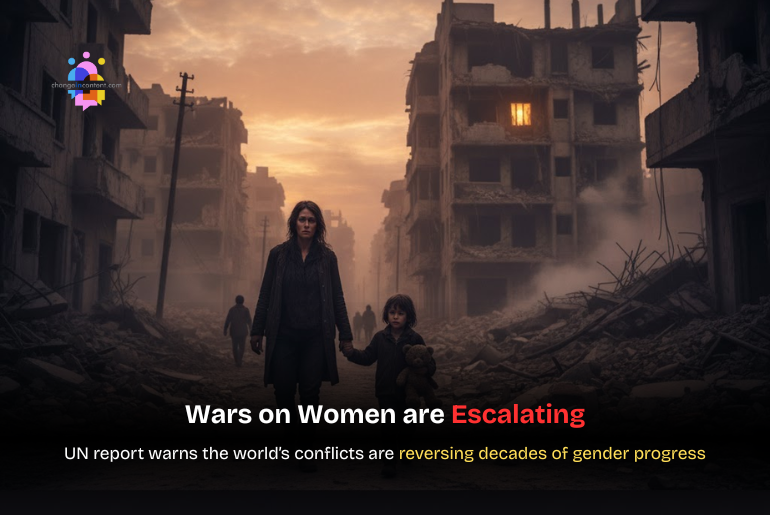
War has never been gender-neutral. From Gaza to Sudan, from Ukraine to Myanmar, women’s bodies, voices, and rights have become silent battlefields for the world’s loudest conflicts. Wars on women are only growing, and that should concern us as a society.
The 2025 UN Secretary-General’s Report on Women, Peace, and Security reveals a grim truth. It says that the number of active conflicts across the globe has reached its highest point since 1946. Over 676 million women now live within 50 kilometres of deadly conflict zones.
Civilian casualties among women and children have quadrupled in just two years. At the same time, the cases of conflict-related sexual violence have surged by 87%.
Twenty-five years after the world promised to protect women through UN Security Council Resolution 1325, that promise stands shattered. The wars have changed. However, their most enduring casualties remain women.
The numbers behind the violence
Numbers rarely tell the whole story, but these ones are impossible to ignore:
- 676 million women live near active conflict zones. It is the highest in decades.
- Women and children form the majority of civilian deaths in modern wars.
- Sexual violence in conflict zones rose by 87% in just two years.
- Only 7% of negotiators and 14% of mediators in peace processes are women.
- Global military spending hit USD 2.7 trillion. At the same time, women’s organisations in conflict zones received just 0.4% of aid.
These figures are not data points; they are verdicts. They tell us that peace is still negotiated by those who wage war. Unfortunately, women remain confined to the margins of decisions that determine their survival.
Wars on women: What it really means
The term “Wars on Women” is no longer metaphorical. It describes how conflict weaponises gender.
Women are not only victims of direct violence. Instead, they are disproportionately affected by the collapse of systems that sustain life. These systems are health care, education, safety, and economic stability.
When conflict strikes, men are drafted or displaced. However, women are left to hold collapsing communities together. They nurse the wounded, rebuild homes, and care for children while facing the constant threat of assault.
In countries torn apart by conflict, rape is not just a consequence of war; it is a strategy. It destroys social fabric, instils fear, and asserts control.
And yet, despite being the first responders and the last line of survival, women are consistently excluded from peace negotiations.
From protection to participation: The failing promise of Resolution 1325
When the UN Security Council adopted Resolution 1325 in 2000, it was historic. For the first time, the global community recognised women’s right to participate fully in peacebuilding and security decision-making.
But 25 years later, the promise has largely failed.
In 2024, 9 out of 10 peace processes had no women negotiators. The agenda that was meant to empower has been reduced to paperwork. We celebrate it in speeches but forget it on the battlefields.
As UN Women Executive Director Sima Bahous said:
“Women and girls are being killed in record numbers, shut out of peace tables, and left unprotected as wars multiply. Women do not need more promises; they need power.”
One should not merely think of wars on women as just physical. These wars are institutional, economic, and political. The world invests trillions in defence, but barely enough to defend women.
When the world funds war, not women
The UN report exposes a shocking imbalance. In 2024 alone, global military expenditure exceeded USD 2.7 trillion. Unfortunately, women-led organisations in conflict zones received just 0.4% of humanitarian funding.
This is not a financial gap; it is a moral one.
When resources flow to weapons instead of welfare, women’s bodies become the collateral damage. Health systems crumble, maternal mortality rises, and access to reproductive care vanishes overnight.
The world continues to invest in destruction faster than it invests in peace.
Why representation matters in peace processes
Research is clear: when you involve women in peace negotiations, agreements are 35% more likely to last at least 15 years. Women-led interventions focus more on community recovery, education, and long-term stability. These are the very elements that make peace sustainable.
Yet they remain tokenised or absent. It is not a lack of ability but a lack of access.
In conflict and post-conflict settings, women activists, journalists, and community leaders often face imprisonment, exile, or death threats. Their exclusion from peace tables is both a symptom and a strategy. It is a deliberate sidelining of the voices that would demand accountability.
The gender data gap: What we do not count, we cannot protect
The UN report also calls for a gender data revolution. That is because what remains unmeasured remains invisible.
Conflict-related data rarely capture gender-specific harm. Death tolls are reported, but the slow deaths caused by starvation, displacement, and sexual trauma are not.
Without disaggregated data, governments and global agencies cannot design policies that protect women. The absence of evidence becomes an excuse for inaction.
Reclaiming peace & ending wars on women: Changes we need
To dismantle the wars on women, the world must replace token inclusion with real power. That begins with:
- Mandatory gender representation in all peace negotiations.
- Dedicated funding for women-led organisations in conflict zones.
- Legal accountability for sexual and gender-based violence in war.
- Data transparency, tracking women’s participation and protection metrics.
- Community reintegration programmes for survivors that focus on dignity, not pity.
As the UN Women report concludes, women are not just stakeholders in peace but the architects of it.
Conclusion: Ending the war within wars
The wars on women are fought not only in conflict zones but also in conference rooms, parliaments, and policies that refuse to prioritise gender justice.
Every bomb dropped, every treaty signed without a woman’s voice, reinforces an old truth. The truth is that power, when unshared, becomes violence.
But the story is not without hope. Across the world, women’s groups continue to resist, rebuild, and reimagine peace — often with no funding, no spotlight, and no protection.
As the world marks 25 years of the Women, Peace and Security agenda, this must be the year of reckoning.
Peace cannot be called peace if half the world has no place in it.
Also Read: 15 years of UN Women: A global commitment to gender equality.
Disclaimer: The views expressed in this article are based on the writer’s insights, supported by data and resources available both online and offline, as applicable. Changeincontent.com is committed to promoting inclusivity across all forms of content. We broadly define inclusivity as media, policies, law, and history. It encompasses all elements that influence the lives of women and marginalised individuals. Our goal is to promote understanding and advocate for comprehensive inclusivity.
