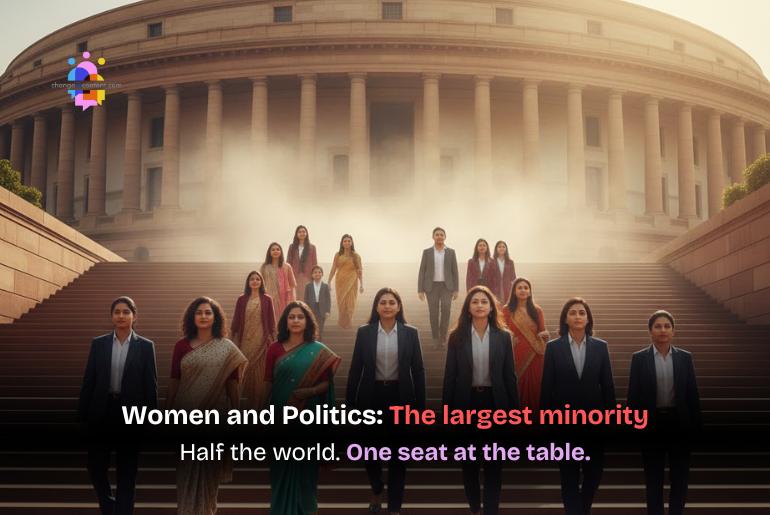
Every time a woman enters politics, the world still treats it like a miracle. ‘Women and politics’ together usually present a blurry image.
Zohran Mamdani’s decision to appoint an all-women transition team in New York City made headlines across continents. People called it “inspiring,” “historic,” even “bold.” And yet, that praise itself revealed how rare such moments still are.
Even now, in 2025, when women make up nearly half the global population, their presence in politics remains exceptional; not expected.
From New York to New Delhi, the reality is the same: women are everywhere in numbers, but missing in power.
The story that brought attention to the fact that women are the largest minority in politics
Zohran Mamdani, the mayor-elect of New York City, has appointed an all-women transition team to guide him as he prepares to take office in January. This team will play a key role in ensuring a smooth handover from Election Day to the inauguration, helping set the priorities and plans for his administration.
The group brings together experienced women from a wide range of fields, including social services, finance, city budgeting, and housing development. Progressive strategist Elana Leopold, a longtime aide to former Mayor Bill de Blasio and senior adviser to Mamdani’s campaign, will lead the team as executive director. The transition’s co-chairs include Maria Torres-Springer, former First Deputy Mayor; Lina Khan, former Chair of the Federal Trade Commission; Grace Bonilla, President of the United Way of New York City; and Melanie Hartzog, a city budgeting expert.
The announcement of an all-women transition team has drawn widespread attention and applause. The excitement around it showed that people are eager to see more women in positions of power and influence. It felt like a long-overdue step toward gender inclusion in political leadership. But at the same time, even today, having a woman in any political team is treated as rare or extraordinary, when it should be the norm.
So yes, it’s a big and inspiring moment, one that celebrates progress. Still, it also quietly reminds us that women, despite being half the population, remain the largest minority in politics.
Supreme Court highlights women’s unequal political representation
The Supreme Court of India, in a bench led by Justice B.V. Nagarathna and Justice R. Mahadevan, recently observed that women are the “largest minority” in the country. They make up 48.44% of the population, yet their representation in Parliament continues to decline.
On October 10, 2025, the Court sought a response from the Central government on a public interest litigation (PIL) filed by Jaya Thakur, urging the early implementation of the Nari Shakti Vandan Adhiniyam, 2023 (the Women’s Reservation Act). This law, part of the 106th Constitutional Amendment, mandates that one-third of all seats in the Lok Sabha, state legislative assemblies, and the Delhi Assembly be reserved for women. The act also ensures a sub-quota for women from the Scheduled Castes (SC) and the Scheduled Tribes (ST).
While the law was passed in 2023 and received President Droupadi Murmu’s assent, it has yet to be implemented. The reservation will only take effect after a delimitation exercise following the first census conducted after the act’s commencement, a timeline that remains uncertain.
Jaya Thakur had first approached the Supreme Court in 2023, seeking the law’s implementation before the 2024 general elections. At the time, the Court declined to hear the plea. Now, in her renewed petition, Thakur has called for action once again, arguing that delaying the reservation defeats the purpose of the equality guaranteed by the Constitution.
During the hearing, Justice Nagarathna remarked, “Who is the largest minority in this country? It is the woman… almost 48%. This is about the political equality of women.”
Senior advocate Shobha Gupta, representing Thakur, called it “unfortunate” that women must still move the courts for fair political representation even after 75 years of Independence.
Three decades of poor progress for women in politics
According to data from the Inter-Parliamentary Union (IPU), women’s participation in national parliaments remains frustratingly slow. In 1995, women held 11.3% of parliamentary seats across the world. Three decades later, in 2025, that number has only increased to 27.2%.
In India, women made up 7.2% of the Lok Sabha in 1995, and in 2025, the figure is only 13.8%. India now ranks 136th globally in women’s parliamentary representation, far behind many smaller nations that have made faster progress toward equality.
Why power still feels so ‘Male’
The Bihar Assembly elections recently recorded the lowest number of women candidates in 15 years. Out of 2,357 male candidates, only 258 women contested. Major political parties continue to justify this imbalance by citing winnability, the stereotype that women are less likely to secure votes.
BJP fielded 13 women, JD(U) 13, RJD 23, Congress 5, Jan Suraaj 25, and the BSP led with 26. In the last election, 26 women MLAs won out of 370 women contestants, a 7% success rate, compared to 10% for men.
Interestingly, in the 2020 elections, some parties did see better outcomes. BJP’s women candidates had a 69% success rate, RJD 44%, Congress 29%, and JD(U) 27%. Yet, overall representation continues to decline, making this the weakest showing for women in Bihar in a decade and a half.
Women and politics: States change, the truth remains the same
Since Haryana’s formation in 1966, only 87 women have ever been elected to its Assembly. In 2024, just 13 women secured victories, bringing the total number to 100 in nearly six decades. States like Chhattisgarh (14.4%) and West Bengal (13.7%) fare slightly better, but they still fall short of genuine equality.
At the local level, women’s presence appears better due to constitutional mandates, but it is just an illusion of representation. The rise of the “Sarpanch Pati” culture, where husbands unofficially control the roles of elected female representatives, shows how patriarchy continues to undermine genuine empowerment. (Read more in our article on how such patriarchal practices keep women invisible in Indian politics.)
Conclusion: Representation is not a gift, but a right
From New York to New Delhi, every “first” or “only” woman in power still feels like a milestone when it should be the norm. India has the talent, ambition, and capacity among its women, but not equal opportunity. True change will come when women’s participation is not treated as a quota to fill but as an essential part of governance.
Changeincontent perspective
At Changeincontent, we ask a question that too few are brave enough to raise: Why are women still treated like guests in the house of power they helped build?
The world celebrates every woman in office as a “first.” But that celebration hides something uncomfortable. The fact is that we have not normalised women in politics; we have only exceptionalised them.
India’s own Parliament mirrors that inequality. Even as women outvote men in states like Bihar, they hold barely 13.8% of seats in the Lok Sabha and 12% in Bihar’s Assembly.
This isn’t a lack of ability. It’s a system designed to reward the familiar — and in politics, familiar still looks male.
Real democracy begins when “first woman” stops being a headline. When power finally stops surprising itself with women in it.
Disclaimer: The views expressed in this article are based on the writer’s insights, supported by data and resources available both online and offline, as applicable. Changeincontent.com is committed to promoting inclusivity across all forms of content. We broadly define inclusivity as media, policies, law, and history. It encompasses all elements that influence the lives of women and marginalised individuals. Our goal is to promote understanding and advocate for comprehensive inclusivity.