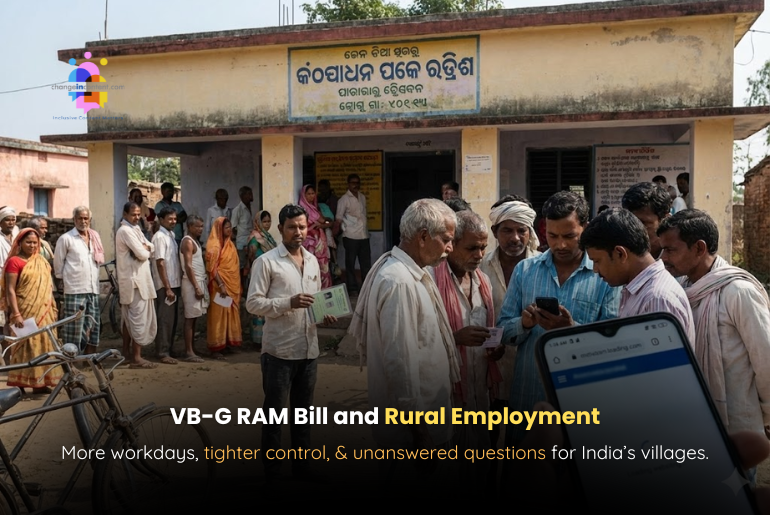
The VB-G RAM G Bill arrives at a fragile moment for rural employment in India. Just months ago, nearly 27 lakh workers were removed from the MGNREGA database after the rollout of electronic Know Your Customer checks. Many of these were removed not because they ceased to function, but because digital systems failed them. Limited internet access, biometric mismatches, and low digital literacy turned verification into exclusion.
Now, Parliament has passed the Viksit Bharat–Guarantee for Rozgar and Ajeevika Mission (Gramin) Bill. The government positions it as a replacement for the two-decade-old MGNREGA framework. The government argues that rural livelihoods have changed and that the old system no longer reflects current realities.
The new law promises more guaranteed workdays and tighter oversight. But it also shifts power away from communities, increases dependence on digital systems, and redefines employment as a budget-controlled programme rather than a legal right. Whether the VB-G RAM Bill strengthens rural livelihoods or deepens existing gaps depends entirely on how these changes play out on the ground.
About the VB-G RAM G Bill
The Viksit Bharat–Guarantee for Rozgar and Ajeevika Mission (Gramin), or VB-G RAM G Bill, 2025, was introduced in the Lok Sabha on December 16, 2025. The government has stated that rural livelihoods have evolved over the last twenty years and that the old scheme no longer matches current needs.
In the 2024–25 financial year, authorities reported misuse of MGNREGA funds amounting to ₹193.67 crore. During the same period, only 7.61% of rural households completed the full 100 days of work promised under the scheme. These figures point to gaps between what the scheme promises and what workers actually receive. The proposed VB-G RAM G framework aims to fix issues such as the misuse of funds, poor oversight, and projects that do not add much value to villages.
Under MGNREGA, every rural household could seek up to 100 days of unskilled manual work in a financial year. The new bill raises this guarantee to 125 days, which could increase income security for many families. Like the earlier law, the bill keeps the rule that if authorities fail to provide work within 15 days of a request, the state must pay an unemployment allowance.
Key features and challenges under the VB-G RAM G Bill
The most significant change is the increase in the number of guaranteed workdays per household per year from 100 to 125. Other provisions include:
Clearer rules on wage delays
One improvement lies in accountability. The bill clearly states that workers must receive wages weekly or within 15 days. If delays occur, authorities must pay compensation. This provision directly addresses one of the most common complaints under MGNREGA.
Shift from demand-based work
Under MGNREGA, workers could ask for work at any time, and authorities had a legal duty to respond. If officials failed to provide work, they had to pay compensation.
VB-G RAM G changes this structure. Employment now depends on preset budget limits. When funds run low, work may stop even if people continue to ask for it. This weakens the idea of work as a guaranteed right and turns it into an administrative decision.
Higher financial burden on states
Earlier, the central government paid almost the full wage cost, while states contributed a small share. This enabled poorer states to run the programme without undue financial strain. The new bill requires states to cover about 40% of the total cost.
Reduced role of Panchayats
MGNREGA gave Gram Panchayats the power to plan and carry out works based on local needs. This approach focused on improving community participation and local decision-making. VB-G RAM G introduces tighter central planning and monitoring. As a result, Panchayats may have less control over project selection and execution, thereby weakening grassroots involvement.
Limits on seasonal work
Under the new law, authorities may temporarily suspend public employment projects during busy farming periods, such as sowing and harvesting. The rationale for this rule is to ensure that farms do not face a labour shortage when agricultural activity peaks. Supporters believe this helps farmers complete time-sensitive work and keeps food production on track.
However, critics raise serious concerns. Many rural workers rely on public employment schemes because farm wages often remain low, delayed, or uncertain. When officials suspend public works during these seasons, workers lose the freedom to choose where they work. In areas where private farm work pays poorly or offers irregular hours, this restriction can reduce overall income and increase financial stress for households.
In farming, women often receive lower wages than men for the same work. In many cases, families treat their labour as unpaid help rather than formal employment. Public employment schemes offered an alternative by guaranteeing equal wages, written records of work, and direct payments to women.
Who should decide the 60-day pause?
Agricultural seasons do not follow the same timeline across regions. Crop cycles depend on rainfall, soil, and local farming practices, which can vary widely even within the same state. A blanket 60-day pause imposed from above can disrupt public work at the wrong time, leaving workers without income when farm work remains scarce.
When Gram Sabhas make this decision, the pause can reflect real local conditions. Village assemblies know when farming activity actually peaks and when labour demand rises. This local decision-making helps ensure that public employment pauses only when alternative work is truly available, thereby protecting workers from sudden income loss.
Greater dependence on digital systems
The VB-G RAM G Bill places substantial reliance on Aadhaar linkage, digital attendance, and online monitoring to manage worker records and payments. The government presents these systems as tools to improve transparency and reduce misuse. However, recent experience under MGNREGA shows that heavy dependence on digital processes can create serious exclusions.
In November 2025, authorities removed nearly 27 lakh worker names from the MGNREGA database soon after the electronic Know Your Customer process began. Many of these deletions did not occur because workers stopped working, but because they could not complete digital verification. Poor internet access, lack of smartphones, biometric failures, and limited digital literacy played a significant role in cutting workers off from the scheme.
The digital divide affects not just a small group but a wide range of rural workers, including older workers, women, migrants, and people with disabilities. Digital access remains uneven, and technology does not work the same way for everyone. Treating digital systems as the default entry point risks excluding those who need employment schemes the most.
As the new bill replaces MGNREGA, it becomes critical not to repeat these mistakes. Any system that depends heavily on technology must also provide strong offline options, human verification, and empathetic grievance support.
VB-G RAM G Bill: The closing thoughts
While more workdays and faster wage payments are positive steps, the earlier experience with MGNREGA shows that the way the scheme is run is very important. Digital checks, limits on when work is available, and reduced local control could make it harder for the most vulnerable workers to benefit. Women, older workers, and those without good internet access may lose out if the system does not provide offline support or local flexibility.
The success of VB-G RAM G will depend on whether it truly protects people’s livelihoods and keeps work accessible for everyone who needs it.
Disclaimer: The views expressed in this article are based on the writer’s insights, supported by data and resources available both online and offline, as applicable. Changeincontent.com is committed to promoting inclusivity across all forms of content. We broadly define inclusivity as media, policies, law, and history. It encompasses all elements that influence the lives of women and marginalised individuals. Our goal is to promote understanding and advocate for comprehensive inclusivity.