
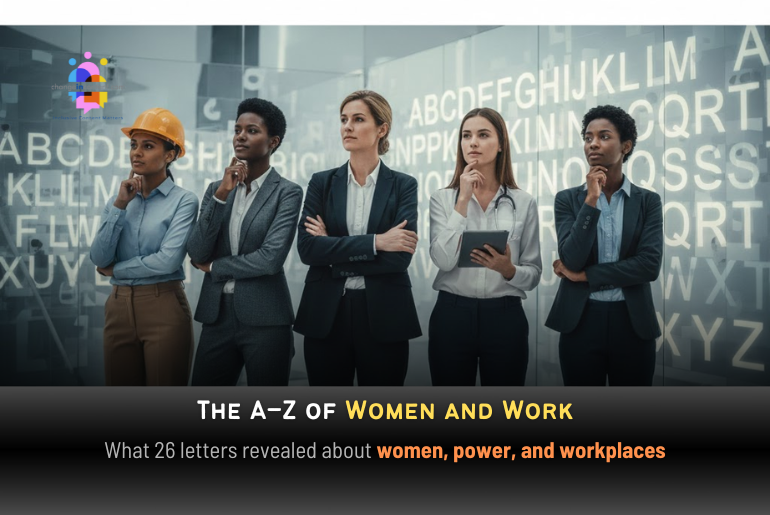
The A–Z of Women and Work was never meant to be a glossary in the traditional sense. We at changeincontent created it as a living record of what women experience in the workplace every day, often without language, recognition, or recourse. Over the course of this series, we explored 26 realities that shape how women enter, survive, grow, and, too often, leave work.
From bias and conditioning to leadership gaps, unpaid labour, quiet quitting, return-to-work penalties, and zero-tolerance failures, the A–Z of Women and Work mapped patterns that rarely appear in policy documents but consistently show up in women’s careers.
This editorial is not a recap. It is a reckoning with what we learned, what connects these issues, and why none of them exist in isolation.
What the A–Z of Women and Work really revealed
At first glance, each letter stood alone. Bias. Equal pay. Harassment. Networking. Sponsorship. Tokenism. Overwork. But as the series progressed, a clearer picture emerged. These are not separate problems. They are symptoms of the same structure.
Women are not excluded from work because they lack ambition. They are excluded because workplaces reward uninterrupted careers while expecting women to absorb care work. Women are not absent from leadership because they lack capability. They are absent because leadership pipelines rely on sponsorship, access, and trust that we routinely deny women. Women do not disengage because they are lazy. They disengage because systems demand more from them while giving less in return.
The A–Z of Women and Work demonstrated how early this begins. Youth bias dismisses young women before they can build authority. Conditioning teaches girls to stay agreeable. Pink-collar roles funnel women into undervalued work. Vertical segregation keeps them away from power even when they dominate a sector. By the time women reach mid-career, they are already negotiating burnout, bias, and invisible labour.
Why language matters more than we admit
One of the most powerful outcomes of this series was naming. Many women recognise these experiences instinctively but struggle to articulate them. The moment something is named, it becomes harder to deny.
Terms such as the glass cliff, impostor syndrome, quiet quitting, emotional labour, and X-factor bias shape various patterns. These are the same patterns that we used to dismiss as personal weakness or individual failure. Naming does not fix the problem, but it removes isolation. It shifts the conversation from “why can’t she cope?” to “why is this system designed this way?”
The A–Z of Women and Work functioned as a shared vocabulary. And shared vocabulary is the foundation of collective accountability.
What the series exposed about power at work
Across all 26 letters, one theme kept resurfacing: power is rarely neutral. It determines who receives flexibility without penalty, who receives the benefit of the doubt, whose mistakes are forgiven, and whose potential is invested in.
Women are often visible but not influential. Included but not empowered. Celebrated on Women’s Day but sidelined in decision-making rooms. Tokenism thrives where accountability is weak. Sponsorship gaps widen when leadership remains homogeneous. Zero-tolerance policies fail when seniority shields misconduct.
The A–Z of Women and Work made it clear that representation without authority changes nothing. Inclusion without enforcement is cosmetic. Progress without a redistribution of power is temporary.
Why women leave, and why that is not the real failure
Several letters in the series addressed exit points: overwork culture, return-to-work barriers, lack of work–life balance, and quiet quitting. These are often framed as women’s choices. The series reframed them as organisational outcomes.
Women do not leave because they stop caring. They leave because the cost of staying becomes too high. They leave because flexibility stalls careers. Because harassment goes unresolved, caregiving penalties compound. And because growth requires endurance, not excellence.
When women exit, the system rarely asks what went wrong for them. The A–Z of Women and Work insisted that this question must be asked, loudly and consistently.
The common thread: Systems that expect women to adjust
If there is one insight that binds this entire series together, it is this: workplaces are still designed around uninterrupted, male-centric life patterns. Women are expected to adapt to these systems rather than have them adapt to reality.
Menstruation, maternity, menopause, caregiving, health transitions, and emotional labour are treated as inconveniences rather than structural considerations. Women are praised for resilience rather than supported through reform. This expectation of silent adjustment is the invisible glue holding inequality together.
The A–Z of Women and Work exposed how deeply this expectation runs, from early careers to leadership roles.
Conclusion: Why the A–Z of Women and Work is one story
Each letter matters because each one feeds the next. Bias shapes opportunity. Opportunity shapes leadership. Leadership shapes policy. Policy shapes culture. Culture decides who stays safe, seen, and supported.
This series was not about highlighting problems in isolation. It was about showing how inequality sustains itself unless disrupted at multiple points. If organisations want women to stay, grow, and lead, they cannot fix one letter and ignore the rest.
The A–Z of Women and Work demands a holistic response, not symbolic gestures.
The ChangeInContent Perspective
At ChangeInContent, we do not believe gender inequality at work is a women’s issue. It is a leadership issue, a design issue, a data issue, and most importantly, a courage issue.
This series exists because silence has been normalised for too long. Because women still face the pressure to endure rather than question. Because workplaces still reward comfort over fairness.
The A–Z of Women and Work is our attempt to shift the narrative from celebration to scrutiny, from awareness to accountability. We hope it becomes a reference point, a conversation starter, and a mirror that organisations are willing to look into.
The alphabet ends here. The work does not.
Disclaimer: The views expressed in this article are based on the writer’s insights, supported by data and resources available both online and offline, as applicable. Changeincontent.com is committed to promoting inclusivity across all forms of content. We broadly define inclusivity as media, policies, law, and history. It encompasses all elements that influence the lives of women and marginalised individuals. Our goal is to promote understanding and advocate for comprehensive inclusivity.
