
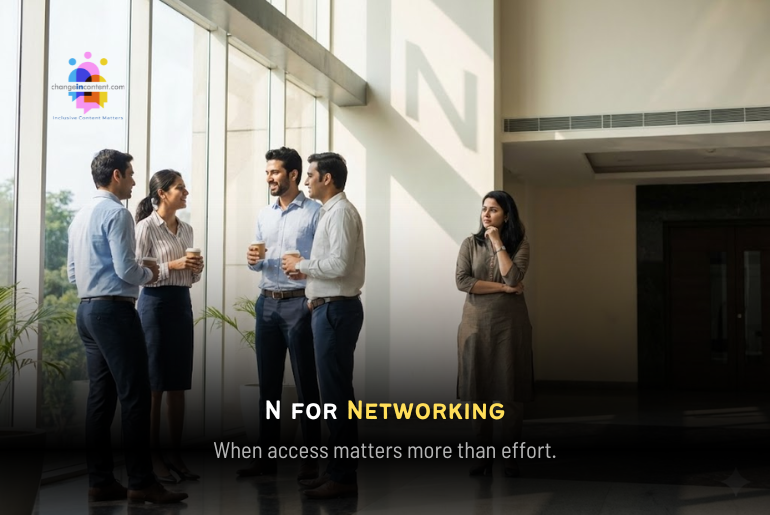
Networking is often described as a soft skill, but in reality, it is a powerful currency. It shapes careers, opens doors, and determines who gets visibility long before promotions are discussed. N for Networking examines how access to professional networks influences opportunity, and why women do not have equal access.
While networking helps people learn, grow, and collaborate, it also operates through informal spaces that are not always visible or welcoming. For many women, the challenge is not a lack of effort, but a lack of access to the circles where influence quietly moves.
The ‘Networking Gap’ women still face at work
For many women, the real challenge is not formal networking events but access to informal networks. These are the everyday spaces where relationships form naturally, such as casual conversations after meetings, quick coffee breaks, group chats, or decisions made outside official work settings. Important information, opportunities, and influence often move through these informal circles.
Women are frequently excluded from these spaces, sometimes unintentionally and sometimes through biased design. Social norms, male-dominated leadership, and gender-based grouping often lead to the same people repeatedly gaining access. Women who do not fit into these circles may miss out on visibility, mentorship, and timely information, even when they perform at least as well as, or better than, others.
Research also shows how invisible these informal networks can be to women. Many women do not even realise these groups exist until much later. Some only discover them by accident, long after key relationships and decisions have already formed. In several cases, women learned that colleagues met regularly outside work, not because someone told them, but because the information surfaced casually or indirectly.
Even when women receive invitations, the message often lacks clarity or intent. Instead of a clear plan or a direct ask, the invitation stays vague and non-committal. Phrases like “you can join anytime” leave the responsibility on women to push their way in, rather than feeling genuinely welcomed.
The Workplace Boys’ Club Problem
In many workplaces, influence does not come from job titles alone. It comes from informal boys’ clubs, the close groups of men who share access to information, decision-making, and opportunities. These keep women at a distance. A large survey by InHerSight showed that more than 50% of working women have experienced this kind of culture at some point in their careers.
A boys’ club culture places men at the centre of power. Leadership roles remain predominantly male, and women struggle to enter spaces where real decisions are made. Important conversations often occur over lunch, drinks, or private chats, and women are rarely invited. When women propose ideas, others may ignore them or attribute them to male colleagues instead.
Networking with gender sensitisation
Gender sensitisation helps people understand how everyday behaviour, bias, and assumptions affect women at work. Many forms of exclusion occur unintentionally, yet they still limit access and growth. Through sensitisation, employees and leaders learn to notice who gets invited into conversations, whose ideas receive support, and who gets left out. This awareness is the first step toward changing workplace culture.
Moving beyond policies to daily practice
Written policies alone do not create equality. Gender sensitisation focuses on daily actions and decisions. It encourages leaders to question informal power structures and recognise how boys’ club culture operates. Managers learn to distribute opportunities more fairly, give credit where it is due, and ensure visibility is not tied to personal comfort or gender.
Creating equal networking opportunities
To expand networking access for women, organisations must take a structured approach. Companies should create formal networking spaces rather than relying solely on informal meetups. Mentorship and sponsorship programs can connect women with senior leaders who actively support their progress. Mixed-gender teams and cross-functional projects also help women build strong professional relationships.
Removing practical barriers to participation
Workplaces should design networking opportunities that consider real-life constraints. Events held during work hours and in safe, accessible settings allow more women to participate. This approach recognises caregiving responsibilities and personal safety concerns without placing the burden on women to adjust.
The final thoughts
When access depends on informal circles, vague invitations, or boys’ club culture, women continue to miss out on visibility and influence through no fault of their own. Workplaces must question how networks form, who gets invited, and who benefits. When organisations pair gender sensitisation with fair, structured networking opportunities, they move closer to genuine inclusion.
ChangeInContent will return with the next letter in The A–Z of Women and Work, continuing the conversation on the realities women face at work and what needs to change.
Changeincontent perspective
Networking shapes careers long before performance reviews or promotion cycles begin. When access depends on comfort, similarity, or informal exclusion, inequality becomes routine rather than intentional.
At Changeincontent, we believe networking should not reward familiarity over fairness. When organisations actively design inclusive networking structures, they shift power, visibility, and opportunity, not just participation. That is how connection becomes equity.
Also Read: The A–Z of women and work: A year-end glossary | H for Harassment.
Disclaimer: The views expressed in this article are based on the writer’s insights, supported by data and resources available both online and offline, as applicable. Changeincontent.com is committed to promoting inclusivity across all forms of content. We broadly define inclusivity as media, policies, law, and history. It encompasses all elements that influence the lives of women and marginalised individuals. Our goal is to promote understanding and advocate for comprehensive inclusivity.
