
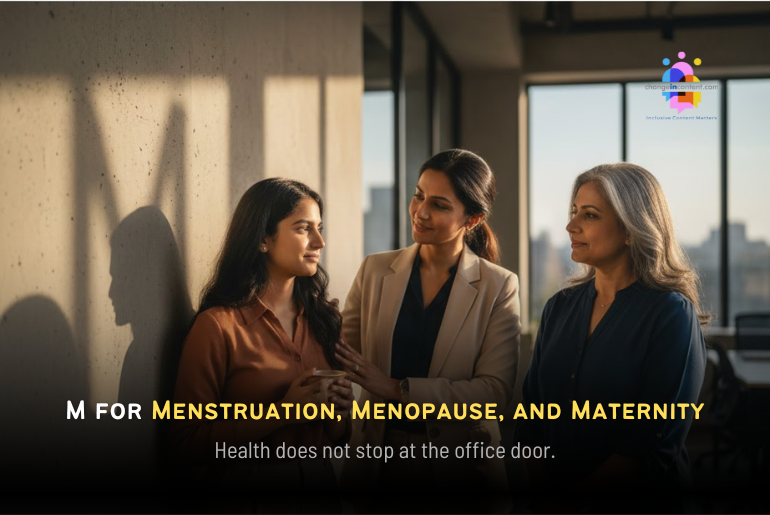
As we arrive at the letter M in our A–Z of Women and Work, the focus turns to something workplaces often treat as inconvenient rather than inevitable: women’s health. M for Menstruation, Menopause, and Maternity brings together three life stages that shape how women experience work (physically, emotionally, and professionally), often at the same time as they are expected to perform without pause or accommodation.
These are not exceptions or interruptions. They are normal, recurring realities across a woman’s working life. Yet many organisations still operate as if these stages do not exist, forcing women to adapt quietly while systems remain unchanged.
M for Menstruation (in the Workplace)
Many workplaces still fail to recognise menstruation as a normal part of working life. Women, particularly in lower-paid, shift-based roles, often struggle to access basic facilities, such as regular restroom breaks. The absence of women-friendly support systems makes menstruation a workplace equality issue. Moreover, silence around menstruation creates barriers at work.
Women continue to manage pain, fatigue, and medical needs without flexibility or understanding from employers. When organisations refuse time off for treatment or ignore simple accommodations, they are indirectly showing women’s health does not matter.
Slowly, this is beginning to change. Open conversations and emerging policies are helping break the taboo around periods. You can explore this shift further in our primary article on the status of menstrual leave policies in India.
M for Menopause (in the Workplace)
Menopause remains one of the most overlooked stages of a woman’s working life, even though its impact is significant. Symptoms such as anxiety, hot flashes, brain fog, and persistent fatigue can affect confidence, focus, and performance. This issue matters because nearly 8 out of 10 menopausal women are present in the workforce. While most women experience some symptoms, about 1 in 4 experience symptoms severe enough to disrupt daily work.
Supporting employees through menopause
Employers can create a more inclusive and supportive environment for menopausal employees by:
- Implement flexible working options, such as adjustable hours, remote work, or reduced schedules, during challenging periods.
- Ensure easy access to credible health resources, medical guidance, and counselling focused on menopausal health.
- Train managers and HR teams to understand menopause, recognise its impact, and respond with sensitivity and fairness.
- Design workplace environments that improve comfort, including temperature control, access to rest areas, and private spaces.
- Encourage open and respectful conversations so employees feel safe discussing menopause-related needs without stigma.
- Review performance evaluation practices to ensure temporary health-related challenges do not unfairly affect career progression.
- Promote wellness programmes that address physical and mental health, including stress management and sleep support.
- Communicate clearly that menopause support forms part of the organisation’s broader commitment to employee well-being and inclusion.
Maternity Leave and the Reality of the Maternity Penalty
While time off for childbirth and recovery is essential, many women return to work facing slower career growth, reduced responsibilities, or stalled promotions. This phenomenon, widely known as the maternity penalty, comes from the biased assumption that motherhood reduces ambition, availability, or capability.
Women often find themselves overlooked for key projects, excluded from opportunities, or informally sidelined after returning from leave. The challenge does not end with the duration of maternity leave. Gaps in career progression, loss of professional visibility, and pressure to “prove commitment” again create long-term setbacks that compound over time.
Workplaces can counter this by treating maternity leave as a temporary life stage rather than a professional disadvantage. Inclusive return-to-work plans, fair performance evaluations, flexible schedules, and accountability for managers play a critical role in preventing bias. When organisations actively address the maternity penalty, they protect women’s careers and retain experienced talent.
You can explore this issue in greater depth in our dedicated article on the maternity penalty.
Addressing health needs without reinforcing bias
Supportive policies play an important role, but they require thoughtful design. Menstrual or menopause-specific leave can sometimes create resentment or misunderstanding in the workplace, leading to unfair treatment of women or doubts about their commitment and capability.
To avoid this, companies should focus on inclusive health and flexibility policies that support diverse needs without singling women out in harmful ways. Real progress lies in building a culture of respect, openness, and flexibility in which women receive support without facing stigma or discrimination.
The closing thoughts
Menstruation, menopause, and maternity are normal parts of many women’s lives, and for most women, they happen while they are building careers, supporting families, and contributing at work. When organisations avoid talking about women’s health, women learn to stay quiet too. They work through pain, hide symptoms, delay medical care, and downplay major life changes.
Over time, this silence takes a toll. It affects confidence, performance, and long-term career choices. Some women step back. Others leave altogether. Not because they lack skill or ambition, but because the system was never built with them in mind.
This conversation is not only about women’s health. It is about how workplaces define commitment, productivity, and leadership. It is about recognising that strong organisations are built by people who feel safe, supported, and respected through all stages of life.
Changeincontent perspective
Women’s bodies do not pause for work, yet work continues to demand that women perform as if nothing changes. At Changeincontent, we believe workplaces cannot claim to value inclusion while ignoring menstruation, menopause, and maternity. These are not special considerations. They are fundamental realities. When organisations acknowledge women’s health without stigma or penalty, they do more than support women; they build systems that recognise people as a whole, not fragmented. That is what sustainable work entails.
Disclaimer: The views expressed in this article are based on the writer’s insights, supported by data and resources available both online and offline, as applicable. Changeincontent.com is committed to promoting inclusivity across all forms of content. We broadly define inclusivity as media, policies, law, and history. It encompasses all elements that influence the lives of women and marginalised individuals. Our goal is to promote understanding and advocate for comprehensive inclusivity.
