
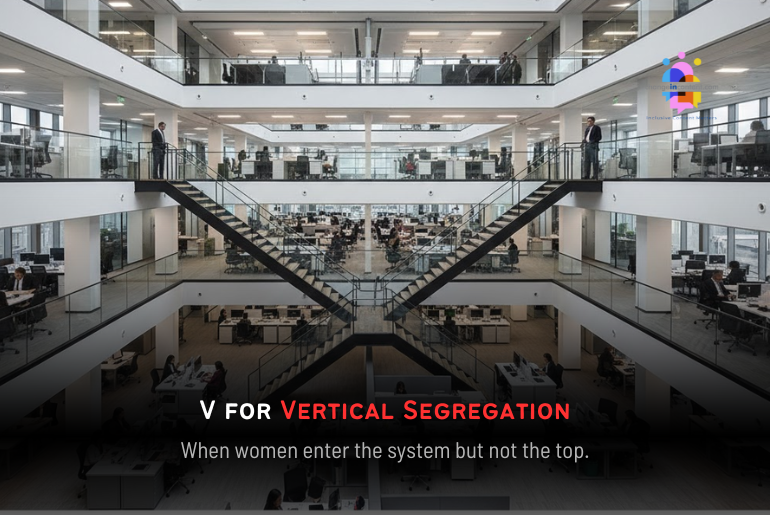
As we move to V in The A–Z Glossary of Women and Work, the focus shifts from access to ascent. Earlier, in J for Job Segregation, we examined how women and men are channelled into different kinds of work. Vertical Segregation poses a more difficult question: what happens after women enter the workforce?
Across industries, women show up, perform, and stay. Yet as roles climb higher in authority, influence, and decision-making power, women begin to disappear. This is not accidental. It is structural.
Vertical segregation explains why women are visible in organisations but absent from where power actually sits.
What do we mean by Vertical Segregation?
Vertical segregation or vertical occupational segregation refers to the unequal distribution of men and women across different levels of organisational hierarchy. Women may enter the workforce in good numbers and may even dominate certain professions, but they do not move to top roles or leadership positions in the same way.
Vertical segregation refers to the placement of men and women at different levels of power within the same field. Men typically occupy positions at the top of the hierarchy, including senior leadership roles, decision-making roles, and positions of authority. In contrast, women remain concentrated in lower- or mid-level roles, even when they hold the same or higher academic qualifications.
Horizontal segregation, on the other hand, focuses on the type of work men and women do, even when they belong to the same overall occupational group or industry. Here, men and women may work at similar levels, but they receive different tasks and responsibilities based on gendered expectations.
When representation does not lead to leadership
Vertical segregation becomes most visible in sectors where women make up a large share of the workforce but hold far fewer senior roles. Take the education sector. At first glance, it seems like a field dominated by women because female teachers lead many classrooms across the world.
Across 28 OECD countries, women constitute approximately 70% of lower secondary teachers, yet only 45% of school principals. In developing countries such as Sri Lanka, 71% of teachers are women, whereas women account for only 28% of principals. This means women handle most of the teaching roles but do not reach leadership in the same proportion, even when they have the academic credentials and experience to do so.
Education is only one example; the same vertical segregation occurs in many other sectors.
Why does this gap exist?
The problem lies not in women but in the environments in which they work and the expectations placed upon them. Vertical segregation grows when organisations value certain behaviours, assume certain stereotypes, and ignore the structural barriers women face.
Leadership stereotypes
Many organisations still hold the belief that men are “natural leaders,” while women are better suited to supportive, nurturing, or coordination-based roles. Managers may assume that men can handle pressure, authority, and risk more effectively, whereas women are better suited to service, communication, or team care roles. This bias steadily pushes men upward and keeps women in secondary positions.
Unpaid domestic and care work
Another critical factor lies beyond the office. Women continue to carry a larger share of unpaid domestic work and caregiving responsibilities. They often manage households, care for children, support elderly family members, and hold emotional responsibility for families. When leadership roles require long working hours, constant availability, extensive business travel, and limited flexibility, women face a dilemma.
Unequal access to sponsorship, mentorship, and advocacy
Career growth does not depend only on talent. It also depends on who advocates for you. Men often benefit from senior leaders who guide them, open doors, recommend them for significant projects, and speak for them in decision-making rooms. Women do not always receive the same level of sponsorship. Many talented women continue to work at high performance levels, yet no one advances their names, highlights their achievements, or advocates for their promotion when it matters.
How do we tackle Vertical Segregation?
Vertical segregation reminds us that women do not fall behind because they are less capable. They fall behind because workplaces, leadership cultures, and social expectations do not support their growth to the same extent.
Challenge leadership stereotypes and bias
Tackling vertical segregation also requires unlearning deeply rooted gender assumptions. Leaders and decision-makers must consciously question the belief that men are naturally better suited to power and that women are naturally suited to support. This means rethinking how leadership potential is identified, how promotions are discussed, and how performance conversations unfold. Training helps, but more importantly, accountability matters.
Make it easier to balance leadership and life
Leadership structures often clash with the realities of care, family, and social expectations. Supportive parental policies, flexibility without stigma, predictable schedules where possible, and empathetic managerial cultures make leadership more accessible.
Invest in mentorship, sponsorship, and visible opportunities
When someone advocates for women with the same intent, consistency, and influence that leaders have historically shown while supporting men, it creates a stronger and more inclusive leadership pipeline.
For decades, men have benefited from networks, mentoring, sponsorship, and informal support that have propelled them into key roles and growth opportunities. Women, on the other hand, have often had to prove themselves repeatedly, navigate bias, and work harder to be recognised, even when they possess equal or superior capabilities.
From symbolism to inclusion
Ultimately, tackling vertical segregation means shifting from celebrating women’s participation to ensuring women’s influence. It requires workplaces to move from symbolic inclusion to structural inclusion, in which policies, cultures, and leadership practices genuinely support women’s development.
Vertical segregation can change. However, it changes only when leadership recognises that equality does not end with the inclusion of women in the workforce.
The final thoughts
Vertical segregation highlights that having women in the workforce is not enough if power, influence, and senior leadership remain unequal. Women already contribute deeply to organisations and institutions. The next step is to ensure they have the same opportunities, confidence, and support as other groups.
ChangeInContent will return with the next letter in The A–Z Glossary of Women and Work, continuing this journey of improving understanding of workplaces.
Changeincontent perspective
Vertical segregation exposes the gap between participation and power. Workplaces often celebrate the number of women they employ while ignoring who gets promoted, who decides, and who leads. Inclusion that stops at entry-level access is incomplete.
Real equality begins when women rise through organisations at the same speed, with the same support and authority as men. Until leadership structures change, representation will remain symbolic rather than transformative.
Disclaimer: The views expressed in this article are based on the writer’s insights, supported by data and resources available both online and offline, as applicable. Changeincontent.com is committed to promoting inclusivity across all forms of content. We broadly define inclusivity as media, policies, law, and history. It encompasses all elements that influence the lives of women and marginalised individuals. Our goal is to promote understanding and advocate for comprehensive inclusivity.
