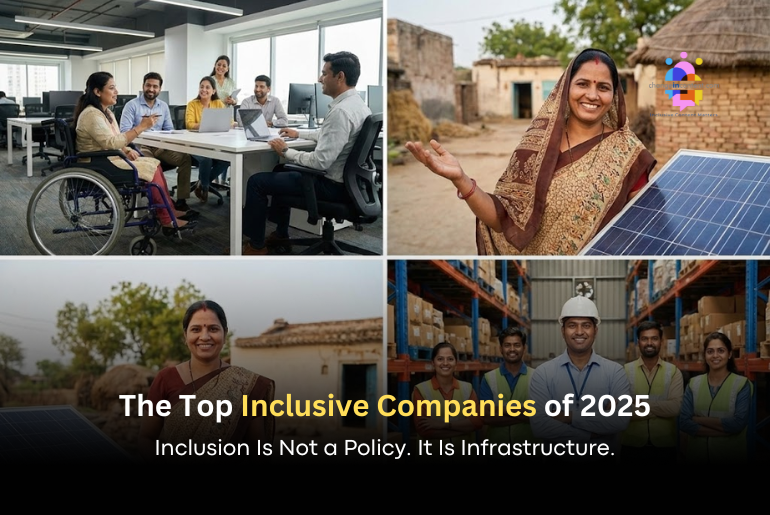
Every December, organisations publish glossy diversity reports. Many talk about intent. Fewer talk about outcomes. And even fewer show what inclusion looks like once it moves beyond hiring numbers and enters everyday work, leadership pipelines, and community impact. The top inclusive companies of 2025 demonstrate how incremental steps can make a significant difference.
As we approach the end of 2025, ChangeInContent looked closely at companies that did more than comply. We examined who stayed consistent, who invested when it was inconvenient, and who treated inclusion as infrastructure rather than optics. The result is not a ranking in the conventional sense. This curated editorial list features the Top Inclusive Companies of 2025. These are the organisations whose actions created measurable shifts within and beyond workplaces.
What inclusion looked like for the top inclusive companies of 2025
Inclusion this year did not revolve around slogans. It showed up in retention data, in return-to-work pathways, in leadership accountability, and in who was still standing when economic pressures made diversity budgets easy to cut.
Across industries, three patterns stood out.
- First, inclusive companies addressed the broken rung. It is the invisible barrier that keeps women from progressing beyond early-career stages.
- Second, they confronted the motherhood penalty. They did not do it with rhetoric about flexibility, but with redesigned systems.
- Third, the most credible organisations extended empowerment outside their payrolls. These organisations recognise that gender equity does not stop at the office door.
Inside the workplace: Companies that rebuilt the system
Let’s look at the top inclusive companies of 2025 and their actions to ensure inclusion remains a key priority.
Optum India
In India’s corporate landscape, Optum India continued to stand out. That is not because it introduced something new in 2025, but because it did not retreat. Its induction into the Avtar–Seramount Hall of Fame for the eighth consecutive year reflects a sustained commitment. The company continues to commit to gender-neutral parental leave, structured returnships, and leadership grooming that feeds global roles from India. What mattered was continuity. Inclusion did not pause during business cycle fluctuations.
Amazon
At Amazon, inclusion translated into scale. Programmes such as ElevateHER and Amazon WoW focused on career readiness and mentorship at different stages. At the same time, operational changesacknowledged that frontline roles need inclusion as much as corporate offices do. These changes included menstrual leave provisions and rest facilities for women in logistics.
Alight
Alight tackled one of the most persistent attrition points in corporate India: post-maternity exits. Its Care Circles and phased hybrid return-to-work model reframed flexibility as a transition, not a permanent trade-off. The result was not just higher retention, but stronger peer networks among women leaders.
Microsoft and Accenture
Global technology firms such as Microsoft and Accenture remained benchmarks in 2025 by tying leadership accountability to outcomes. Diversity targets were not symbolic; they were embedded in performance metrics and senior-level incentives. Representation at the top was not accidental, but was engineered.
Beyond Payroll: When inclusion reached communities
Inclusion deepened in 2025 when companies recognised that economic participation matters as much as workplace presence.
Hindustan Unilever Limited
Hindustan Unilever Limited’s Project Shakti continued to empower over 200,000 rural women entrepreneurs, not through charity, but through market access and digital enablement. The programme’s longevity proved that community empowerment can be commercially viable and socially transformative at the same time.
Tide
Fintech platform Tide moved steadily toward its goal of supporting half a million women-led small businesses by 2027. What distinguished its 2025 efforts was the focus on advisory support. The company works on acknowledging that access to finance without knowledge rarely changes outcomes.
Senco Gold & Diamonds
In the jewellery sector, Senco Gold & Diamonds’ #SheForHer campaign reframed women’s empowerment within traditional industries. The campaign combines financial grants with skill-building and visibility for women artisans and entrepreneurs.
Future-facing inclusion: Redefining who belongs
Some of the most compelling inclusion stories in 2025 came from organisations working outside mainstream corporate frameworks.
SHEROES
Platform SHEROES crossed 22 million women users by building a digital ecosystem that combined work, health, and peer support. It is particularly for women navigating career breaks, caregiving, or non-linear professional paths.
Mowo Fleet
Urban mobility startup Mowo Fleet challenged deeply gendered labour norms by training women to drive electric vehicles. Its work in the EV sector signalled where inclusion and climate transitions can intersect.
Kuberjee
Rural fintech initiative Kuberjee expanded its women-led agent network, enabling local “Bank Sakhis” to become trusted financial intermediaries in underserved regions. Authority, income, and agency grew together.
Changeincontent perspective
What unites the top inclusive companies of 2025 is not perfection. It is intent backed by structure. These organisations did not treat inclusion as an annual campaign; they treated it as operational design. They invested early, stayed consistent, and accepted that meaningful change rarely delivers instant applause.
For other companies watching from the sidelines, the lesson is clear: inclusion does not require grand announcements. It requires patience, budgetary courage, and a willingness to be measured not by promises, but by who stays, who grows, and who finally gets access.
Top inclusive companies of 2025: Summing up
As 2025 comes to a close, inclusion stands at a crossroads. Economic uncertainty has tested commitments, and social fatigue has made it tempting to scale back. The companies featured here chose otherwise.
They remind us that inclusion is not a moral add-on. It is a strategic choice. Moreover, it is a choice that shapes leadership pipelines, market reach, and long-term relevance. The real question for 2026 is not whether inclusion works. It is those who are prepared to do the work when it no longer feels fashionable.
Disclaimer: The views expressed in this article are based on the writer’s insights, supported by data and resources available both online and offline, as applicable. Changeincontent.com is committed to promoting inclusivity across all forms of content. We broadly define inclusivity as media, policies, law, and history. It encompasses all elements that influence the lives of women and marginalised individuals. Our goal is to promote understanding and advocate for comprehensive inclusivity.