
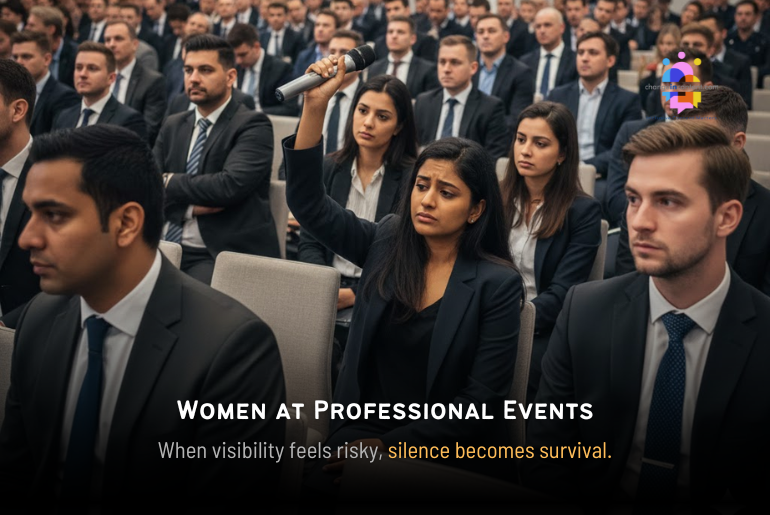
The absence of women at professional events is rarely accidental. It is structural. After attending a startup event in Delhi, content strategist and entrepreneur Divyanshi Dhouni shared an observation that many women quietly recognise but seldom articulate. The ideas were strong, the ambition palpable. However, the room was overwhelmingly male. Fewer than five women were present.
This moment prompted a broader question that Changeincontent has been examining for years: why do professional spaces that promise learning, networking, and visibility still feel inaccessible to women? The answer does not lie in confidence gaps or ambition deficits. It lies in how these spaces are designed, moderated, and culturally reinforced. It also asks why many women decide the emotional cost of participation is simply too high.
Less participation of women at professional events and conferences
Women play a significant role behind the scenes in the business events industry. In fact, women hold most event planning and coordination roles. Estimates indicate that women have between 77% and 86% of roles in planning and coordination. However, women’s participation as delegates and speakers changes depending on the industry and seniority level. Although no single dataset tracks women’s attendance across all business events, women account for only about one-third of participants.
Research shows that women often participate less in conferences and formal discussion spaces, especially in the STEM field. One study looked at 286 presentations across 59 sessions at medical and scientific conferences. While women made up 32% of the professional audience, men accounted for 68%. Moreover, women participated in only 24% of the question-and-answer sessions.
Two studies conducted during the pandemic revealed a noticeable shift in women’s participation as professional events transitioned online. Virtual conferences saw an increase in the number of women attending sessions. They also observed more women participating as speakers, panellists, and presenters than in in-person conferences held before the pandemic.
Why do women avoid business events and conferences?
The promotion of business events and conferences is typically framed as opportunities for learning, visibility, and networking. However, many women choose not to attend them or attend selectively. This decision is primarily due to safety concerns, bias, unequal participation, and structural barriers that make these spaces feel unwelcoming or exhausting.
Safety and fear of harassment
Safety remains one of the strongest reasons women avoid business events. Nearly 45% of women surveyed said they personally faced harassment or unwanted advances at professional conferences. Even more concerning, 86% of these incidents happened at mixed gender events.
It is because of these experiences that many women enter such spaces already on guard. They think twice before staying late, networking informally, or attending social mixers linked to the event.
Lack of clear rules and accountability
Many conferences still lack zero-tolerance and necessary codes of conduct. Two-thirds of women surveyed said event organisers must create and strictly enforce clear rules around behaviour. When organisers fail to act on complaints or downplay incidents, women lose trust in the space.
No parity in speaking time and visibility
Even when women attend or present at conferences, they often receive less speaking time. Studies show that men usually speak longer during audience discussions. Speaking time ranged from 4 to 128 seconds for women. In contrast, men talk for about 3 to 146 seconds.
This difference matters because longer speaking time often signals authority and confidence. Over time, repeated exposure to such an imbalance discourages women from raising questions or participating actively.
Gendered expectations around communication
Women often refrain from participating in public discussions. Many women overthink about being judged as taking too long, speaking out of turn, or appearing pretentious. There are differences in how men and women frame their questions.
Analysis says men often begin with a longer introduction before reaching their point. Women tend to ask direct questions without extended framing. This hesitation usually stems from past experiences in which women’s voices were questioned, interrupted, or dismissed.
Networking that feels unwelcoming
Networking at conferences often occurs in informal settings such as cocktail hours, late evening meetups, or closed-group conversations. These spaces tend to be male-dominated, particularly in industries in which men hold more senior roles. As a result, women may find it more challenging to enter conversations or to be taken seriously once they do.
Many women report feeling ignored or spoken over during these interactions. Others feel judged based on how they look, how they speak, or how they choose to engage. Unlike men, women often feel pressure to strike a careful balance. They must appear friendly but not too informal, confident but not assertive, and approachable but not open to misinterpretation.
Timing also plays a role. Networking events scheduled late in the evening or centred around alcohol can feel unsafe or impractical, especially for women with caregiving responsibilities or concerns about personal safety.
Most women turn to women-only spaces for networking and mentorship
The Women’s Professional Conference Experience and Impact Study found that many women felt more comfortable attending women-only conferences. Approximately 30% reported that they joined these events primarily to network and find mentors. In comparison, only 25% reported the same about mixed-gender conferences.
Women-only spaces often feel safer and more supportive. Women are more likely to speak openly, ask questions, and approach senior professionals without fear of judgment or dismissal. These events also reduce power imbalances that can exist in mixed gender spaces, especially in male-dominated industries.
Mentorship plays a key role here. Women-only conferences often attract senior women leaders who understand the challenges faced by younger women. This facilitates attendees’ ability to seek guidance, share experiences, and build meaningful professional relationships.
In contrast, mixed-gender events may feel less welcoming to some women. Gender bias, unequal speaking time, and social expectations can make networking harder. As a result, fewer women attend these events with the same confidence or purpose, even though the opportunities may be similar on paper.
How conferences can make networking more inclusive for women
Networking need not feel intimidating or exclusionary. Many of the barriers women face come from how events are organised rather than from the idea of networking itself.
Clear codes of conduct, clear reporting mechanisms, and swift action when boundaries are crossed signal that the space is safe and professional. This reassurance encourages more women to engage confidently.
Representation for women at professional events matters
Most importantly, representation matters. When women see other women as speakers, moderators, and organisers, networking feels less intimidating. It signals that women belong in these spaces and that their presence is valued. Another reason women miss out on business events and conferences is that many remain unaware these events are even happening. While organisers often promote sessions, workshops, and networking opportunities, the information does not always reach women entrepreneurs and founders.
There is also a need for more events that focus specifically on women in business. Conferences and workshops that address challenges faced by women entrepreneurs, such as funding gaps, bias, or work-life balance. Such initiatives not only help women develop skills and confidence but also encourage more women to assume leadership roles and start new ventures.
Participation of women at professional events: Summing up
From safety concerns and bias to unwelcoming networking spaces and unequal visibility, professional events often work against women rather than for them. The solution lies in awareness, inclusion, safety, and support.
Women need to know which events exist, and organisers need to create spaces that are safe, structured, and inclusive. Women-only or women-focused events, mentorship opportunities, and visible on-stage representation can also empower women to speak up, network confidently, and access resources.
Also Read: Hope for Women’s Rights: 2025 was brutal. It also quietly proved that ‘Patriarchy’ isn’t invincible.
Disclaimer: The views expressed in this article are based on the writer’s insights, supported by data and resources available both online and offline, as applicable. Changeincontent.com is committed to promoting inclusivity across all forms of content. We broadly define inclusivity as media, policies, law, and history. It encompasses all elements that influence the lives of women and marginalised individuals. Our goal is to promote understanding and advocate for comprehensive inclusivity.
