
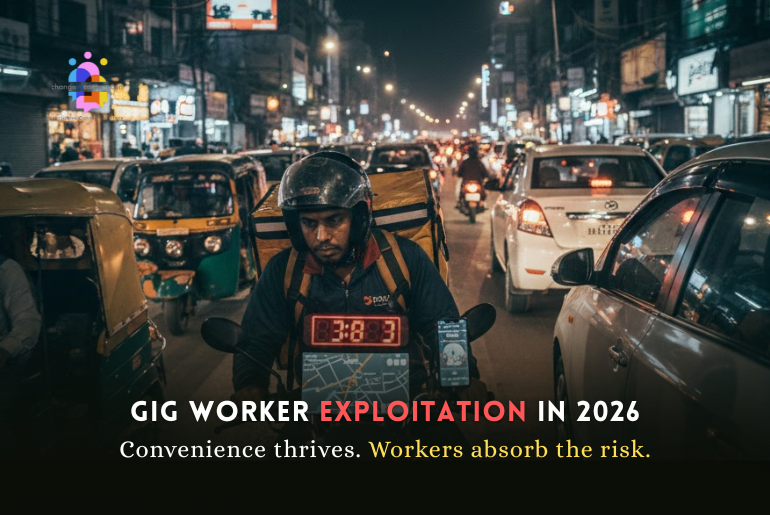
As 2026 begins, gig worker exploitation continues to define the reality of India’s working-age majority. On December 31, delivery partners from food delivery and quick-commerce platforms (Zomato, Blinkit, Amazon, and Swiggy) went on a nationwide strike. Their demands were around fair pay, safer working conditions, and basic dignity.
Central to the protest was a call to end the much-publicised ten-minute delivery model, which workers allege places them in dangerous situations on already unsafe roads. The strike also highlighted a deeper problem. Automated systems that reduce incentives, penalise delays, or threaten account suspensions operate with little regard for traffic, weather, or restaurant delays. At the same time, workers lack social security, paid leave, or income stability.
While companies frame this work as a flexible opportunity, the lived experience tells a different story. It is a story where financial pressure keeps workers logged in, even when conditions feel unsafe or unjust.
Gig worker exploitation behind record orders and viral discounts
Top executives, founders, and co-founders of these platforms claimed the strike did not affect business. Deepinder Goyal, Group CEO of Eternal, the parent company of Zomato and Blinkit, said the company delivered over “75 lakh orders on New Year’s Eve, an all-time high.”
In a post on X, Goyal also wrote, “If a system were fundamentally unfair, it would not consistently attract and retain so many people who choose to work within it.“
In response, the Telangana Gig and Platform Workers Union said, “around 7.5 million orders were delivered because workers cannot afford to log out, not because the system treats them justly.”
This explains why many workers stayed away from the strike despite agreeing with its demands. Most delivery partners do not receive paid leave or sick leave. Missing even one day of work often results in a loss of essential income. In addition, workers have repeatedly shared fears about account suspensions when they fail to meet company targets. As a result, financial pressure keeps many workers logged in, even when conditions feel unsafe or unjust.
At the same time, it is essential to discuss the flood of offers users received, with apps pushing discounts and coupons that prompted customers to place orders. There were heavy discounts, large coupon offers, and flat price cuts of up to ₹150–₹175. These offers stayed available throughout the day, encouraging customers to place orders despite the strike and helping platforms maintain high order volumes.
Why gig worker exploitation persists despite public protests
The demands raised by gig workers during the protest were not excessive or unrealistic. One of their strongest demands was a ban on the 10-minute delivery promise. In Indian cities, traffic congestion, narrow roads, poor road surfaces, and frequent construction already make daily commuting difficult.
Expecting workers to deliver within ten minutes adds intense pressure and increases safety risks. Yet platforms continue to market this model as a selling point, committing customers to the idea that groceries can reach any address within a roughly three-kilometre radius in just ten minutes.
In India, roughly 45 accidents and 20 deaths occur every hour, with the highest number of fatalities among people aged 18 to 45. Two-wheelers account for around 80,000 deaths each year, and 55,000 deaths are linked to not wearing helmets.
At least 73% of delivery riders working for online platforms ride without helmets, use earphones, exceed speed limits, or run red lights while making deliveries. Another study of 173 food delivery riders in Tamil Nadu found that 32.36% had experienced accidents on the job. Long-term work as a food delivery rider, combined with daily bike rides exceeding 51 km, has been linked to higher risks of developing chronic pain.
Millions of gig workers, with minimal safeguards
Beyond road safety, gig workers also pointed to the lack of income security and basic protections. They do not receive a fixed salary, guaranteed minimum income, or benefits that traditional labour laws provide.
Platforms describe workers as “partners” rather than employees, which allows companies to place gig and platform work outside the scope of labour laws. As a result, workers remain without paid leave, health coverage, or long-term security, even though they perform essential services every day.
Based on 2024–2025 data, India has an estimated 7.7-12 million gig workers, covering delivery drivers for food, groceries, and e-commerce. Of these, approximately 3 million are actively working as delivery partners, handling orders daily across the country.
A 2023 report by government research agency Niti Aayog estimates that India’s gig workforce will reach 23.5 million by 2030. That means millions more workers will enter this form of work in the coming years. The question then becomes how long policymakers and companies can continue to turn a blind eye to exploitative labour practices.
What consumers can (& cannot) do about gig worker exploitation
As consumers, we have some influence over how this system functions. When platforms push unusual coupons and high discounts, they often create the feeling that ordering is a smart way to save money. Pausing to question that impulse matters. Some deliveries are necessary, but many happen out of habit rather than need.
If an app offers a standard delivery choice, selecting it instead of the fastest option reduces pressure on delivery workers. Speed-based promises, especially ten-minute deliveries, place workers in unsafe situations.
At the same time, resisting exploitative labour is not only an individual responsibility. This is a larger class struggle against capitalistic corporate policies and weak regulation. Consumers alone cannot fix a system built around cost-cutting, cheap labour, and speed. Companies must change how they design incentives, and governments must set clear rules that protect workers.
Read our take on 10-minute delivery. Convenience at what cost?
The final thoughts
What is unfolding in the gig economy is not just a matter of business success or customer convenience. It reflects the kind of working life the country is willing to accept. As more people turn to gig work, the absence of stable pay, rest days, and basic safeguards will no longer affect only delivery workers. It will decide how employers value labour more broadly.
The question is not whether gig work will continue, because it will. It is whether the gig economy will continue to rely on pressure and insecurity, or whether dignity and safety will finally become part of this growing workforce.
Disclaimer: The views expressed in this article are based on the writer’s insights, supported by data and resources available both online and offline, as applicable. Changeincontent.com is committed to promoting inclusivity across all forms of content. We broadly define inclusivity as media, policies, law, and history. It encompasses all elements that influence the lives of women and marginalised individuals. Our goal is to promote understanding and advocate for comprehensive inclusivity.
