
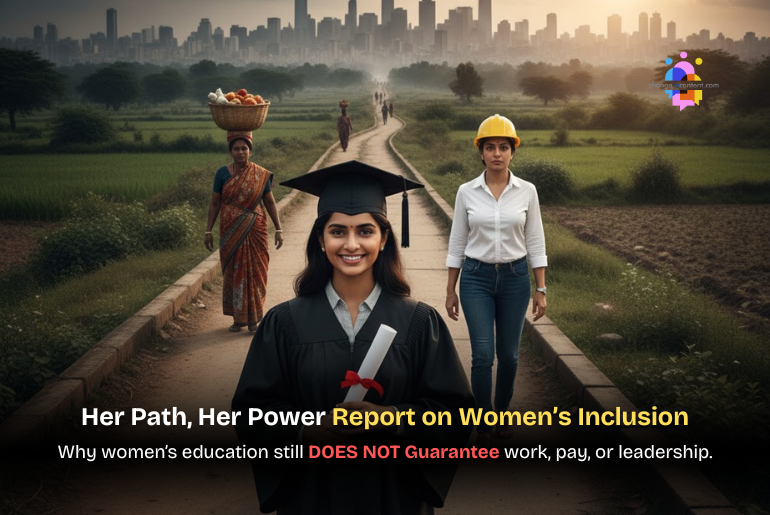
The Her Path, Her Power Report captures a paradox that continues to define women’s inclusion in the workforce in India. On paper, progress is visible. More women are enrolling in higher education, and participation in apprenticeships has risen sharply over the past three years. According to the TeamLease Degree Apprenticeship report, the number of women apprentices increased from 124,000 in 2021–22 to 196,914 in 2023–24. That reflects greater access to skill-building pathways.
Yet this progress coexists with a deeper structural failure. Women contribute only 18% to India’s GDP. At the same time, nearly 60% of working-age women remain outside the formal workforce. The Female Labour Force Participation Rate stands at 29% for women aged 15 to 29, 45% for those aged 15 to 59, and just 31.7% overall. These numbers place India among the lowest in the world.
These numbers indicate that education and training alone do not translate into sustained employment, leadership, or economic power. The report clearly shows that women’s participation in the workforce is not limited by ambition, but by systemic barriers that continue to block entry, retention, and growth.
Why higher education still fails to guarantee jobs for women
Between 2014–15 and 2021–22, the number of women enrolled in higher education increased by 32%. However, employment did not grow at the same rate. Today, women make up more than 42% of undergraduate students. Yet their presence declines sharply in technical fields, where most growth-oriented jobs are located.
- Women account for only 28–30% of enrolments in engineering and technology programmes
- In core engineering disciplines, their share falls below 20%
Barriers for women
Due to the above process gaps, many educated women remain excluded from sectors that offer stable employment, higher pay, and long-term growth opportunities. Research from the V. V. Giri National Labour Institute explains that women continue to face multiple barriers. Higher education alone cannot remove these barriers. These include:
- A heavy burden of unpaid care work
- Safety concerns that limit mobility and job choices
- Occupational segregation that channels women into fewer roles
- A shortage of suitable entry-level formal jobs that match women’s qualifications
The institute also notes that women’s labour force participation declined steadily between 2004–05 and 2017–18, even during years of strong economic growth. That is because gender bias continues to influence who gets to work, where, and on what terms.
Her Path, Her Power Report on gender pay gaps
Although more women now earn degrees, jobs do not follow at the same pace. The TeamLease report shows a clear gap between education and employability. Only 34-37% of graduating women meet employability standards. The report states that technical and STEM-heavy fields continue to leave women behind.
- IT and software: About 36% of women qualify as employable
- Banking, financial services, and insurance (BFSI): Around 40% meet employability benchmarks
- Retail and sales: Nearly 42% qualify
- Healthcare: Between 55–60% qualify, only when supported by clearer skill requirements and training
- Engineering: Only 22% of women meet employability standards
India’s women workforce could reach 255 million by 2047, with participation rising to 45%. Yet even this scenario leaves 145 million women outside the workforce. There is also a very big disparity between the demand and supply of women workers.
In 2021, the economy needed 3.35 million employable women. However, only 1.38 million could meet employability standards. This created a gap of 1.97 million. By 2027, the number of employable women may increase to 2.01 million. Even then, demand will rise to 3.82 million, leaving a deficit of 1.81 million.
Even with jobs, women earn less and hold fewer leadership roles
Women face numerous barriers at every stage of the work process, beginning with training itself. Many organisations still do not include women in their apprenticeship pipelines. In fact, 38% of organisations surveyed report having no female apprentices. Only 2% report that women make up more than half of their apprentice intake. It means that for most women, the pathway into skilled jobs closes before it even begins.
In rural areas, 70% of women may remain outside the workforce by 2047. Limited job options, lack of training centres, safety concerns, and unpaid care work continue to block rural women from paid employment.
Nipun Sharma, chief executive of TeamLease Degree Apprenticeship, points to both progress and clear limits. Over the last three years, female enrolment in apprenticeships has grown by nearly 58%. However, women still make up less than one-fifth of the total apprentice base. At the same time, industries such as manufacturing, electric mobility, and telecom face skill shortages of 40–50%.
More concerning numbers from Her Path, Her Power Report
Even when women do enter the workforce, inequality continues. Women earn 20–35% less than men for similar roles. At leadership levels, the pay gap widens to 28%. Women hold around 31% of entry-level positions. Still, only 17% of executive roles and 20% of corporate board seats are held by women. Although more women graduate with MBBS degrees, only 17% go on to practise as allopathic doctors.
Why women’s workforce inclusion is an economic imperative
Keeping women out of the workforce comes at a high cost for the economy. According to the TeamLease report, closing the gender gap in employment could increase India’s GDP by 27%. It could also add USD 18 trillion to a projected economy of USD 30 trillion by 2047.
When more women work, household incomes rise. Families become more financially stable and better able to manage economic fluctuations. Women’s employment benefits not only individual workers. Instead, it strengthens the economy as a whole.
Accordingly, the report urges stronger support for existing government programmes. These include the National Apprenticeship Promotion Scheme and the National Apprenticeship Training Scheme. It also calls for women-focused skilling hubs, recognition of prior learning, and flexible apprenticeship models that allow women to balance paid work with care responsibilities. Additionally, the report emphasises the need for stronger workplace protections to enable women to remain in their jobs without facing discrimination or insecurity.
Kathryn Rowan, executive director of GAN Global, said, “When businesses invest in inclusive work-based learning, it strengthens talent pipelines and improves long-term workforce resilience.“
The closing thoughts
Apprenticeships, by themselves, cannot fix the problem of low women’s employment. Training women for jobs helps. However, it does not eliminate the everyday barriers that push them out of the workforce. If labour policies, city planning, skilling programmes, and social welfare schemes do not work together, progress will stay slow and uneven.
Policymakers must link skilling programmes with childcare services, safe public transport, and housing near workplaces. Employers should offer flexible work hours, clear promotion paths, and strong protections against discrimination. As a resolution for 2026 and the coming years, let it be to ensure that women remain employed, advance in their careers, and attain decision-making and leadership roles.
The changeincontent perspective
The Her Path, Her Power Report does not point to a lack of effort by women. It exposes a system that extracts women’s labour, education, and ambition without offering stability, mobility, or authority in return. Apprenticeships and skilling initiatives matter, but they cannot compensate for unsafe cities, unpaid care burdens, biased hiring, and workplaces that push women out before they rise.
We cannot treat workforce inclusion as a pipeline problem alone. Until policies, employers, and urban systems align to support women at every stage of their careers, India will continue to educate women for an economy that refuses to fully employ them.
Disclaimer: The views expressed in this article are based on the writer’s insights, supported by data and resources available both online and offline, as applicable. Changeincontent.com is committed to promoting inclusivity across all forms of content. We broadly define inclusivity as media, policies, law, and history. It encompasses all elements that influence the lives of women and marginalised individuals. Our goal is to promote understanding and advocate for comprehensive inclusivity.
