
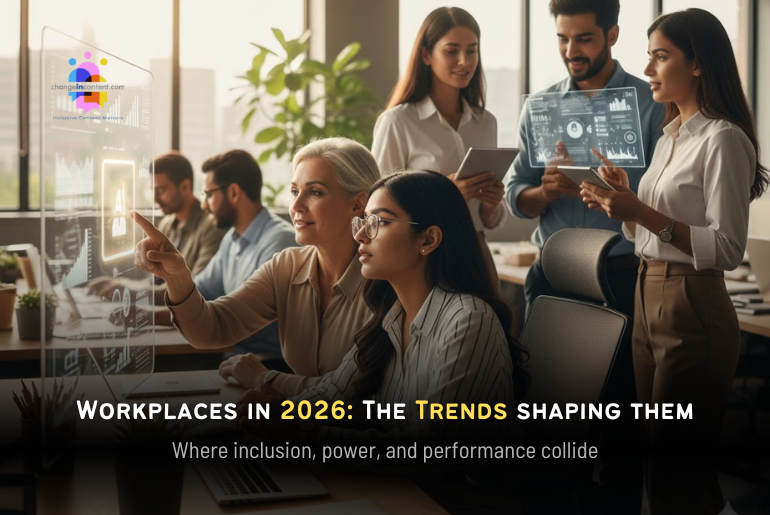
The trends shaping workplaces in 2026 are not emerging in a vacuum. They are shaped by what organisations chose to ignore in 2024 and quietly dilute in 2025. It includes shrinking DEI budgets, performative flexibility, unregulated adoption of AI, and leadership pipelines that continue to exclude women at critical moments.
As we enter 2026, the workplace is no longer just about productivity or profit. It is about trust, inclusion, safety, care, and accountability. Employees (especially women and Gen Z) are no longer asking whether organisations have policies. They are asking whether those policies work when it matters most.
This is not another trends list. It is a guide for leaders who want their organisations to survive the challenges of relevance, scrutiny, and talent flight in 2026.
The context we cannot ignore
Over the past year, many companies have quietly withdrawn from public DEI commitments. Some reframed inclusion as “culture”. Others cut budgets while insisting values remained intact. But research (including the Women in the Workplace Report 2025) clearly shows the cost of this retreat. The cost is stalled leadership pipelines, widening ambition gaps for women, and declining trust in management.
At the same time, artificial intelligence entered workplaces faster than regulation, training, or ethics could keep up. It is disproportionately impacting women through invisible labour, bias amplification, and skill access gaps.
Top 10 trends shaping workplaces in 2026
The trends shaping workplaces in 2026 are not about novelty. They concern what organisations must now repair, redesign, and recommit to.
1. Inclusion will shift from programs to power
In 2026, inclusion will no longer be measured by how many workshops an organisation runs, but by who holds decision-making power.
Women continue to face the “broken rung” at the first step to management. Without fixing this structural failure, leadership parity will remain a distant dream. Organisations that succeed will have to rethink hiring, redesign promotion systems, introduce transparent criteria, and reward managers for developing (not gatekeeping) talent.
Inclusion will cease to be a side initiative and become a leadership performance metric.
2. Flexibility will be judged by outcomes, not optics
Flexible work is no longer a benefit. It is a baseline expectation. However, 2026 will expose the flexibility stigma. This stigma is where women pay career penalties for using policies that men benefit from silently.
The workplaces that thrive will move toward outcome-based performance, where presence is irrelevant and contribution is visible. Leaders who still equate long hours with commitment will lose talent, particularly women and caregivers.
Flexibility without parity will not survive scrutiny.
3. AI will become a workplace equity issue
AI is no longer optional. But in 2026, it will become clear that unregulated AI deepens gender gaps.
Women are less likely to receive AI training, less likely to be included in tool design, and more likely to absorb the invisible work AI creates. It includes cleaning data, correcting errors, and managing emotional labour around automation.
Organisations must audit AI for bias, invest in women’s upskilling, and treat AI literacy as a leadership skill rather than a technical add-on.
4. Mental health will move from policy to infrastructure
Burnout is no longer episodic. It is systemic.
Women (especially in leadership) are reporting chronic fatigue, decision overload, and emotional exhaustion. The invisible labour and constant self-regulation worsen it.
In 2026, organisations will have to choose between symbolic wellness campaigns and real mental health infrastructure. This infrastructure includes workload redesign, realistic targets, mental health leave, and manager accountability.
Care cannot remain performative.
5. Women’s health will enter the workplace conversation, finally
Menopause, menstruation, fertility, and caregiving are no longer “personal issues”. They are workplace realities.
Organisations that ignore this will continue losing experienced women at senior levels. Those that adapt will introduce healthcare benefits, normalise conversations, and design policies that acknowledge biological realities without stigma.
Parity does not mean sameness. It means fair support for unequal burdens.
6. Leadership will be redefined by empathy and courage
2026 will reward leaders who can hold difficult conversations. It means conversations about bias, privilege, pay, safety, and power. Changeincontent.com plans to host regular conversations to help participants learn how to do it.
Command-and-control leadership will fail in workplaces shaped by Gen Z values. At the same time, coaching, listening, and accountability will define effective leadership.
Empathy will no longer be labelled “soft”. It will be recognised as strategic.
7. Transparency will become non-negotiable
Employees are no longer satisfied with promises. They want data.
Pay transparency, promotion clarity, grievance outcomes, and safety protocols will be in demand. It will primarily come from women who have historically navigated ambiguity at personal cost.
Organisations that hide behind complexity will lose credibility. Those who disclose will build trust.
8. Employee activism will shape organisational culture
Gen Z employees are not passive participants. They question leadership decisions, challenge silence, and demand alignment between values and action.
In 2026, workplaces will either listen or fracture.
Silencing dissent will no longer work. Inclusion will mean participation, not compliance.
9. Safety will be treated as a workplace responsibility
From night shifts to commute risks, women’s safety will be recognised as a matter of workplace infrastructure, not personal resilience.
Organisations will be expected to ensure transport, lighting, reporting mechanisms, and swift action. And this needs to happen beyond policy documents.
Empowerment without safety will be called out.
10. Inclusive language will shape belonging
Language is not cosmetic. It signals who belongs.
In 2026, inclusive language will influence recruitment, retention, and psychological safety. Remember, organisations that ignore this will appear outdated. Those who adapt will foster belonging without diluting standards.
Words shape culture. Culture shapes performance.
What workplaces must do now (And why waiting is no longer an option)
If the trends shaping workplaces in 2026 have made one thing clear, it is this: organisations can no longer afford passive inclusion. That is because the gap between intent and impact is widening, and employees (especially women) are noticing. Fixing this does not require grand statements. It requires deliberate, sustained action.
Reality, not rhetoric
First, organisations must audit reality, not rhetoric. That means going beyond headcount diversity numbers and examining where women drop off, who gets stretch assignments, whose work is visible, and who exits quietly. Hence, pay equity audits, promotion audits, and attrition analysis (disaggregated by gender and role) should be a part of basic hygiene.
Redesign leadership pipelines
Workplaces need to redesign leadership pipelines, particularly at the first managerial rung. Moreover, they must formalise sponsorship and not rely on chance or goodwill. Companies should evaluate managers not just on delivery, but on how equitably they develop talent. Remember, if leadership accountability does not change, outcomes will not either.
Flexibility and safety
Organisations must treat flexibility and safety as infrastructure, not perks. Outcome-based performance, stigma-free flexibility, safe commute policies, night-shift safeguards, and caregiving support must be embedded into systems. At the same time, we must ensure that these should not be negotiated individually by women at personal cost.
AI and technology adoption
AI and technology adoption must be inclusive by design. This includes bias audits of tools, equal access to AI upskilling, and clear accountability for how automated decisions affect hiring, performance, and promotion. Without this, technology will quietly reinforce old hierarchies under a new name.
Invest in capability building
Finally, workplaces must invest in capability-building, not compliance. Conversations around power, patriarchy, language, bias, and leadership discomfort need structured spaces. Hence, it is vital to organise workshops, facilitated dialogues, policy rewrites, and manager training that move beyond checkbox learning.
Need assistance? We can help.
This is where ChangeInContent works with organisations (not as moral arbiters, but as strategic partners). We help teams:
- Conduct inclusion and culture audits rooted in real workplace data
- Design gender-sensitive, legally sound workplace policies
- Facilitate leadership and manager workshops on power, parity, and accountability
- Support organisations through difficult but necessary DEI (Inclusive) conversations
- Translate intent into frameworks that actually work on the ground
Not because it looks good, but because workplaces that fail to evolve will lose talent, trust, and relevance.
The Changeincontent perspective
At ChangeInContent, we do not believe the future of work will be built through trends alone. It will be built through intentional design, uncomfortable honesty, and sustained commitment.
The trends shaping workplaces in 2026 are not warnings. They are invitations to rethink power, redefine leadership, and redesign systems that have historically excluded women.
Progress will not come from silence. It will come from courage.
The final thoughts on trends shaping workplaces in 2026
2026 will expose which organisations were serious about people, and which relied on optics.
The future of work will not be gender-neutral by default. Instead, it will require deliberate choices, sustained investment, and leaders willing to confront patriarchy within systems they benefit from.
Workplaces will either evolve or be left behind.
Disclaimer: The views expressed in this article are based on the writer’s insights, supported by data and resources available both online and offline, as applicable. At Changeincontent.com, we are committed to promoting inclusivity across all forms of content. We broadly define inclusivity as media, policies, law, and history. It encompasses all elements that influence the lives of women and marginalised individuals. Our goal is to promote understanding and advocate for comprehensive inclusivity.
