
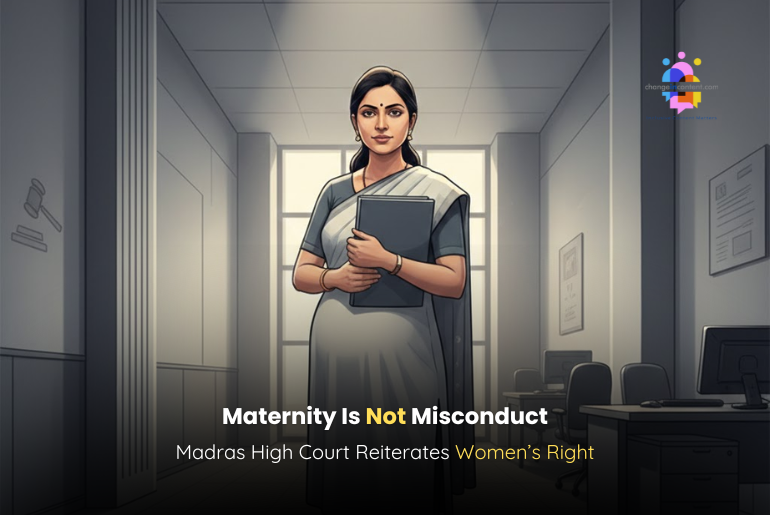
The maternity benefit for third pregnancy is no longer a grey area; at least not in law. In a sharp and unambiguous reiteration, the Madras High Court has once again held that maternity leave cannot be denied to public servants solely because it is their third pregnancy.
Let us not see it as a new legal principle. What is new (and deeply troubling) is the court’s observation that authorities continue to ignore settled law. That is forcing women to repeatedly litigate for rights that should have been granted administratively without resistance.
At the heart of this case is a lot more than just one employee’s struggle. It is a systemic refusal to treat maternity as a constitutional concern rather than a compliance inconvenience.
The case that should never have reached the court
P. Mangaiyarkkarasi, an employee of the Madras High Court itself, filed the petition. She sought maternity leave for her third pregnancy. It is an entirely reasonable request, supported by multiple prior judicial decisions.
Yet, the High Court Registry denied her the benefit, citing a 2025 clarification issued by the Tamil Nadu Human Resources Management Department. The clarification claims that the Tamil Nadu Fundamental Rules do not provide maternity leave for a third child.
This denial is telling. Even when the employer is the judiciary, administrative rigidity can overpower legal reasoning unless courts step in to correct it.
“The Law is Already Clear”: Why the court was firm
A Division Bench comprising Justice R. Suresh Kumar and Justice Shamim Ahmed did not mince words.
The bench noted that both the Supreme Court and the Madras High Court itself have repeatedly allowed maternity benefits for third pregnancies. They focused on adopting a progressive, rights-based interpretation of service rules.
The problem, the court observed, was not ambiguity in law, but wilful misunderstanding.
Authorities argued that earlier judgments applied only to individual petitioners and could not be treated as general principles. The bench rejected this logic outright, calling it pedantic and legally unsustainable.
When constitutional courts repeatedly speak on the same issue, they are not offering favours but laying down the law.
Maternity benefit for third pregnancy is not an optional policy
One of the most significant aspects of this judgment is its insistence on institutional accountability.
The court directed:
- The High Court Registry is to circulate the order to all district judicial officers across Tamil Nadu
- The Chief Secretary is to communicate the ruling to all Secretaries and Heads of Departments
- Immediate compliance, with maternity benefits granted within one week
It matters because maternity rights in India often fail not at the law-making stage, but at the implementation stage. That is where interpretation becomes obstruction.
The larger constitutional question the state keeps avoiding
At its core, this case exposes an uncomfortable truth.
India still treats women’s reproductive lives as service rule exceptions, not as constitutional realities. Maternity is not a reward for good behaviour. Neither is it a population-control tool nor a benefit that expires after a numerical threshold.
The Supreme Court has long held that maternity benefits flow from Article 21, which is about the right to life and dignity. That dignity does not dissolve after a second child.
When governments attempt to regulate maternity through rigid service rules, they cross into dangerous territory. It is a territory where bodily autonomy is subordinated to bureaucratic convenience.
Why this judgment matters far beyond Tamil Nadu
This ruling will resonate with:
- Women in government service across India
- Contractual and temporary employees who are routinely denied benefits
- HR departments that are still relying on outdated interpretations
- Women who silently avoid pregnancy because the workplace makes motherhood punitive
It also sends a message to employers (public and private) that you cannot selectively enforce progressive law. Rights delayed through administrative stubbornness are rights denied.
The changeincontent perspective
At Changeincontent, we see this judgment as a reminder that women should not have to litigate for the right to motherhood. At the same time, it is telling that even after multiple Supreme Court and High Court rulings, women are still forced into courtrooms to prove that pregnancy is not misconduct.
We do not see it just as a legal failure. Instead, it is a cultural failure.
Until workplaces stop treating maternity as a liability (and women as risks to be managed), courts will continue to play cleanup for administrative indifference.
And women will continue to pay the emotional, financial, and professional costs.
Maternity benefit for third pregnancy: The final thoughts
The maternity benefit for third pregnancy should never have been controversial. Yet, it took judicial intervention (again) to reaffirm what should have been standard practice.
Do not see the ruling as radical. That is because it is humane, constitutional, and long overdue. The real question is no longer what the law says. It is why the system still refuses to listen.
Disclaimer: The views expressed in this article are based on the writer’s insights, supported by data and resources available both online and offline, as applicable. Changeincontent.com is committed to promoting inclusivity across all forms of content. We broadly define inclusivity as media, policies, law, and history. It encompasses all elements that influence the lives of women and marginalised individuals. Our goal is to promote understanding and advocate for comprehensive inclusivity.
