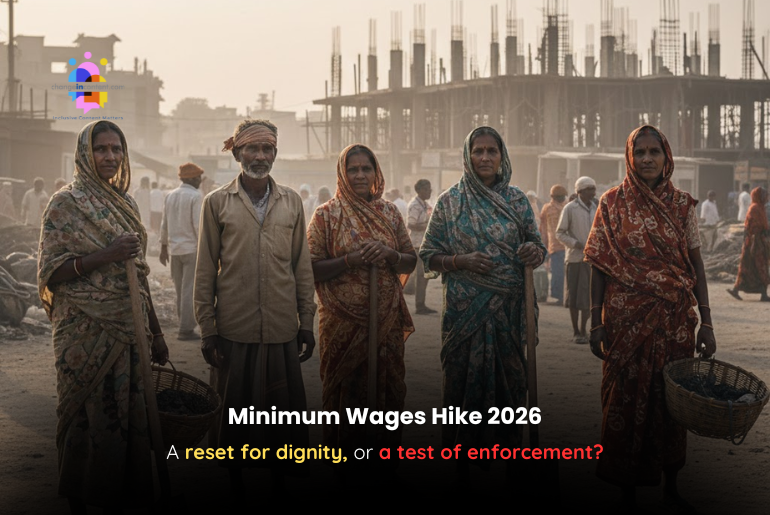
As conversations around Minimum Wages dominate policy circles in early 2026, the Centre’s proposal to revise statutory wage floors by nearly 2.5 times has triggered rare consensus across labour groups, economists, and political observers: this is not a routine notification. It is a structural intervention, one that acknowledges a reality workers have lived with for years. Official minimum wages failed to reflect the cost of surviving, let alone living, in post-pandemic India.
For millions of workers employed across construction sites, sanitation services, farms, factories, and informal urban jobs, minimum wages have remained symbolic numbers. It means that they are legally defined but practically irrelevant. The Minimum Wages 2026 proposal seeks to change that equation. Whether it succeeds will depend not only on the size of the hike but on how seriously India treats wage enforcement, state coordination, and worker protection going forward.
Why the Minimum Wages Hike 2026 is different from previous revisions
India has revised minimum wages many times before. Most of those changes were modest, often absorbed quietly by inflation within months. What sets Minimum Wages 2026 apart is scale and intent.
A 2.5-fold hike does not merely adjust for inflation; it resets the wage baseline. Labour officials involved in consultations have acknowledged that incremental corrections have lost credibility. Prices of food, fuel, rent, healthcare, and education rose sharply after the pandemic. Still, the statutory wages lagged behind real household expenses.
This time, the government appears to be responding to accumulated income stress rather than annual inflation metrics alone. Some labour economists describe the move as a “structural correction.” They argue that when legal wages are unrealistically low, employers treat them as optional. They further add that a stronger baseline has the potential to improve compliance. However, it is only possible when we strengthen enforcement mechanisms alongside the revision.
The long build-up: Why pressure on minimum wages could no longer be ignored
The Minimum Wages Hike 2026 decision did not emerge in isolation. It is the result of years of economic signals pointing in the same direction.
Consumer expenditure data consistently shows that low-income households spend a disproportionate share of earnings on essentials. During the pandemic, this vulnerability became visible at scale. Job losses, reverse migration, and rising indebtedness exposed the fragility of income security for informal workers.
Trade unions have repeatedly flagged that minimum wages failed to protect workers against inflation shocks. At the same time, policymakers faced political pressure as stagnant wages began to affect rural demand and consumption patterns. Incremental hikes were no longer defensible when wage floors remained detached from lived realities.
In that context, the Minimum Wages hike 2026 appears less like generosity and more like a delayed course correction.
What the Minimum Wages Hike means for workers and families
For daily wage earners, the impact of higher minimum wages is immediate and deeply personal.
Construction helpers, domestic workers, loaders, agricultural labourers, and sanitation workers often operate with no financial buffer. Rent, groceries, transport, and medical expenses leave little room for emergencies. A meaningful wage increase can reduce reliance on informal lenders, which can trap families in cycles of debt due to high interest rates.
Social researchers point out that income stability has consequences beyond consumption. When wages are predictable, families are more likely to keep children in school and invest in preventive healthcare. Some sociologists studying labour migration note that income certainty influences long-term decisions, from education to mobility.
For women workers, especially those in informal and care-linked roles, wage floors carry additional weight. Low wages often intersect with unpaid care work, unsafe working conditions, and a lack of social security. Any serious conversation on Minimum Wages must recognise that wage policy is also gender policy.
Category-wise minimum wages after the hike
| Worker Category | New Wage (per day) | Monthly Wage (Approx.) |
| Unskilled | ₹783 | ₹20,358 |
| Semi‑Skilled | ₹868 | ₹22,568 |
| Skilled | ₹954 | ₹24,804 |
| Highly Skilled | ₹1,035 | ₹26,910 |
Industry response: Between acceptance and anxiety
Reactions from the industry have been measured rather than confrontational. Large, organised firms already pay above the statutory minimum Wage, limiting the direct impact. The sharper concerns come from micro, small, and medium enterprises (MSMEs), where labour costs account for a significant portion of operational expenses.
Textiles, food processing, and small manufacturing units are raising concerns about sudden cost escalation. Industry bodies are asking for phased implementation, easier access to working capital, and targeted relief to cushion the transition.
Government officials also hint at flexibility for states on timelines. They acknowledge the need to balance labour welfare with business viability. The challenge will be preventing flexibility from becoming dilution.
Minimum Wages Hike 2026 and the bigger economic picture
International evidence on wage hikes shows mixed outcomes. Where an economy pair reforms with skill development, social security expansion, and productivity investment, it stimulates domestic demand. Where enforcement is weak, benefits fail to reach informal workers.
In India, the Minimum Wages Hike 2026 intersects with the ongoing implementation of the labour codes and digitised compliance systems. Labour departments are expected to update wage schedules and strengthen monitoring through digital attendance and wage payment records.
If enforcement remains patchy, the reform risks becoming a headline rather than a turning point. Coordination between the Centre and states will determine whether this becomes a one-time correction or a sustained shift in wage policy.
Conclusion: A reset that must be taken seriously
Minimum Wages Hike 2026 has undeniably shifted the national conversation around income, dignity, and labour value. It acknowledges that survival costs have outpaced wage protection. Workers have known the same for years, but now the nation agrees.
But ambition on paper must translate into accountability on the ground. Enforcement, state capacity, and political will will decide whether this reform strengthens worker security or fades into uneven implementation.
For Changeincontent, this moment matters because minimum wages are not just economic numbers. They define whose labour is valued, whose work is protected, and whose lives remain vulnerable.
The changeincontent perspective
Minimum wages should not function as a moral gesture or an electoral promise. They are a baseline of dignity.
A 2.5-fold hike is significant, but dignity does not come from numbers alone. It comes from enforcement, transparency, and the recognition that labour policy shapes gender equity, social mobility, and economic stability.
Minimum Wages Hike 2026 is an opportunity. Whether India uses it well will determine how seriously it treats its workers.
Disclaimer: The views expressed in this article are based on the writer’s insights, supported by data and resources available both online and offline, as applicable. Changeincontent.com is committed to promoting inclusivity across all forms of content. We broadly define inclusivity as media, policies, law, and history. It encompasses all elements that influence the lives of women and marginalised individuals. Our goal is to promote understanding and advocate for comprehensive inclusivity.